



Odisha Govt’s War on the Sand Mafia: From Budhabalanga Crackdown to a Statewide Offensive| Special story
Key Points
* The Mohan Majhi government collected nearly Rs76 crore in penalties while deploying drones, hotspot monitoring and joint task forces against sand mafias.
* The Budhabalanga River operation in Mayurbhanj reflects a statewide strategy using Section 163 orders to curb illegal sand extraction and transportation.
Bhubaneswar/Baripada: The seizure of illegally stored sand and imposition of Section 163 around five sand ghats of the Budhabalanga River in Mayurbhanj is not an isolated administrative action. It is the latest chapter in Odisha's escalating war against the sand mafia.
The recent crackdown by the Mayurbhanj administration, which saw prohibitory orders imposed around Mahupura, Dingira, Baguli, Ashukanda and Shakua sand ghats, reflects a much larger statewide campaign launched by the new BJP government against illegal sand mining, transportation and stockpiling.
Intense Crackdown
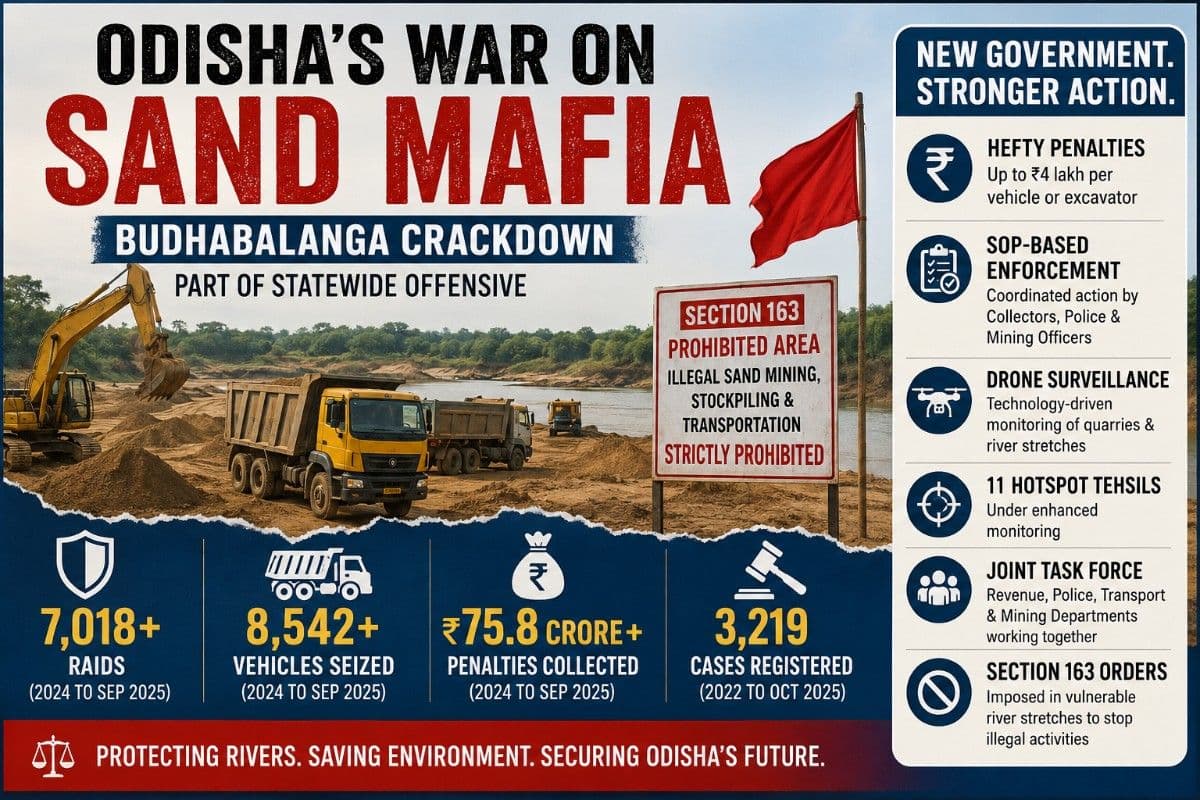
According to data with the Odisha govt, During 2024-25 alone, Odisha authorities conducted 4,426 raids against illegal sand mining and transportation, resulting in the seizure of 4,676 vehicles. By September 2025, another 2,592 raids had been conducted and 3,866 vehicles seized.

📱 Get Argus News App
✨The government collected Rs 48.4 crore in penalties during 2024-25, followed by another Rs 27.4 crore by September 2025, indicating the scale of the illegal mining economy operating across the state.
Budhabalanga: The Latest Frontline
The latest operation in Mayurbhanj was carried out under the supervision of Badasahi Tehsildar Biswanath Biswal after the Baripada Sub-Collector imposed Section 163 around vulnerable stretches of the Budhabalanga River.
A joint team comprising revenue officials, police and mining authorities raided sand ghats across five mouzas. Authorities seized nearly 153 cubic metres of illegally stored sand, installed warning signboards and red flags within a 500-metre radius of restricted zones and launched public awareness campaigns through loudspeaker announcements.
Officials
have also directed the registration of criminal cases against offenders under
the Odisha Minor Mineral Concession (OMMC) Rules, 2016.
The action
has reportedly sent shockwaves through illegal sand mining networks operating
in the region.
A Multi-Crore Illegal Economy
Illegal sand mining has evolved into one of Odisha's most profitable organised crimes.
Driven by growing demand from the construction, infrastructure and housing sectors, sand has become a highly sought-after commodity. Delays in auctioning legal sand sources, supply shortages and rising construction activity have often created opportunities for illegal operators.
Government figures reveal that between 2022 and October 2025, authorities registered 3,219 cases related to illegal minor mineral mining and transportation and carried out 15,187 seizures. During the same period, fines collected exceeded Rs126 crore.
Officials believe these figures represent only a fraction of the actual scale of illegal extraction occurring along river systems across Odisha.
Odisha BJP Govt's New Strategy
Unlike previous piecemeal enforcement efforts, the Mohan Majhi government has adopted a more aggressive and technology-driven approach.
Heavy Financial Penalties
The government revised rules governing the release of vehicles seized in illegal mining cases. Under the new framework, penalties can reach up to Rs4 lakh per vehicle or excavator, significantly raising the cost of violations.
SOP-Based Enforcement
A new Standard Operating Procedure (SOP) has been introduced by the Steel and Mines Department to streamline enforcement. District collectors, tehsildars, mining officers and police officials have been empowered to conduct coordinated operations and ensure accountability.
Drone Surveillance
Technology has become a key weapon in the government's anti-mining arsenal. Drone surveys are increasingly being used to identify excess excavation and monitor vulnerable river stretches.
In one notable case, drone mapping in Cuttack district detected illegal extraction and led to penalties of nearly Rs 12 crore across 15 quarries.
Hotspot Monitoring
The government has identified 11 sensitive tehsils as illegal mining hotspots and placed them under enhanced surveillance and monitoring.
Joint Task Force Model
A coordinated task force system involving revenue, police, transport and mining departments has replaced isolated enforcement drives. The model is now being implemented in districts including Balasore, Mayurbhanj, Jajpur, Jagatsinghpur and Rayagada.
Use of Section 163
District administrations are increasingly invoking Section 163 around vulnerable river stretches to prohibit illegal entry, stockpiling and transportation activities. The Budhabalanga operation is among the latest examples of this strategy.
The Challenge Ahead
Despite intensified enforcement, officials admit that the battle is far from over.
Odisha's expanding infrastructure network, growing urbanisation and increasing demand for construction materials continue to create incentives for illegal sand extraction. Experts argue that stronger enforcement must be complemented by faster auction of legal sand sources, real-time monitoring systems and greater community participation.
The Budhabalanga crackdown demonstrates that the state's approach is changing – from sporadic raids to sustained surveillance and coordinated enforcement.
The Final
Word: the
government's message is becoming increasingly uncompromising – Odisha's rivers
are no longer open for plunder.
Also Read: NHRC Steps In After 17-Year-Old Tribal Girl Trafficked, Sold, Sexually Assaulted: Why Odisha's Trafficking Crisis Defy 36 Specialized Police Units| Exclusive
Related Topics
Explore more stories