



NHRC Steps In After 17-Year-Old Tribal Girl Trafficked, Sold, Sexually Assaulted: Why Odisha's Trafficking Crisis Defy 36 Specialized Police Units| Exclusive
Key Points
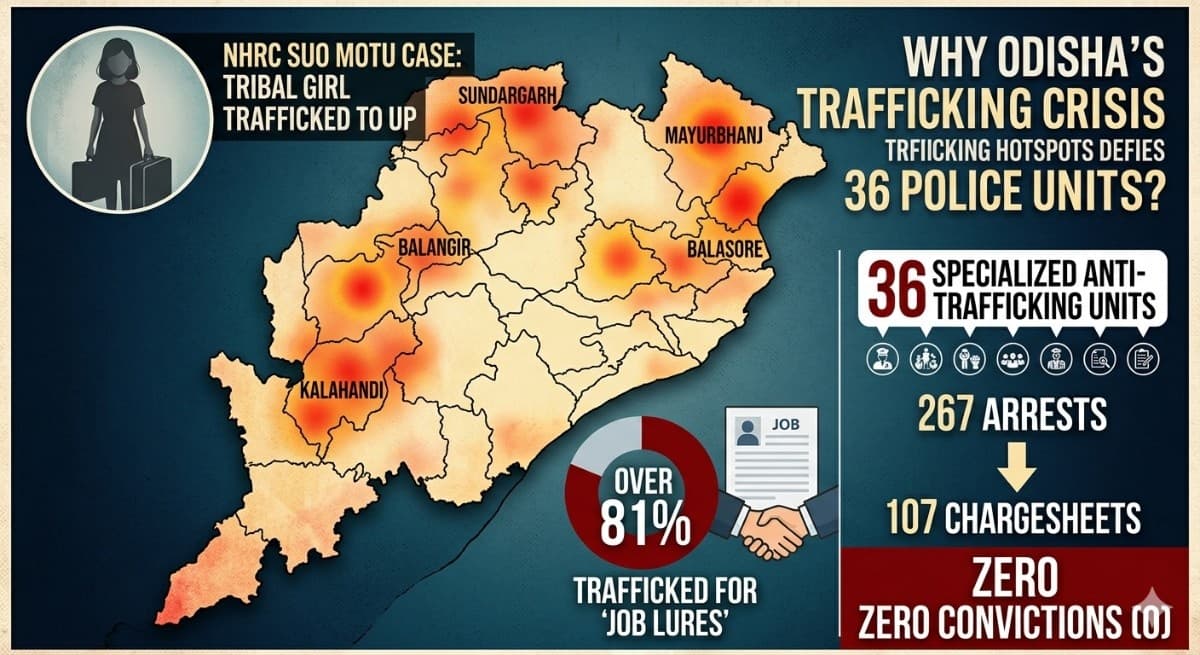
* More than 81% of Odisha’s 971 trafficking victims were allegedly trapped through fake job assurances targeting vulnerable communities.
* Despite 36 Anti-Human Trafficking Units, Odisha recorded zero trafficking convictions, exposing a major enforcement gap.
Bhubaneswar: The National Human Rights Commission (NHRC) has taken suo motu cognizance of a horrific cross-border trafficking case involving a 17-year-old tribal girl from the Kankadahada area of Odisha’s Dhenkanal district. Trapped in a multi-state nightmare for two years, the minor and three other girls were lured to Uttar Pradesh on the pretext of fake job assurances.
Once in Jhansi, the victim was confined to a house for three months, repeatedly sexually assaulted, and forced into an abortion against her consent. She was later sold like commodity to another individual for Rs 50,000, continuing her ordeal before she courageously escaped with the help of a local advocate.
While the NHRC has fired off urgent notices to the Directors General of Police (DGPs) of both Odisha and Uttar Pradesh demanding a detailed investigation and rehabilitation report within two weeks, this case raises a glaring institutional question:
Why is human trafficking continuing in Odisha despite the existence of 36 dedicated Anti-Human Trafficking Units (AHTUs) across 36 police districts?

📱 Get Argus News App
✨Enormity of Crisis: Digging Into Data
An analysis of the state's latest crime figures reveals a massive, hidden machinery of exploitation. Across all age groups, total trafficking victims in Odisha have stood at 971 individuals, with males accounting for 501 and females for 470.
A closer look at the demographics reveals a strategic targeting system deployed by traffickers:
- The Minor Trap: Total underage victims stand at 242. Among them, 97 are boys and 145 are girls. This indicates that in female trafficking, nearly one-third (31%) of the victims are minors under the age of 18, exactly matching the profile of the Dhenkanal victim.
- The Adult Spike: Once victims cross the threshold of 18 years, the numbers jump drastically to 729 total victims (404 males and 325 females). While female trafficking rises by 124% in adulthood, male trafficking explodes by an astronomical 316%, pointing to an unyielding demand for manual and industrial exploitation.
"Other Reasons" Paradox: Job Lures and Marginalization
While official documentation specifically lists known motives like forced labor (152 cases), sexual exploitation for prostitution (18 cases), domestic servitude (8 cases), and forced marriage (4 cases), it is the "Other Reasons" category that masks the true nature of the crisis.
A staggering 789 out of 971 cases – over 81% of all trafficking in Odisha – fall under "Other Reasons."
TRAFFICKING PURPOSES IN ODISHA (Out of 971 Total Victims)
* 81.2% - Other Reasons (Job Lures) (789)
* 15.6% - Forced Labour (152)
* 1.8% - Sexual Exploitation (18)
* 0.8% - Domestic Servitude (8)
* 0.4% - Forced Marriage (4)
This structural anomaly yields two critical inferences:
1. The Employment Bait: Over 81% of the victims are being trafficked using fake job assurances. Traffickers systematically exploit the aspirations of rural youths, using employment as a front to transport them across state lines before stripping away their freedom.
2. Targeting the Marginalized: The victims predominantly belong to the most marginalized sections and socio-economic strata of society – particularly tribal communities – where poverty makes families highly vulnerable to deceptive brokers.
The Hotspot Map: A Decades-Old Unchecked Pipeline
This crisis is deeply entrenched in specific geographical belts. Grassroots mapping by the NGO Shakti Vahini highlights clear district-level heat maps where brokers run unchecked.
This geographic reality is not new. Over a quarter-century ago, the House Committee on Women and Child Welfare (1999-2000) of the Odisha Assembly officially acknowledged that the immoral trafficking of girls by rogue agencies on the pretext of providing employment and arranging marriages was rampant in five primary districts:
- Kalahandi
- Balangir
- Mayurbhanj
- Sundargarh
- Balasore
Decades later, the pipeline from these exact vulnerable zones to destination states like Uttar Pradesh remains fully operational, rendering the historic warnings of the state assembly unheeded.
Total Legal Impunity: Zero Convictions
The ultimate catalyst behind Odisha’s thriving trafficking industry is the near-total collapse of judicial deterrence. The latest National Crime Records Bureau (NCRB) data reveals a grim reality for law enforcement accountability:
- Arrests vs. Charge Sheets: Law enforcement agencies arrested 267 individuals connected to trafficking syndicates. Out of these, formal charge sheets were filed against only 107 accused.
- The Conviction Void: When cases finally transitioned to the courts, the conviction rate stood at exactly zero (0).
- Acquittals: Instead of penalizing traffickers, the legal process resulted in the acquittal of 2 individuals, while the remaining cases languished.
This environment of absolute impunity explains why syndicates operate with total confidence. Even when a victim like the Dhenkanal girl manages a daring escape, she faces institutional apathy.
The Final
word is even with 36
Anti-Human Trafficking Units in the State, the zero court convictions have been
the primary reason behind the continuing cases of human or women trafficking
from the State.
Also Read: Mob Lynching / Balianta Horror: Why The Dangerous Trend of 'Instant Justice' Happen in Odisha
Related Topics
Explore more stories