



EXCLUSIVE Tribute| The Nana Patekar Imprint: How the Icon’s Gritty Realism Rewrote the DNA of Ollywood Action Cinema
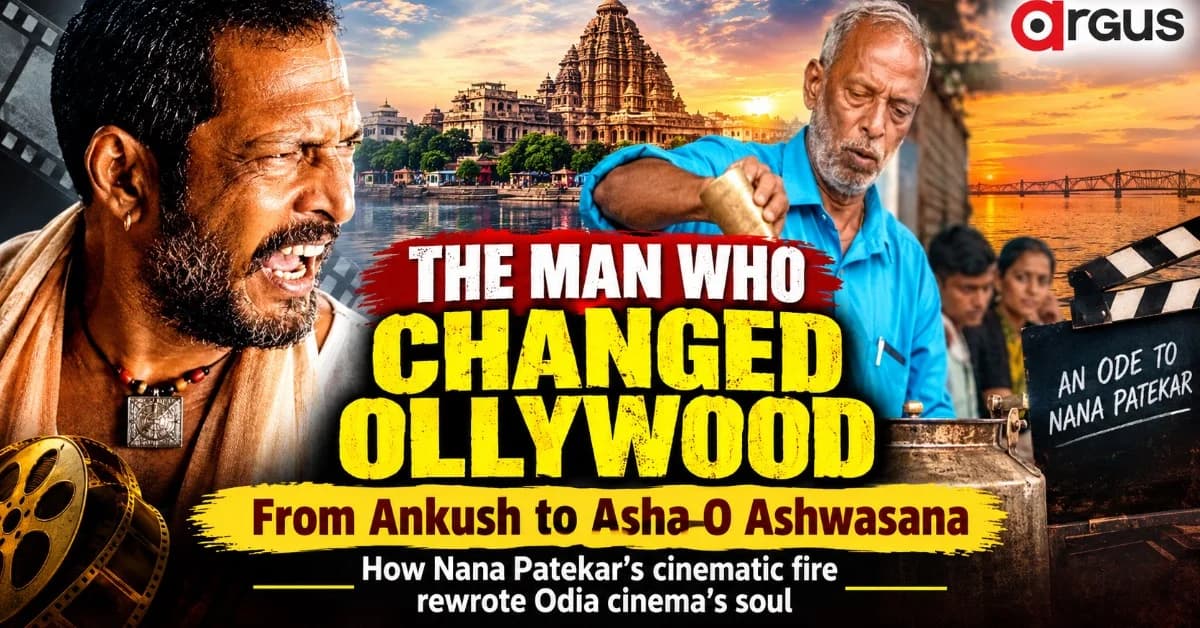
Key Points
Structural Shift in Ollywood: Nana Patekar’s gritty realism in 1980s classics like Ankush shattered traditional, predictable family melodramas and shaped the modern Odia action-drama blueprint.
Stylistic Borrowing: Prominent Odia directors like Mohammed Mohsin, Hara Patnaik, and Basant Sahu adapted Patekar’s rapid-fire monologues, working-class backdrops, and flawed, anti-establishment protagonists.
The Unmade Biopic: Patekar was the sole choice to portray Cuttack's legendary tea seller and Padma Shri awardee D. Prakash Rao, a project permanently halted by Rao's passing and Patekar's recent demise.
Bhubaneswar: Cinema, at its purest, is an exchange of vital energies. It does not look at regional borders, nor does it wait for linguistic translations. When a standard Marathi theatrr veteran named Vishwanath Patekar transformed into Nana Patekar on the national screen, he did not just build a career; he created a seismic shift in structural storytelling across the Indian subcontinent.
For the Odia Film Industry (Ollywood), a region steeped deeply in the gentle tradition of family melodramas, soft musicals, and rural mythological narratives, the explosion of Nana Patekar’s brand of visceral realism in the late 1980s was an artistic wake-up call. It was a structural transformation that tore through the comfortable, predictable tropes of regional commercial scripts.
Following his sudden passing on 8 October 2026 at the age of 75, directors, film critics, and industry stalwarts across Bhubaneswar and Cuttack took a collective step back to appreciate how deeply the DNA of mainstream Odia cinema was rewritten by his creative legacy.
The Architecture of Rage: How Ollywood Borrowed the Blueprint

📱 Get Argus News App
✨The landmark year was 1986. Director N. Chandra unleashed Ankush upon the Indian public, featuring Nana Patekar as Ravi Kelkar – a fiercely cynical, educated, yet systematically unemployed youth struggling inside urban ruins. Before Ankush, commercial Odia film protagonists were pristine, impeccably dressed figures of absolute moral virtue who operated within soft romantic frameworks or domestic crises.
Ollywood directors quickly realized that the local youth of Odisha, facing their own economic shifts and post-industrial transitions in cities like Cuttack, Rourkela, and Sambalpur, deeply identified with Patekar's raw anti-establishment energy. The blueprint of the "Angry, Disillusioned Commoner" had arrived.
The Directors and Their Cinematic Transplants
Prominent Odia filmmakers of the late 1980s and 1990s actively began adapting the pacing, tone, and character dynamics of Nana Patekar’s works into local narratives:
1 Mohammed Mohsin: Known for introducing gritty structural changes to mainstream Odia storytelling, Mohsin observed the massive popularity of Ankush among local Odia crowds. He pivoted his writing toward urban street culture, capturing the economic frustration of common youth trapped in a web of institutional negligence.
2 Hara Patnaik: As one of Ollywood’s most legendary directors and iconic antagonists, Patnaik closely analyzed Patekar’s complex work in Parinda (1989) and Angaar (1992). Patnaik infused his own directorial ventures with the highly unpredictable, psychologically tense atmosphere that defined Patekar’s criminal underbelly movies. He frequently directed high-octane commercial dramas where the hero and villain were forced into extreme, claustrophobic psychological standoffs, directly echoing the cinematic pressure cookers of N. Chandra and Vidhu Vinod Chopra.
3 Subas Das and Basant Sahu: Directors like Sahu restructured the traditional commercial action formula of the 1990s. The standard "hero meets girl, defeats local goon" dynamic was heavily cast aside. In its place came films driven by sweeping vigilante justice, social critique, and intense institutional confrontations, drawing a direct line back to Patekar's masterclass performance in Krantiveer (1994).
|
Core Aesthetic Adapted by Ollywood |
Cultural Impact on Odia Films |
|
The Rapid-Fire Monologue |
Shifted the Odia hero's weapon from simple physical fists to explosive, hyper-intellectual, and rhythmically charged speeches aimed directly at systemic corruption. |
|
The Working-Class Set Design |
Replaced opulent, clean studio sets with raw, crowded urban slums, real local streets, and realistic, unglamorous neighborhood backdrops. |
|
The Flawed Protagonist |
Erased the "perfect hero" trope, allowing lead Odia actors to portray morally gray, hot-headed characters driven to the brink by social injustice. |
The Stylistic Signature
The most distinct stylistic element Ollywood integrated from Patekar was his legendary delivery cadence: the rapid-fire, theatrical, and conversational rant that frequently abandoned conventional poetic dialogue delivery in favor of blunt, conversational prose. Throughout the 1990s, when lead characters confronted corrupt politicians or dynamic villains on screen, scriptwriters crafted lengthy, unedited monologues designed to mimic the breathless, explosive cadence that Patekar made famous.
The Unmade Masterpiece: The Biopic of D. Prakash Rao
While Nana Patekar’s influence on Ollywood remained structural and text-based for decades, the closest he ever came to stepping physically into the frame of an Odia-centered film was a project that would have stood as his definitive tribute to the spirit of Eastern India: the official cinematic biopic of Devarapalli Prakash Rao.
The Soul of 'Padmashri Chaiwala'
D. Prakash Rao was a legendary social activist and humble tea seller based in Cuttack, Odisha. Despite living a life of extreme financial constraints, earning his livelihood purely through a modest wooden tea stall, Rao committed an astonishing 50% of his daily earnings to fund, manage, and sustain Asha O Ashwasana – a grassroots primary school providing free education, meals, and medical checkups to hundreds of impoverished slum children. His lifelong, selfless humanitarian work earned him national recognition, culminating in the prestigious Padma Shri award in 2019.
Prakash Rao: The Cuttack Tea Seller
- Core Contribution: Dedicated 50% of his daily tea stall earnings directly to educating slum children.
- Key Initiative: Founded the 'Asha O Ashwasana' slum school and free student hostel in Cuttack.
- National Recognition: Conferred the prestigious Padma Shri in 2019 for social service and grassroots education.
The Shared Philanthropic Philosophy Both grassroots changemakers proved that true social impact stems from relentless daily commitment rather than immense wealth—turning modest livelihoods into enduring platforms of hope.
Nana Patekar: Co-Founder of NAAM Foundation
- Core Contribution: Channels major personal film earnings and public donations into farmer welfare.
- Key Initiative: Co-founded the NAAM Foundation to support drought-stricken farmers and prevent agrarian distress in rural Maharashtra.
- National Recognition: Renowned actor whose cinematic success serves as a vehicle for large-scale rural rehabilitation.
Why Only Nana Fit the Frame
When Odia filmmaker Ramesh Barik conceptualized a multilingual biographical drama to bring Rao’s deeply moving life to screens across India, there was only one name put forward to play the lead role. It could not be a traditional commercial star; it required an individual who carried the weight of real-world service in their bones.
Nana Patekar was the ultimate choice because his off-screen identity was perfectly mirrored in D. Prakash Rao's life. As the co-founder of the NAAM Foundation, Patekar had spent decades working on the ground in drought-stricken regions, building water conservation systems, and donating vast majorities of his national acting wealth directly to the families of impoverished farmers.
Patekar understood poverty not as an acting exercise, but as a visceral reality. He possessed the exact brand of sharp, unpretentious humility, the weathered look of an honest working-class man, and the profound emotional depth needed to portray a man who boiled tea by day and built futures by night.
A Door Closed Forever
The project was discussed with immense passion, and Patekar expressed profound interest in immersing himself in Cuttack's distinct culture to do justice to Rao's memory. However, the harsh realities of independent biographical filmmaking stalled early production: independent funding bottlenecks, script refinements, and the logistical challenges of executing a complex, authentic bilingual shoot delayed the start of production.
The window of opportunity shattered entirely when D. Prakash Rao passed away in January 2021 due to post-COVID complications. The guidance of the real-world subject was gone. With Nana Patekar’s subsequent passing in October 2026, the proposed project is now completely impossible.
It remains a bittersweet
chapter in Indian cinema – a masterpiece that will never be made because the
role belonged exclusively to Nana Patekar. No other actor could mimic the
genuine, unvarnished empathy required to step into the worn slippers of
Cuttack’s saintly tea seller. It stands as a silent monument to a deep,
unfulfilled creative union between a giant of Indian cinema and the beating
heart of Odisha.
Also Read: EXCLUSIVE | Did Nana Patekar Foretell His Own Silent Killer Ten Years Ago? How Heart Attacks Are Quietly Claiming Lives from Bollywood to Odisha
Related Topics
Explore more stories