



Power / Here's How Transformers Step Down High-Voltage Electricity To 230 Volts
·1 month ago·2 min read
Key Points
Electrical transformers change voltage without creating electricity, using two coils of wire wrapped around a magnetic core to step down high-voltage power for household use.
Bhubaneswar, Sep 24: Look up at the electricity lines outside your home and it is hard to imagine what is travelling through them. The electricity may be moving at thousands of volts, while the fan spinning inside your house or the phone charger plugged into the wall needs electricity at around 230 volts.
So, how does this enormous drop happen?
The answer is the humble electrical transformer, usually seen as a large box mounted on an electricity pole or installed inside a substation.
Think of a transformer as a voltage-changing machine. It does not create electricity. Instead, it takes electricity coming at one voltage and changes it to another.
So, how does this enormous drop happen?
The answer is the humble electrical transformer, usually seen as a large box mounted on an electricity pole or installed inside a substation.
Think of a transformer as a voltage-changing machine. It does not create electricity. Instead, it takes electricity coming at one voltage and changes it to another.

📱 Get Argus News App
✨📰 60 Word News🎬 Argus Podcast📺 Live TV and Breaking News🔔 Free Notification Alerts
Download Free:
Inside the transformer are two coils of wire wrapped around an iron or magnetic core. Electricity first enters the primary coil. Because the electricity is alternating current, it creates a constantly changing magnetic field inside the core.
That changing magnetic field then produces electricity in the second coil, known as the secondary coil.
Here comes the clever part.
Also Read: Big Update on Bullet Train: India's Fastest Train Is Coming! Check Launch Date, Speed & Route
Imagine two bicycles with different-sized gears. Changing the gear does not create energy, but it changes how that energy is delivered. A transformer works on a somewhat similar idea. The number of turns of wire in the two coils determines how much the voltage changes.
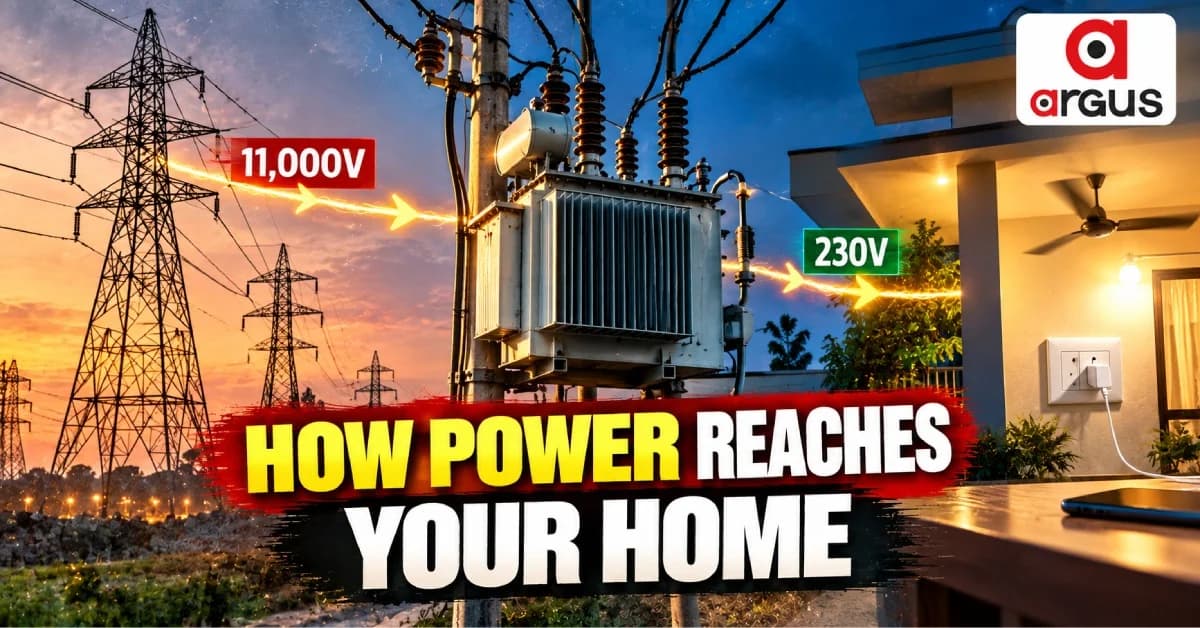
If the primary coil has many more turns than the secondary coil, the voltage is reduced. So, electricity arriving at a distribution transformer at, say, 11,000 volts can be stepped down to around 230 volts before it enters homes.
That changing magnetic field then produces electricity in the second coil, known as the secondary coil.
Here comes the clever part.
Also Read: Big Update on Bullet Train: India's Fastest Train Is Coming! Check Launch Date, Speed & Route
Imagine two bicycles with different-sized gears. Changing the gear does not create energy, but it changes how that energy is delivered. A transformer works on a somewhat similar idea. The number of turns of wire in the two coils determines how much the voltage changes.
If the primary coil has many more turns than the secondary coil, the voltage is reduced. So, electricity arriving at a distribution transformer at, say, 11,000 volts can be stepped down to around 230 volts before it enters homes.
But there is no free lunch. When voltage is reduced, the current that can flow increases for the same amount of power. Some energy is also lost as heat and through other electrical losses.
This is why transformers are so important. Power companies can transmit electricity efficiently at very high voltages over long distances, then gradually bring that voltage down through substations and local transformers.
By the time electricity reaches your wall socket, the thousands of volts it started with have been transformed into the familiar 230 volts we use every day.
This is why transformers are so important. Power companies can transmit electricity efficiently at very high voltages over long distances, then gradually bring that voltage down through substations and local transformers.
By the time electricity reaches your wall socket, the thousands of volts it started with have been transformed into the familiar 230 volts we use every day.
Related Topics
Explore more stories