



AI Tech / Donald Trump Says US “Leading China” in Artificial Intelligence
Key Points
Trump declares the US is “leading China very substantially” in artificial intelligence, tying AI progress to rising investment, as the G20 Innovation Ministerial highlights global competition and cooperation on emerging technologies.
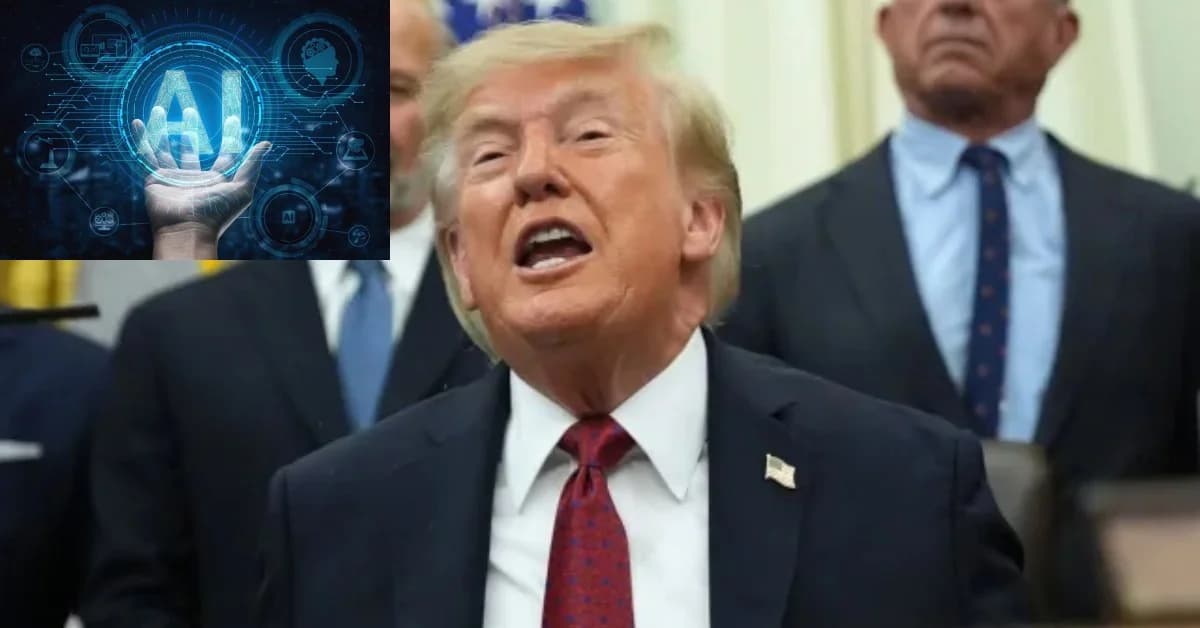
Washington, Sep 3: President Donald Trump has positioned artificial intelligence at the heart of America’s global rivalry, declaring that the United States is “leading China very substantially” in the race for technological dominance.
His remarks highlight Washington’s determination to frame AI not only as an engine of economic growth but also as a strategic lever in national security competition with Beijing.
Speaking on Wednesday during a meeting with US travel industry executives, Trump said, “AI is going up, and we’re leading China in AI very substantially.”
Also read: US Claims Strait of Hormuz Control, Says Iran in Economic 'Death Spiral'

📱 Get Argus News App
✨He linked America’s technology expansion to a broader surge in investment, arguing that capital was flowing into the country at unprecedented levels.
The remarks coincided with the conclusion of the G20 Innovation Ministerial in Chapel Hill, North Carolina, hosted by the US Department of Commerce and the White House Office of Science and Technology Policy.
The two‑day gathering brought together representatives from major economies, including India and China, to discuss artificial intelligence, emerging technologies, investment, and the workforce of the future.
Trump’s administration has increasingly framed AI as both an economic opportunity and a strategic national security contest.
The President has repeatedly asserted that the United States holds a commanding lead over China, while warning that maintaining this advantage requires faster construction of AI infrastructure, greater energy production, investment in advanced manufacturing, and a regulatory environment that enables rapid expansion of American technology companies.
Commerce Secretary Howard Lutnick led discussions with industry leaders such as Nvidia CEO Jensen Huang, OpenAI CEO Sam Altman, Anthropic co‑founder Tom Brown, and Palantir CEO Alex Karp. White House science adviser Michael Kratsios separately convened sessions with Elon Musk, Meta CEO Mark Zuckerberg, and Google DeepMind co‑founder Demis Hassabis.
The ministerial produced a consensus statement recognizing that emerging technologies can expand prosperity, productivity, and opportunity.
It focused on six priority areas: pro‑innovation policy frameworks, technology for economic opportunity, development of a skilled technical workforce, intellectual property policies for AI, AI standards, and investment in industrial supply chains.
In addition, the meeting unveiled the Carolina Principles for Emerging Technologies, which call for investment in foundational research, stronger pathways for commercializing innovation, and wider adoption of trusted technologies.
Trump’s administration has argued that sustaining US leadership in AI requires not only advanced models but also the infrastructure to operate them — chips, data centres, and vast amounts of electricity.
Washington has imposed controls restricting Chinese access to certain American semiconductor technologies, while Beijing has accelerated efforts to build domestic capabilities in chips, AI, and other strategic sectors.
India is emerging as a significant player in this global ecosystem. New Delhi has expanded domestic AI infrastructure and computing capacity while deepening partnerships with the United States and other economies.
Its inclusion in the G20 Innovation Ministerial placed India directly inside the international debate over how artificial intelligence should be developed, governed, and deployed.
(IANS)
Related Topics
Explore more stories