



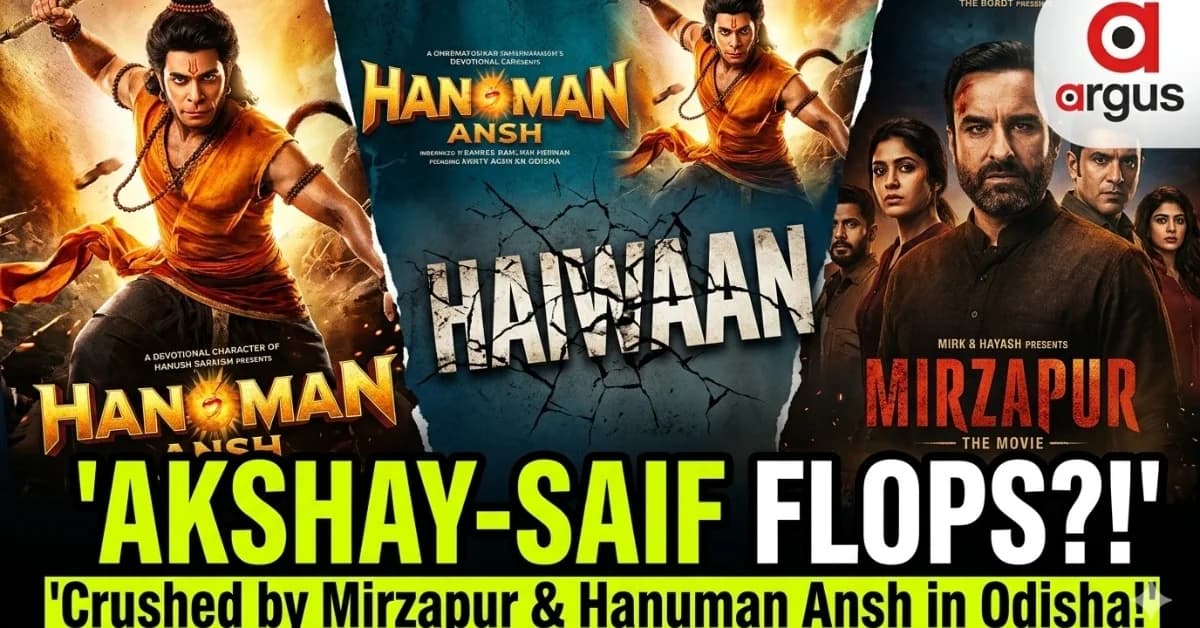
Odisha Dumps Nostalgia: Akshay Kumar-Saif Khan’s 18-Year Reunion in Haiwaan Fails to Replicate 90s Main Khiladi Tu Anari Magic Against Hanuman Ansh & Mirzapur
Key Points
Haiwaan recorded a dismal ~9.21% national occupancy and ~₹0.06 crore collection on Sunday, September 13.
The 18-year reunion of 90s icons failed to pull crowds against strong competition from Mirzapur: The Movie and Hanuman Ansh.
Odisha's shifting theatrical market in 2026 demands franchise loyalty and content-driven appeal over pure nostalgia.
Bhubaneswar: For Akshay Kumar and Saif Ali Khan, Haiwaan carried something more than the promise of a new crime thriller. Their reunion came nearly 18 years after their previous on-screen collaboration, reviving memories of the 1990s when the duo’s Main Khiladi Tu Anari had emerged as a major commercial success.
But Odisha's theatre response to Haiwaan is telling a very different story.
On Sunday, September 13, the new Akshay-Saif release struggled to attract audiences across major Odisha centres, even as two very different films – the faith-driven Hanuman Ansh and the youth-oriented Mirzapur: The Movie – continued to command substantial footfalls.
The numbers suggest that nostalgia alone has not been enough to pull Odisha's audience back to the 1990s.

📱 Get Argus News App
✨And the contrast becomes sharper when Haiwaan is measured against the kind of mass-market response that Main Khiladi Tu Anari once generated in the same broad Eastern Circuit, including Odisha.
Haiwaan Finds Itself Fighting Two Different Audience Waves
The first indication came from theatre occupancy.
On Sunday, Haiwaan managed only about 9.21% occupancy nationally, while its performance in major Odisha markets remained firmly in single digits outside Bhubaneswar.
In Bhubaneswar, occupancy was estimated at 10–12%, while Cuttack and Rourkela were around 7–9%. Sambalpur and Berhampur were weaker still, with occupancy hovering between 5% and 8%.
The contrast was striking because Haiwaan was not entering an empty market.
It was entering a market already occupied by two powerful audience movements.
Hanuman Ansh, despite being in its sixth week, continued to command family audiences and faith-driven footfalls. Meanwhile, Mirzapur: The Movie was pulling younger viewers into evening and night shows.
That left Haiwaan squeezed between two sharply defined audience segments.
|
Odisha Market |
Hanuman Ansh Day 38 |
Mirzapur: The Movie Day 9 |
Haiwaan Day 3 |
|---|---|---|---|
|
Bhubaneswar |
48–55% |
38–42% |
10–12% |
|
Cuttack |
45–50% |
35–39% |
7–9% |
|
Rourkela |
42–48% |
35–39% |
7–9% |
|
Sambalpur & Berhampur |
35–40% |
35–39% |
5–8% |
|
Odisha average |
~46% |
~36% |
~9.21% |
The gap is difficult to ignore.
While Hanuman Ansh was still maintaining an average occupancy of roughly 46%, Mirzapur: The Movie had built a statewide average of around 36% on its second Sunday.
Haiwaan, by comparison, remained stuck at about 9.21%.
The Akshay-Saif Reunion Could Not Manufacture the Old Magic
The interesting part of the Haiwaan story is that the film came with an established Bollywood memory attached to its two leading actors.
Akshay Kumar and Saif Ali Khan were once part of one of the most recognisable commercial pairings of the 1990s.
Main Khiladi Tu Anari, released in 1994, had combined action, comedy, music and star chemistry in a format that worked particularly well in the mass-driven theatrical market of that period.
But the Odisha market of 2026 is no longer the same market. The available historical indicators show the scale of Main Khiladi Tu Anari's commercial reach.
The film was made on a budget of around Rs3.25 crore, collected approximately Rs7.88–8 crore net in India, grossed around Rs13.84 crore worldwide and sold more than 1.10 crore tickets nationwide.
It was classified as a Super Hit/Blockbuster.
That was a different theatrical economy – but also a different kind of audience relationship.
Why the 1994 Formula Worked in Odisha
In 1994, Main Khiladi Tu Anari was released on roughly 210 screens nationwide, with prints being rotated extensively between theatres.
That limited supply helped create a different theatrical dynamic, particularly in smaller markets and single-screen centres.
Odisha's traditional single-screen audience responded strongly to the film's combination of action, comedy, music and star chemistry.
Akshay's martial-arts persona, Saif's comic timing and Anu Malik's music — including songs such as Chura Ke Dil Mera - fitted the commercial formula of the period.
For independent distributors, the economics were also favourable because acquisition costs were far lower than in today's multiplex-heavy market.
The film consequently became one of the major commercial successes of 1994 and a strong performer across the Eastern Circuit.
That history makes the reception to Haiwaan more revealing.
The problem was not that Odisha had forgotten Akshay Kumar.
The problem was that the audience's reason for entering a theatre has changed.
Mirzapur Shows What the New Mass Audience Wants
The strongest warning for Haiwaan did not come from an old film.
It came from a new one.
Mirzapur: The Movie recorded an estimated 34–40% statewide occupancy on Sunday, with particularly strong evening and night performances.
In Bhubaneswar, it was estimated at 38–42%, while Cuttack and Rourkela recorded around 35–39%.
Its appeal was particularly visible in urban centres and mass circuits, with strong walk-ins reported in Cuttack, Berhampur and Rourkela.
The film's youth-oriented action, gritty presentation and established Mirzapur fanbase helped it generate a significant jump from Saturday, with Sunday footfalls rising by more than 35% according to the supplied trade tracking.
The result is striking.
Haiwaan has the stars.
Mirzapur has the franchise loyalty.
Hanuman Ansh has faith-driven family loyalty.
And in Odisha's theatres, the latter two are currently proving stronger audience magnets.
Hanuman Ansh Is the Other Half of the Story
If Mirzapur represents the changing youth and urban audience, Hanuman Ansh represents something entirely different.
The film has continued its remarkable run deep into its sixth week, maintaining an estimated 46% statewide occupancy on Sunday.
Its strength has been particularly visible among family audiences.
In urban multiplexes, including PVR Utkal Galleria in Bhubaneswar, afternoon and evening shows continued to attract substantial family crowds, while night shows across the state were reported to cross 60% peak occupancy.
Its Sunday national collection was estimated at around Rs18.24 crore, on its 38th day.
That figure stood in extraordinary contrast to Haiwaan, which was estimated to collect only around Rs0.06 crore nationally on Sunday in the supplied data.
So Haiwaan was not merely facing a strong new release.
It was facing an unusually powerful combination of an established faith-based sleeper hit and a youth-oriented franchise film.
The Revenue Gap Tells the Bigger Story
The national Sunday numbers underline the scale of the competition.
|
Film |
Stage |
Sunday occupancy/position |
Sunday national collection |
|---|---|---|---|
|
Hanuman Ansh |
Day 38 |
~46% Odisha average |
~₹18.24 crore |
|
Mirzapur: The Movie |
Day 9 |
~36% Odisha average |
~₹36 crore |
|
Haiwaan |
Day 3 |
~9.21% national average |
~₹0.06 crore |
The Odisha market therefore presents a clear hierarchy.
At the top is Hanuman Ansh, which has sustained its audience well beyond the normal lifespan of a theatrical release.
Close behind is Mirzapur, whose established cult following has translated into strong urban and mass-circuit footfalls.
At
the bottom is Haiwaan,
whose opening weekend has failed to generate the momentum expected
from the Ak.
Also Read: Haiwaan September 11 Date: Akshay-Saif Face-Off Sparks Buzz; YT Views Not A Blast!
Related Topics
Explore more stories