



Special Story / Delhi HC Blow to ‘NEET Mafia’ Conspiracy: How Telegram Was Weaponised to Create a Fake Paper-Leak Narrative
Key Points
Bhubaneswar: For lakhs of anxious NEET aspirants, the biggest threat before the 2026 re-examination was not necessarily a leaked question paper. According to the Delhi High Court, it was the illusion of a leaked question paper.
In a landmark judgment delivered on June 19, Justice Tejas Karia upheld the Centre's temporary blocking of Telegram, concluding that a sophisticated ecosystem of fraudsters had systematically exploited the platform's architecture to create panic, extort students, undermine confidence in the examination process and potentially trigger public disorder.
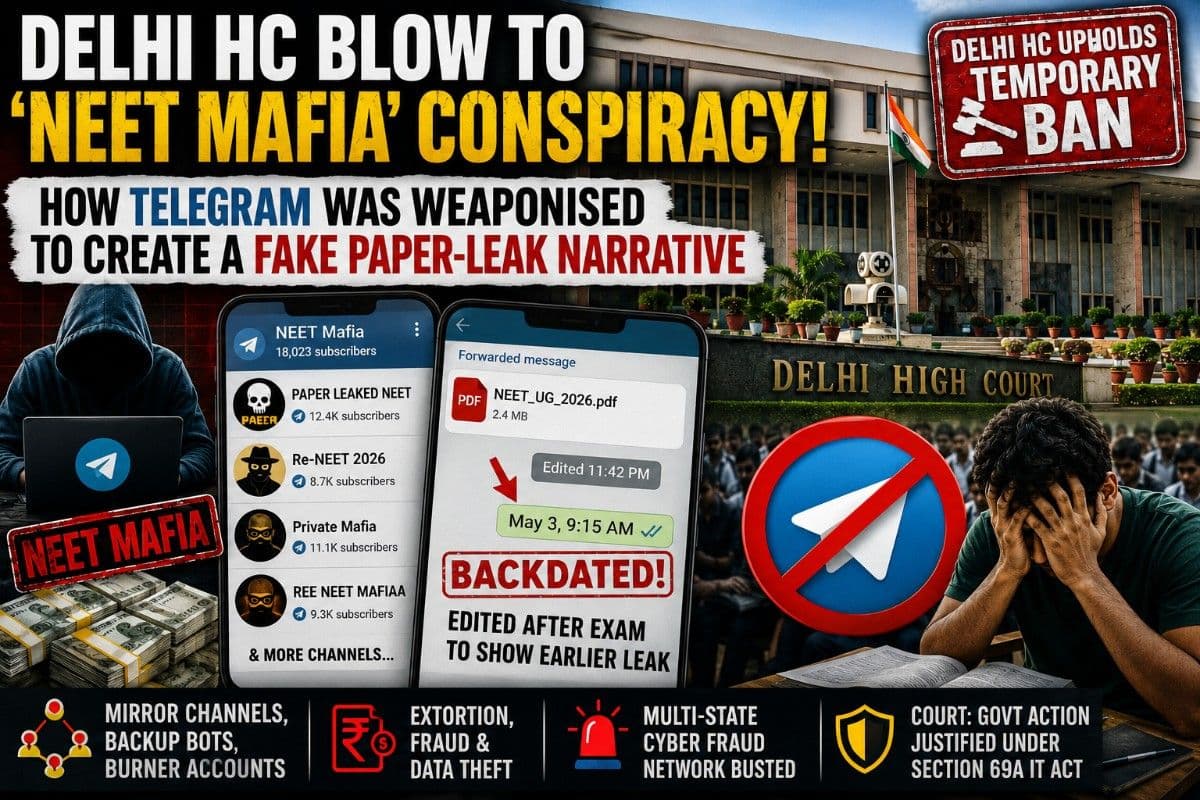
At the heart of the controversy was a network of channels operating under brazen names such as “NEET Mafia,” “PAPER LEAKED NEET,” “Re-NEET 2026,” “Private Mafia,” and “REE NEET MAFIAA.” These channels allegedly promised access to examination papers, collected money from desperate candidates and repeatedly resurfaced even after takedown actions.
The Real Trick Wasn't the Leak. It Was the Timestamp

📱 Get Argus News App
✨The National Testing Agency (NTA) presented what became one of the most critical pieces of evidence before the government and later the Court.
According to the NTA, fraudsters exploited Telegram's message-editing architecture in a particularly deceptive manner. They would first post harmless messages or placeholder files days or weeks before the examination. After the exam was conducted and the actual questions became known, they would edit those old messages and insert the real question paper or related content.
Because the original timestamp remained attached to the message, it created the appearance that the material had been posted before the examination took place. This produced convincing "proof" that the paper had been leaked in advance.
The Court noted that this "backdating scam" had the potential to generate panic among students and parents, damage the credibility of public institutions and fuel unrest surrounding a national examination involving approximately 2.2 million candidates.
Why Channel Takedowns Failed
Telegram argued that it had cooperated with Indian authorities and removed hundreds of offending channels. It also informed the government that it had acted on many of the URLs shared by authorities.
But government agencies contended that the problem ran much deeper.
Solicitor
General Tushar Mehta told the Court that a prominent channel called "NEET
Mafia", with around 18,000 subscribers, was actively promoting alleged
paper leaks, collecting payments and facilitating large-scale fraud.
Read more: Govt Orders Medical Verification of 680 Teachers In Southern Odisha Districts Seeking Transfers on 'Terminal Illness' Grounds
More importantly, authorities argued that Telegram's ecosystem allowed operators to create:
- Mirror channels
- Backup channels
- Reserve channels
- Burner accounts
- Rotating handles
- Automated bot networks
As soon as one channel was removed, another appeared, often carrying over the same audience. This meant conventional takedown measures were constantly being outpaced.
The Court accepted this argument, observing that audience migration and rapid channel regeneration had rendered channel-specific interventions ineffective.
A Multi-State Criminal Enterprise
The judgment paints a picture of a nationwide fraud operation rather than isolated misconduct.
The Court referred to investigations by:
- Rajasthan Police Special Operations Group
- Ahmedabad City Cyber Crime Branch
- Other agencies in Bihar, Rajasthan and Gujarat
One Ahmedabad investigation reportedly uncovered an inter-state cyber-fraud gang operating eight Telegram channels. Authorities alleged that about Rs1.5 crore moved through fraudulent bank accounts and nearly 1,000 mobile numbers were targeted within a month.
The fraud was not limited to money.
Investigators found that candidates were allegedly asked to submit previous NEET admit cards and active WhatsApp numbers as "verification," effectively turning the operation into a personal-data harvesting scheme.
Pavel Durov's Statement Became Evidence
One of the most striking elements of the judgment is the Court's reliance on a public statement made by Telegram CEO Pavel Durov.
On June 16, Durov wrote on X that Telegram had removed "hundreds of channels sharing leaked exam materials and related scams in India" and was making the "edited" label more visible to prevent "backdating scams."
Instead of helping Telegram's defence, the Court treated the statement as a significant admission.
Justice Karia observed that:
1. Durov acknowledged the existence of large-scale exam-related scams.
2. He specifically used the phrase "backdating scams."
3. He effectively conceded that existing safeguards surrounding edited messages were inadequate.
4. Telegram's proposed fix would take time and could not address the immediate threat before the NEET re-examination.
Why the Court Rejected Telegram's Arguments
Telegram's primary defence was straightforward: block specific channels, not the entire platform.
The company argued that a platform-wide ban was disproportionate and affected millions of legitimate users. It also questioned whether Section 69A of the Information Technology Act even permitted blocking an entire platform.
The Court disagreed.
Justice Karia held that authorities had already tried narrower alternatives and found them ineffective. The repeated reappearance of fraudulent entities convinced the Court that less restrictive measures were insufficient.
The judgment further accepted the government's argument that Telegram's architecture – including bots, massive public channels, extensive file sharing and audience migration mechanisms – had become central to the operation of the fraud network.
A Broad Interpretation of Section 69A
Perhaps the most consequential aspect of the ruling is its interpretation of the IT Act.
Telegram argued that Section 69A only permits blocking of specific content.
The government argued that "information" under the IT Act includes software, codes, databases and programs. Since a platform itself is an aggregation of such information, authorities can block an entire platform where the scale of harm justifies it.
The Court accepted this interpretation, holding that Telegram's software infrastructure and communication ecosystem fall within the ambit of "computer resources" and "information" under the Act. Consequently, a platform-wide block can be legally justified in exceptional circumstances.
The Proportionality Test
Applying the principles laid down by the Supreme Court in Anuradha Bhasin, the Court concluded that the government's action satisfied constitutional requirements.
The judge emphasized that:
- The objective was legitimate - protecting examination integrity and public order.
- There was a direct connection between Telegram's misuse and the harm sought to be prevented.
- Less restrictive alternatives had already failed.
- The measure was temporary and linked to a specific event rather than being permanent.
The Bigger Message
The judgment is ultimately less about Telegram as a messaging app and more about how digital platforms can be exploited to manufacture panic.
According to the Court, the "NEET Mafia" did not merely claim to possess leaked papers. It used Telegram's technical design to create convincing evidence that leaks had occurred, thereby amplifying fear, distrust and disorder among millions of students.
By upholding the government's temporary block, the Delhi High Court signalled that when a platform's architecture repeatedly enables large-scale fraud and public-order risks, authorities may be justified in moving beyond individual takedowns and targeting the platform itself.
For students and parents, the ruling offers a stark reminder: in the age of social media, the most dangerous leak may sometimes be a fabricated one.
Related Topics
Explore more stories