



Illegal Immigration / Supreme Court Flags Issue of Non-Citizens Getting Aadhaar, Being Treated as Voters
·10 months ago·3 min read
Key Points
- Supreme Court asks whether non-citizens with Aadhaar should be treated as voters, stressing Aadhaar is not proof of citizenship.
- Bench led by CJI Surya Kant says Aadhaar is meant for welfare benefits, not voting rights, and the EC must verify all Form 6 documents.
- Court sets timelines for challenges to Special Intensive Revision in Tamil Nadu, Kerala and West Bengal; hearing to continue.
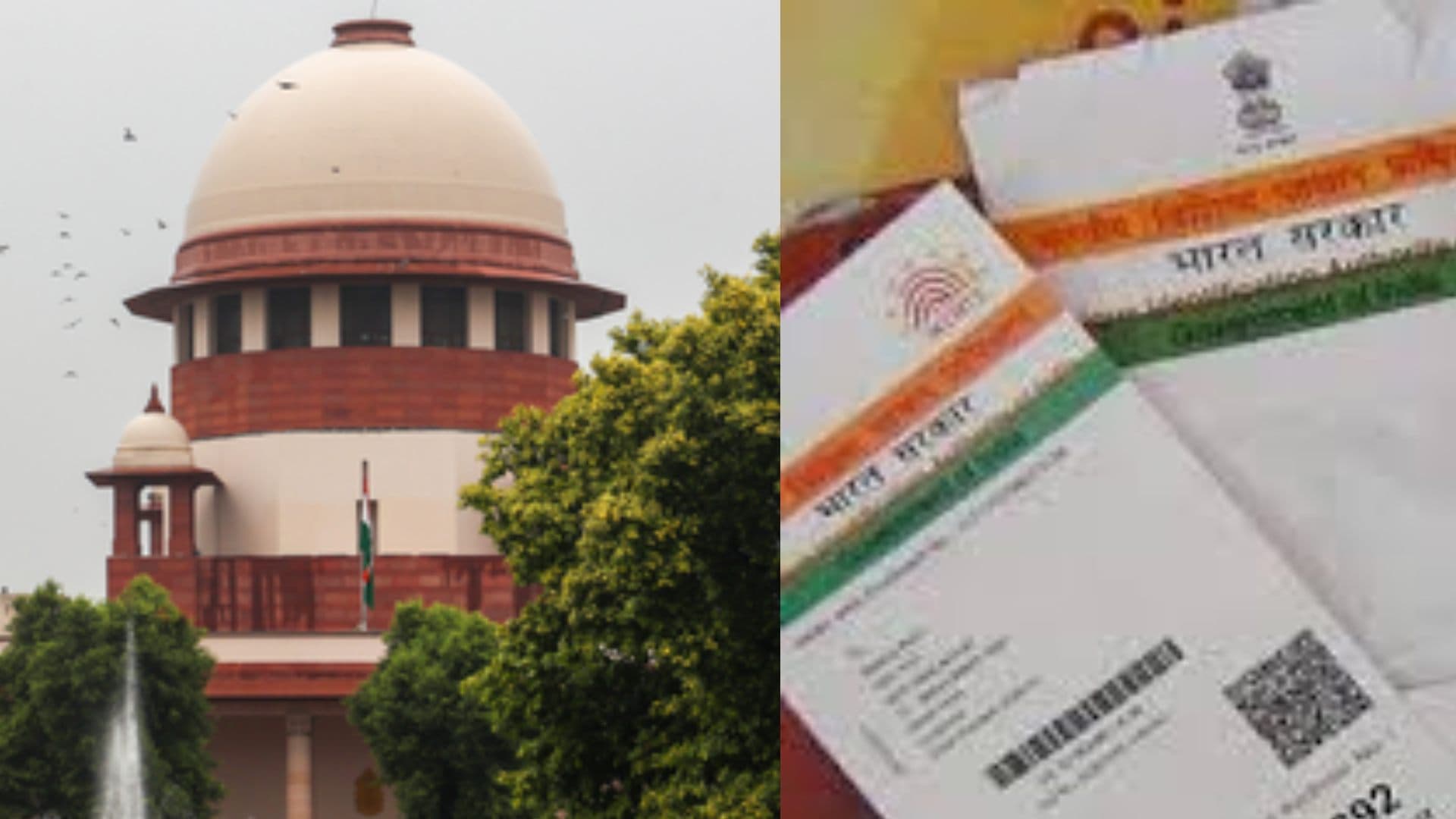
New Delhi, Nov 27: The Supreme Court raised a pointed query on whether non-citizens who obtain Aadhaar cards should automatically be treated as voters, emphasising that the biometric ID is meant solely for accessing welfare schemes and does not establish citizenship.
A bench led by Chief Justice of India Surya Kant, which is hearing petitions challenging the Election Commission’s Special Intensive Revision (SIR) of electoral rolls in several states, said Aadhaar “does not confer absolute proof of citizenship”. The court noted that this is why Aadhaar is only one of several documents required for inclusion in voter lists. “If anyone is deleted, they will have to be given a notice of deletion,” the bench said.
Reiterating that the Aadhaar Act itself clarifies that the document does not grant citizenship or domicile, the CJI remarked: “Aadhaar is a creation of statute for availing benefits. Just because a person was granted Aadhaar for ration, should he be made a voter also? Suppose someone belongs to a neighbouring country and works as a labourer.”
Also Read: Mumbai: Minor Girl Forced Into Prostitution By Her Mother; Two Booked
A bench led by Chief Justice of India Surya Kant, which is hearing petitions challenging the Election Commission’s Special Intensive Revision (SIR) of electoral rolls in several states, said Aadhaar “does not confer absolute proof of citizenship”. The court noted that this is why Aadhaar is only one of several documents required for inclusion in voter lists. “If anyone is deleted, they will have to be given a notice of deletion,” the bench said.
Reiterating that the Aadhaar Act itself clarifies that the document does not grant citizenship or domicile, the CJI remarked: “Aadhaar is a creation of statute for availing benefits. Just because a person was granted Aadhaar for ration, should he be made a voter also? Suppose someone belongs to a neighbouring country and works as a labourer.”
Also Read: Mumbai: Minor Girl Forced Into Prostitution By Her Mother; Two Booked

📱 Get Argus News App
✨📰 60 Word News🎬 Argus Podcast📺 Live TV and Breaking News🔔 Free Notification Alerts
Download Free:
The court also underlined that the Election Commission is empowered to verify documents submitted with a Form 6 application for addition to electoral rolls. “It is not a post office,” the bench observed.
The Supreme Court set timelines for petitions challenging SIR in Tamil Nadu, Kerala and West Bengal, directing the Election Commission to file its responses by December 1. Petitioners may file rejoinders thereafter.
Earlier, Senior Advocate Kapil Sibal, appearing for some petitioners, argued that SIR imposes an unreasonable burden on ordinary voters—many of whom are illiterate—by expecting them to navigate complex forms. The process, he said, risks disenfranchising genuine voters. “Once my name is included in the electoral roll, the presumption of validity follows… Any exclusion must follow a process that is reasonable and fair,” he submitted.
Sibal added that while Aadhaar does not conclusively prove citizenship, it creates a presumption in favour of lawful residence. “You want to take it away—take it away by a process and let that process be proven before this court,” he said.
Justice Bagchi noted the importance of removing deceased voters from rolls and pointed out that updated lists are already displayed in panchayats and on official websites. “We do not judge in a vacuum,” he said.
The hearing will continue today.
The Supreme Court set timelines for petitions challenging SIR in Tamil Nadu, Kerala and West Bengal, directing the Election Commission to file its responses by December 1. Petitioners may file rejoinders thereafter.
Earlier, Senior Advocate Kapil Sibal, appearing for some petitioners, argued that SIR imposes an unreasonable burden on ordinary voters—many of whom are illiterate—by expecting them to navigate complex forms. The process, he said, risks disenfranchising genuine voters. “Once my name is included in the electoral roll, the presumption of validity follows… Any exclusion must follow a process that is reasonable and fair,” he submitted.
Sibal added that while Aadhaar does not conclusively prove citizenship, it creates a presumption in favour of lawful residence. “You want to take it away—take it away by a process and let that process be proven before this court,” he said.
Justice Bagchi noted the importance of removing deceased voters from rolls and pointed out that updated lists are already displayed in panchayats and on official websites. “We do not judge in a vacuum,” he said.
The hearing will continue today.
Related Topics
Explore more stories