



Special Report| Odisha’s Power Play to Prevent Blackouts From Cyclone Arnab: Energy Minister KV Singhdeo Camps in Koraput Ahead of Oct 28 Impact on Malkangiri
Key Points
The Odisha government has deployed over 8,600 specialized engineers and ground crews across vulnerable southern and coastal districts.
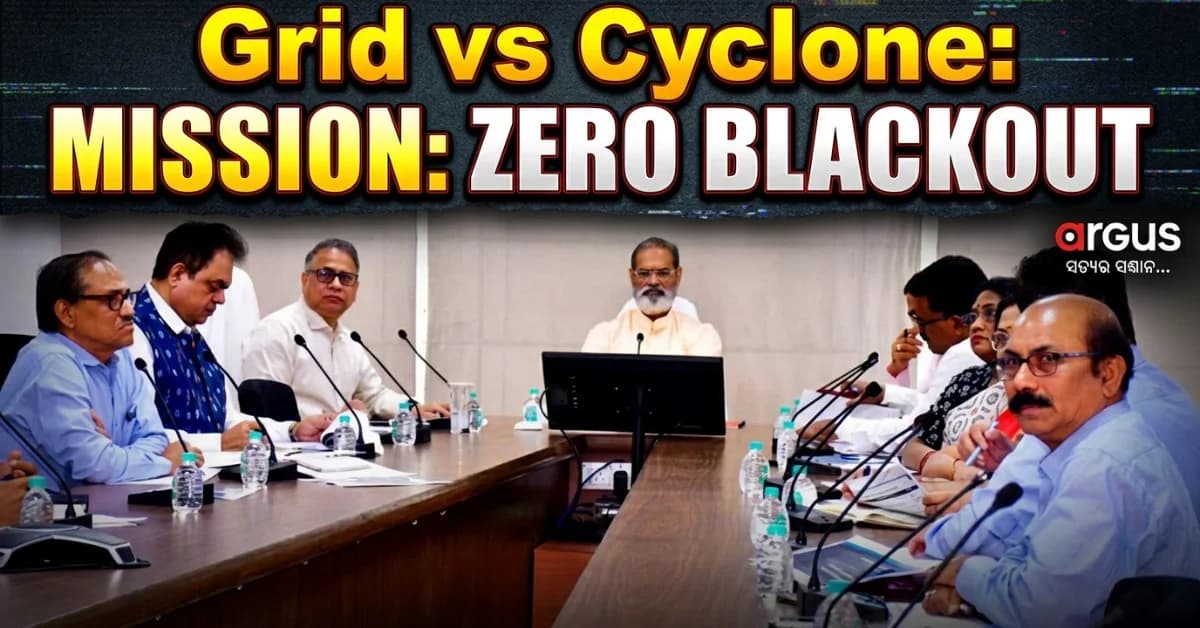
State Energy Minister Kanak Vardhan Singh Deo is personally leading the frontline emergency response directly from Koraput.
Advanced SCADA technology and pre-staged logistics, including 1,115 kilometers of spare conductors, ensure rapid and decentralized grid recovery.
Bhubaneswar: As Cyclone Arnab barrels toward the coast, threatening to lash southern and coastal districts with heavy downpours and wind speeds touching 90 kmph, the Odisha government has launched a massive, preemptive counter-offensive.
Recognizing that electricity is the vital lifeline that powers all other emergency services – from hospital oxygen plants to municipal water pumps – the state has deployed a highly sophisticated, multi-tier strategy designed to withstand the tempest.
This isn't merely a standard emergency response; it is a meticulously engineered "power play" that shifts Odisha’s disaster paradigm from reactive damage control to predictive logistics and decentralized execution.
The Blueprint of the Defense Strategy

📱 Get Argus News App
✨At the heart of the state’s strategy is a massive structural mobilization led by the Odisha Power Transmission Corporation Limited (OPTCL) and the state’s primary distribution companies (discoms), including TPCODL and TPWODL. Rather than managing the crisis from a distant bureaucratic hub, the government has broken its command structure down into localized, self-sustaining cells.
The deployment includes:
· The Command Matrix: A 24/7 central control room activated at the State Transmission Management Centre (STAMC) in Chandaka, backed by zonal oversight at Narendrapur, and 11 strategic field control centres situated directly in high-vulnerability zones such as Malkangiri, Paradeep, and Baleshwar.
· Political and Administrative Grounding: In an unprecedented move of administrative accountability, State Deputy Chief Minister and Energy Minister Kanak Vardhan Singh Deo has personally stationed himself in the southern district of Koraput to lead the emergency response on the frontline.
· Manpower and Tech Mobilization: Over 8,600 specialized ground crew and engineers have been deployed across the western and southern districts alone. These teams are backed by real-time Supervisory Control and Data Acquisition (SCADA) network systems to monitor grid health mid-storm.
· The Logistics Stockpile: Warehouses and transit camps across the state have been packed with heavy hardware, including emergency restoration system (ERS) tower sets, a staggering 1,115 kilometers of spare conductors, thousands of hardware fittings, and hundreds of high-capacity diesel generator (DG) sets.
Deconstructing the Government’s Strategy
To understand why Odisha’s response is being hailed as a masterclass in disaster resilience, one must look past the raw numbers and examine the operational logic dictating each decision. Every step taken by the Energy Department is designed to counter a specific physics-based or logistical failure common to tropical storms.
1. Decentralization to Defeat Communication Blackouts
The Step: Establishing 11
strategic field control centres alongside the central STAMC (State
Transmission Asset management Centre) hub.
Reason: During a category-grade cyclone, communication infrastructure is
often the first casualty. Fibre-optic lines snap, and mobile towers lose power
or blow over. If a disaster response relies on a centralized command structure,
a total communications failure in a place like Malkangiri would leave
field teams completely blind, waiting hours for orders. By setting up fully
autonomous field control centres equipped with satellite communication and
local decision-making authority, the government ensures that local engineers
can initiate restoration protocols the exact second it is safe to do so,
entirely independent of the central hub in Bhubaneswar.
2. Frontline Leadership to Eliminate Bureaucratic Red Tape
The Step: Stationing the Energy
Minister directly in Koraput.
Reason: In the crucial hours immediately following a cyclone's landfall,
time translates directly into lives saved. If a critical sub-station fails or
unexpected heavy machinery is required to clear a line, field engineers
traditionally have to pass requests up a long chain of command to secure
financial and administrative approvals. By placing the state's highest energy
official directly in the projected disaster zone, the government has
effectively eliminated bureaucratic lag. Decisions regarding resource
diversion, emergency funding, or inter-agency coordination can now be made in
real-time on the ground.
3. Predictive Logistics and Pre-Staging Materials
The Step: Positioning 1,115 km of
conductors and emergency tower sets in vulnerable zones before the storm hits.
Reason: Cyclones bring torrential rain that triggers flash floods and
uproots thousands of trees, completely blocking major highways and rural roads.
Sourcing heavy transmission towers and kilometers of wiring from central
warehouses after the storm has passed is a logistical nightmare that can
delay restoration by weeks. Pre-staging massive stockpiles of heavy hardware
directly within the vulnerable districts ensures that repair materials are
already on the correct side of the roadblocks. The moment the winds drop below
hazardous levels, crews only need to travel short distances to begin rebuilding
the grid.
4. SCADA Integration for Grid Isolation
The Step: Utilizing real-time Supervisory Control and Data Acquisition (SCADA) network
monitoring to track the grid.
Reason: When a high-voltage transmission line snaps and hits the ground,
it can cause a catastrophic surge that trips interconnected sub-stations,
potentially triggering a cascading blackout across the entire state grid. By
integrating real-time SCADA technology, engineers at the STAMC can digitally
isolate damaged segments of the network within milliseconds. This containment
strategy ensures that while a localized pocket of the grid might go dark due to
physical damage, the broader state grid remains stable, preventing a localized
emergency from turning into a statewide energy crisis.
Addressing the Core Concerns: An Assessment
The critical question hanging over these preparations is simple: Will it be enough to protect the citizens of Odisha?
The forecast for Cyclone Arnab presents a dual threat. In southern districts like Malkangiri and Koraput, the primary threat is structural damage driven by sustained 89–90 kmph winds. In coastal urban centers like Cuttack and Bhubaneswar, the primary threat is severe waterlogging and urban flooding caused by torrential downpours.
Where the Strategy Succeeds
The government's plan directly answers these distinct threats. By prioritizing critical load centers, the state has guaranteed that hospitals, blood banks, and oxygen manufacturing units will maintain power via dedicated underground lines or heavy-duty DG backups. Furthermore, by pre-arranging power lines specifically for municipal water pumping stations, the plan mitigates the secondary disaster that often follows a cyclone: a major city running out of clean drinking water during a prolonged blackout.
The Reality of the Overhead Vulnerability
However, experts note that despite these world-class preparations, widespread power outages during the peak of Cyclone Arnab are entirely unavoidable. Because the vast majority of Odisha's rural and semi-urban electrical infrastructure still relies on overhead lines, distribution companies will purposefully shut down power to vulnerable grids as the storm approaches. This controlled shutdown is a vital safety protocol designed to prevent live, snapped wires from electrocuting citizens or sparking fires amid high winds.
While the long-term, ultimate
solution to cyclone resilience lies in transitioning the state’s entire network
to underground cabling – a massive capital project currently being mapped out
by the Energy Department for future implementation – the strategy for Cyclone
Arnab focuses heavily on minimizing downtime.
Also Read:EXCLUSIVE| Overcast But No Rain? Why Cyclone Arnab Is Shielding Odisha Districts Till Tuesday—Bhubaneswar, Cuttack, Puri, Berhampur Timeline