



Odisha's Rarest Monsoon Entry in 17 Years: Why Balasore Became the Gateway, What It Means for June Rainfall| Exclusive
Key Points
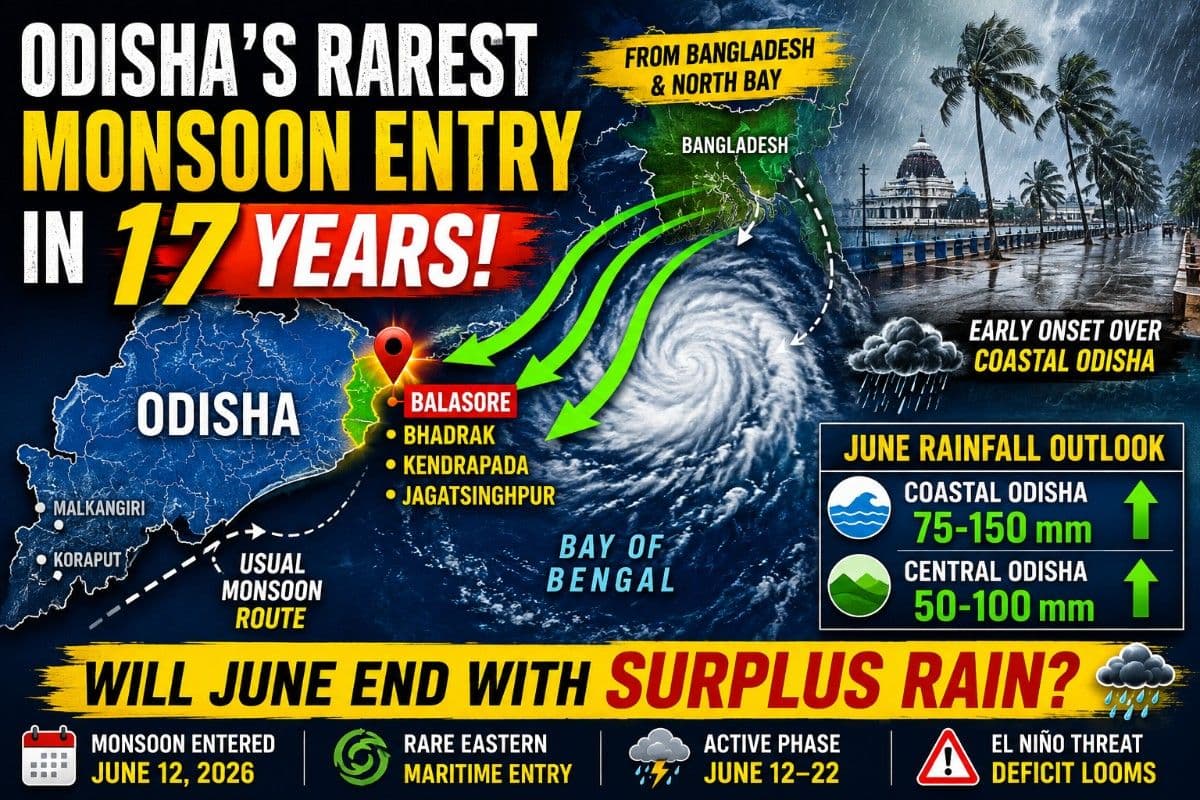
* A Bangladesh-North Bay circulation redirected monsoon winds into coastal Odisha, creating an unusual east-to-west progression pattern.
* June rainfall may turn above normal over coastal and northern Odisha, but El Niño remains a major threat to the overall monsoon season.
Bhubaneswar: When the Southwest Monsoon officially entered Odisha through Balasore, Bhadrak, Kendrapada and Jagatsinghpur on June 12, it quietly rewrote a weather script that has remained largely unchanged for decades.
Unlike most years when the monsoon climbs into Odisha through the southern districts of Malkangiri and Koraput or advances along the Ganjam-Puri coast, the 2026 monsoon has arrived through the state's eastern maritime flank – a route seen only on rare occasions since 1990.
While the unusual entry has raised hopes of an active rainy season along the coast, meteorologists caution that the larger climate background dominated by a strengthening El Niño may ultimately decide whether Odisha experiences a surplus monsoon or another year of erratic rainfall.
Why Did Monsoon Enter Through Balasore?

📱 Get Argus News App
✨The answer lies not over Odisha, but hundreds of kilometres away over the northern Bay of Bengal and coastal Bangladesh.
According to the latest India Meteorological Department (IMD) synoptic analysis, an upper-air cyclonic circulation over coastal Bangladesh and the adjoining northeast Bay of Bengal became the principal steering mechanism for monsoon currents. Simultaneously, the seasonal trough stretched eastward across north India into South Gangetic West Bengal.
The result was a dramatic shift in the monsoon's pathway.
Instead of moving along the traditional Andhra Pradesh – Malkangiri –Koraput corridor, moisture-laden winds curved northward into Bangladesh and West Bengal before spilling southwestward into Odisha through Balasore and Bhadrak.
Adding to this unusual setup was the weakening of cyclonic circulations over the west-central Bay adjoining Andhra Pradesh. Had those systems remained active, southern Odisha would likely have witnessed the first monsoon landfall.
Meteorologically, the state received the monsoon not from Andhra Pradesh but from the Bengal side of the Bay of Bengal.
A Rare Historical Pattern
The closest parallels emerge from 2009 and 2014.
In 2009, Cyclone Aila dragged monsoon currents directly into Odisha's eastern coast, triggering one of the earliest onsets on record. In 2014, a weak Bay circulation pushed the monsoon into the Puri-Balasore belt after a delayed start.
The 2026 pattern differs from both. There is neither cyclone nor deep depression this time. Instead, atmospheric steering currents over Bangladesh and the northern Bay have redirected the monsoon into Odisha's maritime districts.
For weather historians, the event represents one of the rarest onset configurations witnessed in the state since the early 1990s.
What Does This Mean for June Rainfall?
The onset route itself offers important clues.
Historically, when the monsoon establishes itself first over Balasore, Bhadrak, Kendrapada and Jagatsinghpur, coastal Odisha tends to receive immediate and widespread rainfall during June. The Mahanadi delta becomes one of the earliest regions to experience sustained monsoon activity.
Based on the current IMD synoptic chart, the moisture field at 3.1km, along with the Bangladesh-North Bay cyclonic circulation, the Vidarbha-Chhattisgarh circulation and the unusual eastern maritime onset, a reasonable forecast timeline for Odisha can be constructed.
It is a synoptic-based progression scenario.
Phase 1: June 12–16
Coastal and North Odisha Become Wet
Most active districts
- Balasore
- Bhadrak
- Kendrapada
- Jagatsinghpur
- Jajpur
- Mayurbhanj
- Keonjhar
Rainfall:
- Frequent showers
- Isolated heavy spells
- 50-120 mm cumulative rainfall
The Bangladesh-North Bay circulation will continue pulling moisture into north coastal Odisha.
Bhubaneswar-Cuttack
- Monsoon establishes fully
- Daily rain/thunderstorm probability 70-80%
- One or two heavy spells possible
Expected accumulation: 40-80 mm
Phase 2: June 17–22
Statewide Expansion
This may become the wettest period of June.
The moisture stream visible at the 3.1 km chart is likely to spread westward.
Districts benefiting:
- Angul
- Dhenkanal
- Boudh
- Nayagarh
- Sambalpur
- Deogarh
- Sundargarh
Rainfall becomes more organized.
Coastal Belt
The coast remains active but the focus gradually shifts inland.
Potential rainfall:
- Coastal Odisha: 75-150 mm
- Central Odisha: 50-100 mm
This period is crucial for agricultural sowing.
Phase 3: June 23–30: This is the period that will decide whether Odisha finishes June with:
- Near-normal rainfall
or - Significant surplus rainfall
It has been the period where the Bay hosts Depression. Will this happen this time?
A glance at the IMD Meteorological analyses hints big.
The IMD bulletin says:
- West-central Bay circulation has become less marked.
- Andhra circulation has weakened.
- Several upper-air circulations have become less marked.
These conditions, actually, show no immediate low-pressure formation over Bay of Bengal.
How Will the Monsoon Progress Across Odisha?
The present synoptic pattern suggests a rapid east-to-west expansion.
Within the next few days, the monsoon is expected to:
1. Consolidate over the north coastal belt.
2. Advance into central districts including Cuttack, Khurda and Dhenkanal.
3. Expand toward Mayurbhanj, Keonjhar and Sundargarh through moisture transport from the Bengal side.
4. Reach western Odisha after interacting with the cyclonic circulation over east Vidarbha and adjoining Chhattisgarh.
However, the speed of statewide coverage does not necessarily guarantee sustained rainfall afterward.
Floods or Deficit?
At the moment, deficit looms large.
Even as the eastern maritime onset historically increases the probability of heavy rainfall episodes over the Mahanadi delta and north coastal river basins, the El Nino has added a twist.
If multiple depressions form during July and August, flood risks could rise significantly in Balasore, Bhadrak, Kendrapada and Jagatsinghpur.
Since El Niño suppresses depression formation, Odisha may instead witness a monsoon characterised by sharp contrasts – heavy rainfall along the coast interspersed with dry spells across western and interior districts.
The Outlook
For now, the rare eastern maritime onset is expected to boost June rainfall across coastal and northern Odisha.
The bigger challenge lies beyond June.
In weather
terms, Odisha has received an extraordinary start. Whether it turns into a
strong monsoon story or a false dawn will be decided over the next six weeks.
Also Read: NOAA's 63% El Nino Warning: A 2015-16 Scale Is Back on the Climate Radar; What It Means for Odisha, India| Special Story
Related Topics
Explore more stories