



Odisha Records 2nd Driest June Since 1980; 29 Districts in Deficit as El Niño Shadow Deepens| Exclusive
Key Points
* Deogarh district creates unwanted meteorological history by registering an unprecedented 87% rainfall deficit up to June 24.
* The severe early-season drought crisis grips 29 out of 30 districts, threatening Kharif sowing and dropping reservoir inflows across the state.
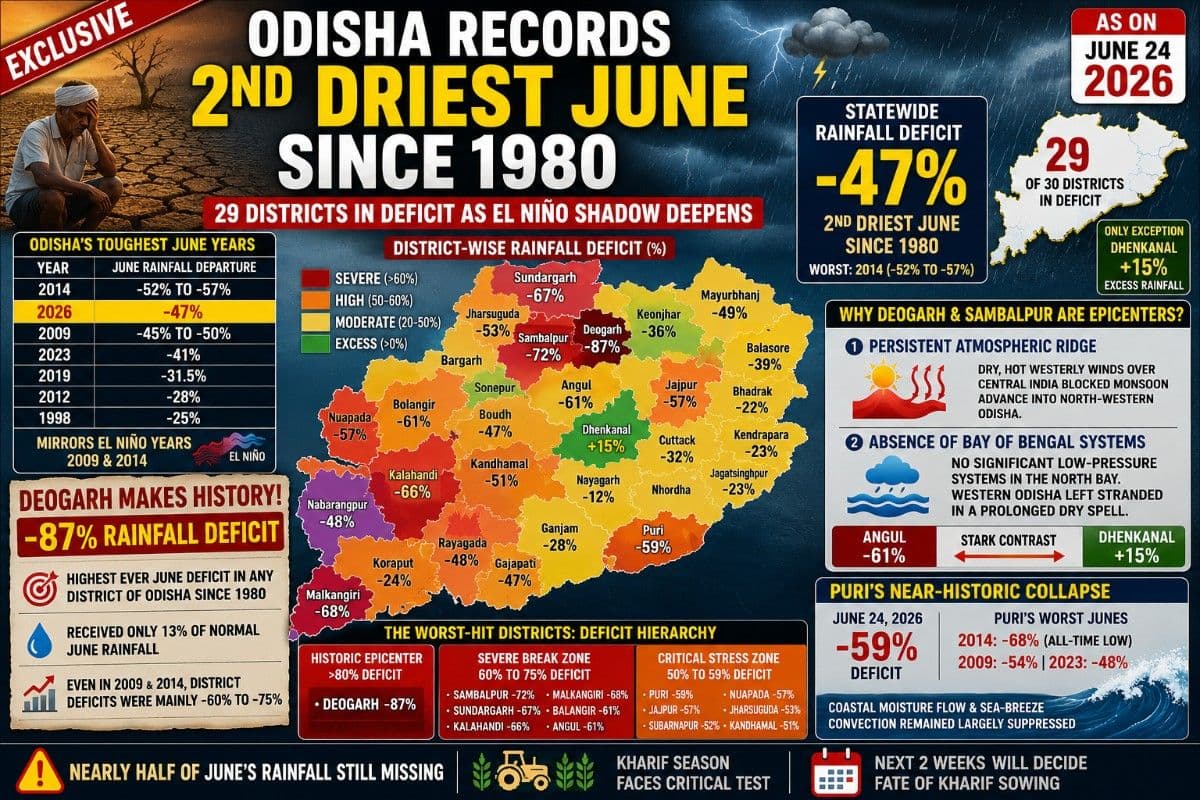
Bhubaneswar: With barely a week left for June to end, rainfall data released by the India Meteorological Department (IMD) points to a historic and deeply concerning trend for Odisha. As of June 24, the state has recorded an overall rainfall deficiency of 47 per cent, making June 2026 the second driest June in Odisha since 1980, surpassed only by the severe monsoon failure of 2014.
The current shortfall closely mirrors the drought-linked conditions witnessed during the El Niño year of 2009, raising fresh concerns over Kharif sowing, reservoir replenishment and rural livelihoods across large parts of the state.
What makes the situation particularly alarming is the geographical spread of the deficit. Nearly the entire state is under rainfall stress, with 29 of Odisha's 30 districts reporting deficient rainfall. The lone exception is Dhenkanal, which has received 15 per cent more rainfall than normal.
From coastal districts to the western plateau, the deficit map is dominated by red and yellow zones. The western and central regions, which depend heavily on June rainfall for agricultural preparation, have emerged as the epicentre of the unfolding crisis.

📱 Get Argus News App
✨Deficit Everywhere, Relief Almost Nowhere
A glance at district-wise rainfall data reveals the severity of the situation.
Among coastal & northern districts, Puri (-59%), Jagatsinghpur (-45%), Mayurbhanj (-49%), Balasore (-39%), Kendrapada (-23%) and Ganjam (-28%) have all recorded significant deficits.
In southern Odisha, Malkangiri (-68%), Rayagada (-48%), Gajapati (-47%), Nabarangpur (-48%), Kandhamal (-51%) and Koraput (-24%) remain under severe rainfall stress.
The western and central belts present an even grimmer picture. Kalahandi (-66%), Balangir (-61%), Nuapada (-57%), Sambalpur (-72%), Jharsuguda (-53%), Subarnapur (-52%), Angul (-61%), Boudh (-47%) and Baragarh (-47%) have all slipped deep into deficient territory.
However, one district stands out for all the wrong reasons.
Deogarh Creates Unwanted History
As of June 24, Deogarh has recorded an astonishing 87 per cent rainfall deficit, the highest in Odisha.
A review of IMD historical records since 1980 suggests that this may be the single most severe June rainfall deficiency ever recorded by any district in modern Odisha's meteorological history.
Even during Odisha's most notorious drought-linked years, including 2009 and 2014, district-level deficits generally remained within the 60-75 per cent range. Deogarh's current figure means the district has received barely 13 per cent of its normal June rainfall.
Meteorologists say the deficit is not merely statistical – it reflects a near-complete collapse of the monsoon's early-season rainfall mechanism over the district.
The Worst-Hit Districts
The crisis has evolved into a distinct hierarchy of rainfall distress.
Historic Epicentre
- Deogarh: -87%
Severe Break Zone (60-75% Deficit)
- Sambalpur: -72%
- Malkangiri: -68%
- Sundargarh: -67%
- Kalahandi: -66%
- Balangir: -61%
- Angul: -61%
Critical Stress Zone (50-59% Deficit)
- Puri: -59%
- Nuapada: -57%
- Jajpur: -57%
- Jharsuguda: -53%
- Subarnapur: -52%
- Kandhamal: -51%
The concentration of extreme deficits across the north-western plateau and central tableland indicates that the crisis is structural rather than localised.
Why Deogarh and Sambalpur Became the Epicentres
Weather experts attribute the extraordinary shortfall to a stalled monsoon pattern that has persisted through most of June.
Two meteorological factors have played a decisive role.
1. Persistent Atmospheric Ridge
A belt of dry and hot westerly winds over central India created a strong atmospheric ridge, effectively blocking the monsoon from advancing into north-western Odisha. While southern and coastal districts received occasional showers, the moisture-bearing currents failed to penetrate deep into the interior.
2. Absence of Bay of Bengal Systems
Districts such as Deogarh, Sambalpur and Angul rely heavily on low-pressure systems forming over the north Bay of Bengal. These systems typically drag moisture inland and trigger widespread rainfall over the Mahanadi basin.
This June, the Bay remained unusually inactive. The absence of any significant head-Bay depression left western Odisha stranded in a prolonged dry spell.
The contrast is starkly illustrated by neighbouring districts Angul and Dhenkanal. While Angul recorded a severe 61 per cent deficit, Dhenkanal reported 15 per cent excess rainfall, highlighting how isolated convective systems benefited one district while bypassing adjacent areas entirely.
Puri's Near-Historic Collapse
While Deogarh's figures are unprecedented, Puri's rainfall performance is equally alarming from a coastal perspective.
At 59 per cent below normal, Puri is experiencing one of its worst June performances in decades.
The district's all-time June low remains 2014, when rainfall deficiency reached around 68 per cent. During the El Niño year of 2009, the district recorded a 54 per cent shortfall.
Coastal districts typically receive substantial rainfall from maritime moisture flows, sea-breeze convection and early monsoon activity. A deficit approaching 60 per cent indicates that these natural moisture sources remained largely suppressed throughout the month.
For a district with a relatively high June rainfall normal, such a collapse could significantly affect agricultural operations and groundwater recharge.
Echoes of 2009 and 2014
The statewide rainfall deficit of 47 per cent places 2026 alongside Odisha's most difficult monsoon onset years.
The state's rainfall history shows only a handful of June seasons approaching the current level of distress.
|
Year |
June Rainfall Departure |
|
2014 |
-52% to -57% |
|
2026 |
-47% |
|
2009 |
-45% to -50% |
|
2023 |
-41% |
|
2019 |
-31.5% |
|
2012 |
-28% |
|
1998 |
-25% |
The common thread linking most of these years is the influence of El Niño conditions, weak Bay of Bengal systems, delayed monsoon progression, or atmospheric patterns that diverted moisture away from eastern India.
A Changing June in Odisha
The emerging concern extends beyond a single season.
Long-term trend analysis indicates that June rainfall across Odisha has become increasingly volatile over the past two decades. The frequency of deficient June months has risen significantly since 2000 compared with the 1980-1999 period.
Meteorologists note that even years classified as "normal" are increasingly witnessing rainfall concentrated into a handful of intense events rather than being distributed evenly across the month.
This shift has major agricultural implications. Farmers depend on regular rainfall during June to prepare nurseries, undertake sowing operations and build soil moisture reserves. Long dry spells, even when compensated later by heavy rain, often disrupt the agricultural calendar.
Kharif Season Faces a Critical Test
With nearly half of June's normal rainfall still missing and no major Bay of Bengal system having emerged so far, Odisha's Kharif season is entering a crucial phase.
The next two weeks will determine whether the monsoon can recover sufficiently to rescue sowing operations across western and central districts.
For now,
however, the numbers tell a stark story: Odisha is witnessing one of its driest
June months in modern history, and districts such as Deogarh, Sambalpur and
Sundargarh have already entered meteorological territory rarely seen in the
state's recorded climate record.
Also Read: Odisha's Reservoirs Only 16.57% Full as El Niño Threat Grows; Kharif Season Faces Twin Rainfall and Water Storage Risks| Exclusive
Related Topics
Explore more stories