



Odisha's Reservoirs Only 16.57% Full as El Niño Threat Grows; Kharif Season Faces Twin Rainfall and Water Storage Risks| Exclusive
Key Points
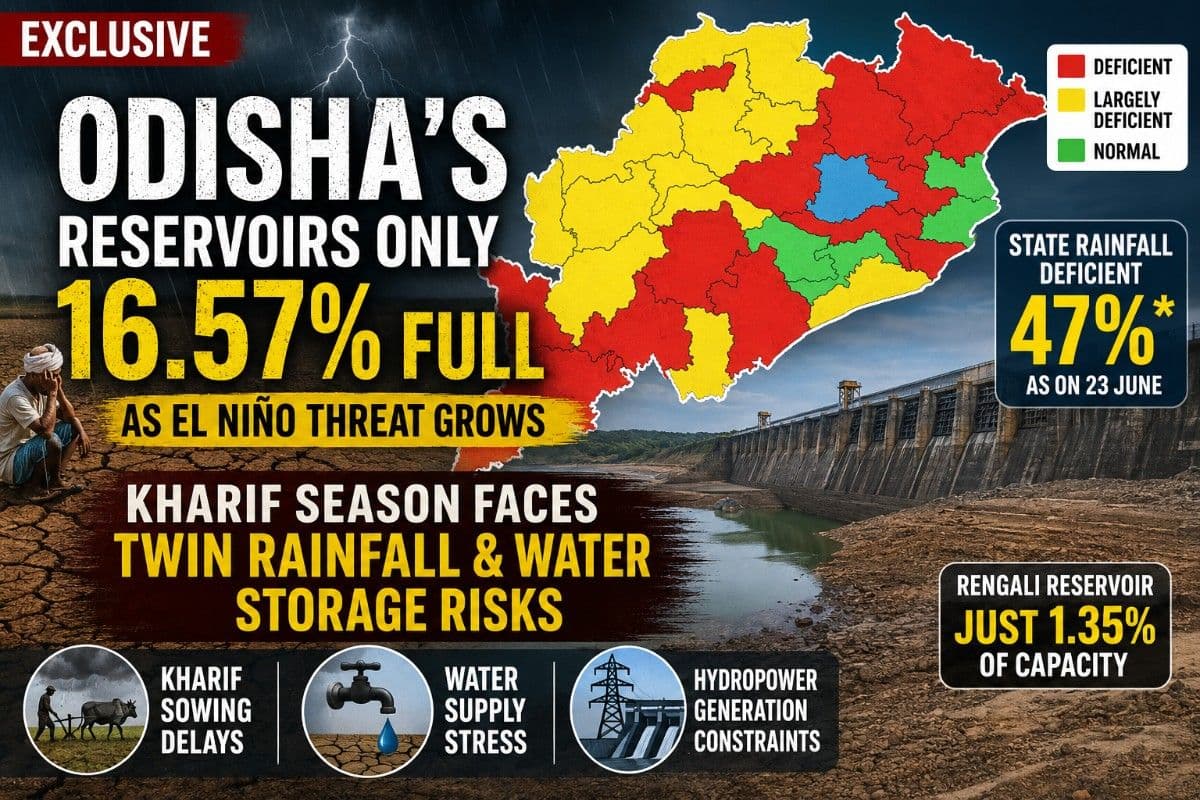
* Rengali reservoir has plunged to just 1.35% of capacity, emerging as the state's biggest water-stress hotspot.
* Low water levels threaten Kharif sowing, canal irrigation, hydropower generation and urban water supply across Odisha.
Bhubaneswar: As the Centre sounds the alarm over a weakening June monsoon and the growing probability of an El Niño event during the 2026-27 season, Odisha is emerging as one of the states most exposed to a potential Kharif disruption.
A recent review chaired by Union Agriculture Minister Shivraj Singh Chouhan identified 315 vulnerable districts across 12 states where inadequate rainfall and limited irrigation could threaten agricultural production. Odisha figures prominently in that risk assessment.
Yet the state's vulnerability goes beyond rainfall forecasts.
Fresh data from the Central Water Commission (CWC) reveals that Odisha enters the monsoon with major reservoirs operating at just 16.57 per cent of their total live storage capacity, leaving little room for error if monsoon deficits deepen in the coming weeks.

📱 Get Argus News App
✨Odisha's Reservoirs: 'Normal' on Paper, Fragile on Ground
At first glance, Odisha's reservoir position appears reassuring.
The state's 10 monitored reservoirs currently hold 2.608 billion cubic metres (BCM) of water against a total live storage capacity of 15.702 BCM. This is marginally higher than the storage recorded during the same period last year and almost identical to the state's 10-year average.
However, experts caution that the headline number hides a more troubling reality.
Over the last week alone, reservoir storage declined by 0.291 BCM as water continued to be drawn for drinking, industrial and agricultural needs ahead of major monsoon inflows. In effect, Odisha is entering the most critical phase of the monsoon cycle with reservoirs already at their annual low point.
If rainfall remains deficient through June and July under El Niño influence, the state could face simultaneous stress on agriculture, irrigation, power generation and drinking water supplies.
The Regional Divide Behind the Statewide Average
A closer examination of basin-wise data reveals stark regional disparities.
Hirakud Holding the Line, But Without a Buffer
The Mahanadi basin is officially classified as "better than normal" nationally, with storage levels exceeding its long-term average.
Yet Odisha's lifeline reservoir, Hirakud, currently stores only 0.835 BCM of water, equivalent to 15.53 per cent of its live capacity.
While better than last year's unusually low level, the reservoir remains far from comfortable. Any prolonged monsoon deficit could quickly erode the limited reserve available for irrigation and downstream releases.
Rengali Emerges as the Biggest Warning Signal
The situation is significantly worse in the Brahmani basin.
The Rengali reservoir has entered the Central Water Commission's list of projects with highly deficient storage. It currently holds just 0.046 BCM of water — a mere 1.35 per cent of its total live capacity.
In practical terms, one of Odisha's most important irrigation and hydropower assets is virtually empty.
For districts dependent on the Brahmani system, expectations of significant canal-based irrigation support during a weak monsoon may prove unrealistic unless substantial rainfall arrives soon in upstream catchments.
Southern Odisha Also Under Pressure
Several reservoirs serving southern Odisha's tribal and agricultural districts are also operating at low levels.
Balimela currently stands at 23.39 per cent of capacity, while Upper Indravati and Upper Kolab are at 19.02 per cent and 14.22 per cent respectively.
Although some of these projects are performing better than last year, they remain far below levels that would provide comfort in an El Niño year.
Why the Centre's Vulnerability Classification Matters
The Union Agriculture Ministry's contingency framework categorises districts based on irrigation coverage.
Districts with less than 25 per cent irrigation coverage are considered the highest priority because farming remains overwhelmingly dependent on rainfall.
Large parts of western, southern and upland Odisha fall into this category.
Meanwhile, districts with extensive canal systems and reservoir support are generally considered lower risk.
The challenge for Odisha is that many of these supposed irrigation safety nets are themselves under stress.
As a result, areas traditionally considered protected against rainfall shocks may find their resilience significantly weakened if reservoir levels fail to recover quickly.
Three Immediate Risks for Odisha
1. Kharif Sowing Delays
June is the critical month for land preparation, nursery raising and early sowing operations.
A weak monsoon combined with depleted reservoirs could delay paddy transplantation across large parts of the state, increasing the risk of lower yields and acreage losses.
2. Water Supply Stress
If reservoir replenishment remains delayed, authorities may be forced to prioritise drinking water over irrigation and industrial releases.
Urban-industrial clusters linked to major reservoir systems could face tighter water management measures later in the season.
3. Hydropower Constraints
Odisha's hydropower network depends heavily on projects such as Upper Indravati, Balimela, Rengali and Upper Kolab.
With reservoir levels already low, power generation may need to be curtailed to conserve water for essential needs, increasing dependence on thermal generation during peak demand months.
All Eyes on July First Week
Though on paper, reservoir storage remains almost exactly in line with the state's 10-year average, beneath that statistical comfort lies a system operating with minimal reserves, uneven regional distribution and little protection against a prolonged monsoon setback.
The State as on 23 June has recorded a whopping 47% deficient rainfall. When a high of 14 districts, including the districts that recorded first monsoon onset over Odisha, have slipped to red zones (deficient), another 14 districts have been categorised as largely deficient.
In this scenario, all eyes on upcoming rain forecast in July first week.
With El Niño risks rising and June rainfall already under pressure, the coming weeks will determine whether Odisha's reservoirs receive the recharge needed to sustain agriculture and water security through the Kharif season.
For now, the
state's water managers and farmers are entering the monsoon with one
uncomfortable reality: there is virtually no buffer left if the rains fail.
Also Read: ECMWF-JRC Warns of Unprecedented El Niño: Will Odisha Face Early Heatwaves in 2027, Cyclone Risks in Post Monsoon?| Exclusive