



Nepal’s Next Himalayan Deluge: China’s Simulation Clock Points to September 1| Special Report
Key Points
Bhubaneswar: The deadly Himalayan disaster that began with a glacier collapse may not be over yet.
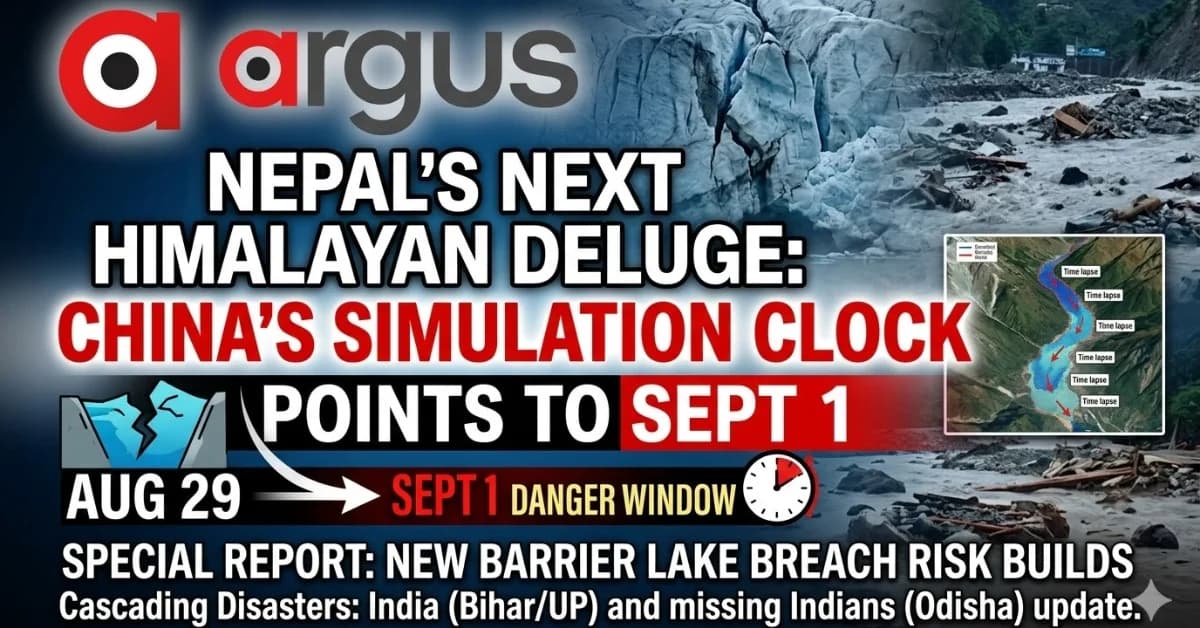
Even as Nepal struggles to recover from the August 26 catastrophe, a newly formed barrier lake near the Nepal-China border has opened a fresh and far more immediate danger window – with China’s hydrological assessment indicating that the highest breach risk could build over the next three days and peak around September 1.
The latest warning from China’s Ministry of Water Resources is based on a rapidly changing hydrological equation.
A barrier lake near the confluence of the Chhochen Khola and Purepu Tsangpo had already accumulated about 2 million cubic metres of water, while another 3 million cubic metres was expected to flow into the basin over the following three days. The lake had already begun overflowing, raising the possibility that erosion of the loose debris barrier could trigger a sudden downstream flood wave, reports Global Times.

📱 Get Argus News App
✨The September 1 Danger Window
This does not mean Nepal is certain to witness another disaster precisely on September 1. Mountains do not follow a clock, and predicting the exact moment of a barrier breach remains impossible.
But the Chinese assessment provides something more important: a probability window.
As more water enters the blocked basin, pressure on the unstable debris barrier rises. If the lake can gradually cut a stable spillway, the water may drain in a controlled manner. But if overflowing water rapidly erodes the loose dam, the breach could enlarge within minutes, converting a lake into a powerful wall of mud, water, boulders and debris.
That is why the critical period is August 29 to September 1, with the projected inflow maximum making around September 1 the most dangerous point in the present cycle.
Not Exactly a New GLOF –But Potentially Another Himalayan Flood Disaster
The terminology matters.
The August 26 catastrophe itself was triggered by a glacier collapse and an ice-rock avalanche, rather than by a conventional glacial lake outburst. The avalanche blocked river channels and created a cascading hydrological crisis.
The present threat is therefore better described as a secondary barrier-lake outburst flood.
But for Nepal’s downstream communities, the distinction may offer little comfort. Whether water is released from a glacial lake or an avalanche-created debris lake, the result can be similar: a sudden flood racing through narrow Himalayan valleys with very little warning time.
Authorities in Nepal and China have already responded as if the danger is immediate. Rescue operations were temporarily halted, helicopters suspended and people in vulnerable areas moved or asked to move to safer ground after the lake began overflowing and water levels started rising.
China’s Simulation Models Are Now Running Against Time
China’s water authorities are using flood simulations to estimate what could happen if the barrier fails.
The models are designed to assess different breach scenarios, including partial erosion and a larger structural collapse, and to estimate how the resulting flood wave could move through the steep downstream valleys.
The publicly reported assessment in Global Times is stark: another 3 million cubic metres of inflow over three days could sharply increase the breach risk. Chinese authorities have therefore been monitoring the barrier lake and preparing for a possible new flood emergency.
The danger is compounded by the geography.
A Himalayan barrier lake is not a conventional reservoir built with concrete and engineering controls. Its wall can consist of loose mud, rock, ice and avalanche debris. As water rises and begins cutting through such material, a small channel can rapidly widen. The faster the channel widens, the more water escapes, creating a destructive feedback loop.
That is the nightmare scenario behind the current warning.
So, When Could Another Major Outburst Hit?
Based on the available inputs, the answer can be divided into three windows:
Immediate
window: Now to September 1
This
is the most critical period for the existing barrier lake. The
additional inflow projected into the basin could push the unstable
debris structure towards failure.
Late-monsoon
window: Until the end of September
Even
if the present lake drains without a catastrophic breach, the
Himalayan slopes remain destabilised. Continued rainfall, melting,
landslides and secondary avalanches can block streams again and
create new temporary lakes.
Medium-term
window: The next 1–3 years
The
broader danger remains far beyond this one disaster. The Himalayas
are witnessing expanding glacial lakes, thawing permafrost and
increasingly unstable high-altitude slopes. That means the
probability of similar cascading events will remain elevated even
after the current monsoon ends.
The safest conclusion is therefore not that “another GLOF will hit Nepal on September 1”, but that September 1 is the current high-risk breach window for the newly formed barrier lake, while the wider Himalayan outburst risk could continue through the remaining monsoon and beyond.
The Indian Impact: Bihar Faces Most Direct Downstream Risk
India is not directly connected to every river threatened by the Nepal-Tibet barrier lake, but the wider disaster has already demonstrated how quickly Himalayan hydrological shocks can cross borders.
The immediate Indian concern remains the Nepal-origin river systems entering Bihar and Uttar Pradesh, particularly the Gandak-Kosi basin network. Any renewed extreme flood in Nepal can add pressure to an already swollen river system.
The most vulnerable Indian region is therefore north Bihar, where rivers originating in or flowing through Nepal can carry flood surges into densely populated plains. The Gandak system, in particular, can become a critical transmission channel for Himalayan floodwaters.
According to the inputs, Bihar has already seen renewed pressure, with multiple rivers approaching or crossing danger levels at different locations. Uttar Pradesh’s Maharajganj and Kushinagar districts also remain vulnerable to sudden changes in transboundary river flows.
Why India Should Watch Nepal’s September 1 Window Closely
For India, the present warning offers three lessons.
First, a Himalayan flood disaster does not end when the first flood wave passes. The August 26 glacier collapse has already created a cascading hazard – avalanche, debris blockage, barrier lake and possible secondary flood.
Second, cross-border real-time hydrological data is now as important as weather forecasting. India needs rapid information on lake levels, breach scenarios and river discharge from upstream areas.
Third, Bihar and Uttar Pradesh must prepare for compound flooding. A Nepal-origin surge combined with local monsoon rainfall can create a far more dangerous situation than either event alone.
The Missing Indians
Here is the information in a clean tabular format:
|
State |
Status of Citizens |
Notes & Impact Level |
|---|---|---|
|
Tamil Nadu |
21 Rescued & Safe |
Highest number of early confirmed safe evacuations. Citizens were tracked and assisted through the Indian Embassy in Kathmandu. |
|
Bihar |
High Disruption / Under Brunt |
Bihar borders the core disaster pathways. Many local traders, transit workers and travellers around the Rasuwa border area remain uncontactable. |
|
Uttar Pradesh |
Fatalities Recovered |
Four bodies, believed to have been washed downstream from Nepal, were recovered in a severely decomposed condition in Maharajganj district. |
|
Odisha |
2 +3 Missing |
A couple from Khurda remains uncontactable near the Nepal-China border immigration point. Similarly, 3 from Bargarh: A couple and their 2-yr kid. |
Missing Indian citizens largely fall into three categories:
Trishuli 1 power project workers — 73 workers reported missing
Tourists travelling in the affected Himalayan region
Pilgrims undertaking the Kailash Mansarovar Yatra
The Bottom Line
The next major Himalayan flood threat is already on Nepal’s doorstep.
The most immediate danger window is the next three days, with China’s assessment pointing to peak flood risk around September 1, as millions of cubic metres of additional water enter the unstable barrier lake.
But the larger warning is even more serious: the August 26 disaster was not a one-time event. It has destabilised an entire mountain-river system.
The first disaster came from the mountain collapsing.
The
next one, if the barrier fails, could come from the water the
mountain collapse has trapped behind it.
Also Read: Nepal Catastrophe Explained: Not Rain, Disaster Triggered by a 4.4 Quake; China Could Have Saved Lives & The India Lessons| Exclusive