



Monsoon On, Rain Off in Odisha: El Niño Plays the Game | Exclusive
Key Points
* El Niño is weakening monsoon circulation, preventing moisture-laden winds from organizing into widespread rain-bearing systems.
* Western and interior Odisha are bearing the brunt of the dry spell, with several districts reporting large rainfall deficits.
Bhubaneswar: The Southwest Monsoon has officially
arrived in Odisha. Yet, for much of the state, the monsoon seems to exist only
on weather maps.
When the India Meteorological Department (IMD) declared the onset of monsoon over Odisha on June 12, expectations were high. After all, strong southwesterly winds had entered through the coastal districts of Balasore, Bhadrak, Kendrapara and Jagatsinghpur, marking the onset from the eastern maritime zone after a long 17 years.
But 96 hours later, the reality on the ground told a different story.
Large parts of Odisha continued to witness bright sunshine, high humidity and little rainfall. The skyline zooms only thin cloud line at some places, but hardly they rains.

📱 Get Argus News App
✨Rainfall Numbers Tell the Tale
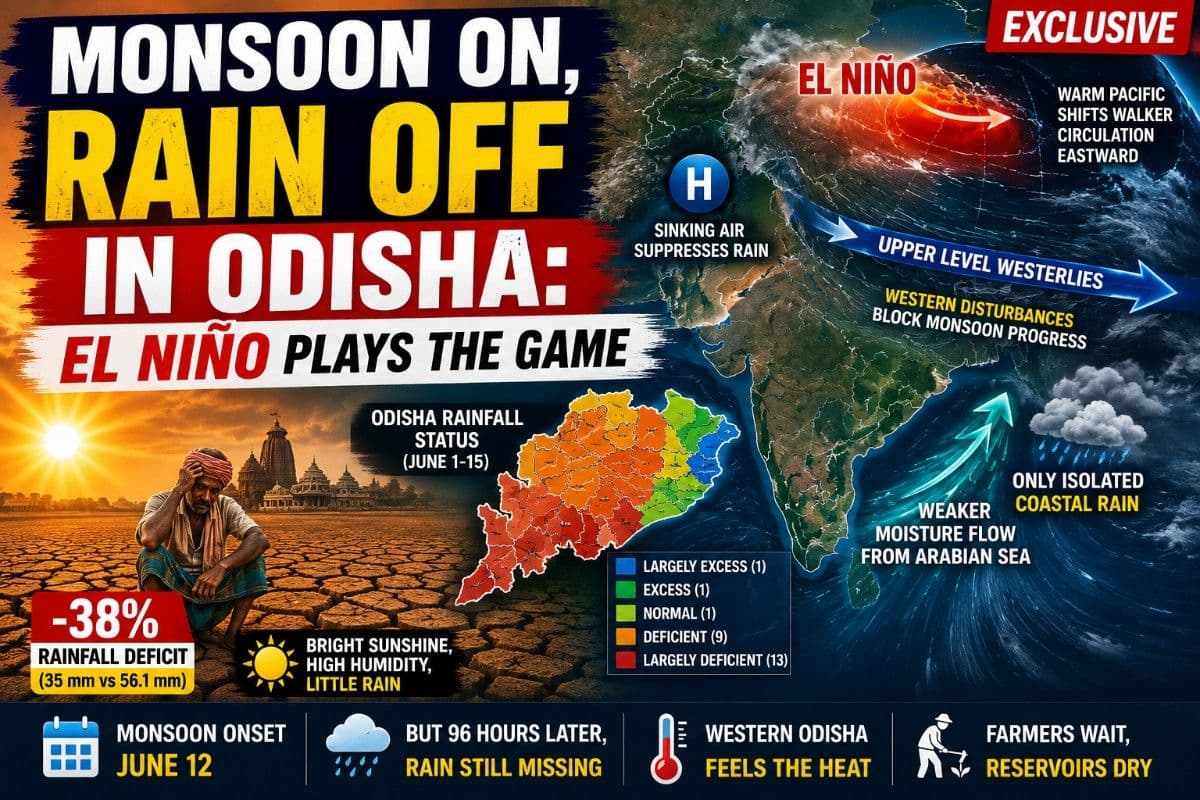
The state has recorded only about 35 mm rainfall against the normal 56.1 mm for the period, leaving Odisha with a rainfall deficit of nearly 38 percent.
The district-wise picture is even more striking.
Jagatsinghpur remains the lone district in the largely excess rainfall category, while Kendrapara has recorded excess rainfall. Mayurbhanj is broadly normal.
The rest of Odisha is struggling.
Most coastal districts, including Puri, Khordha, Cuttack, Balasore and Bhadrak, are in the deficient category. Conditions are even worse across western and interior Odisha, where districts such as Sambalpur, Jharsuguda, Bargarh, Balangir, Nuapada, Kalahandi and Kandhamal have slipped into the largely deficient zone.
The rainfall map reveals a clear east-to-west gradient. While a few pockets along the coast have benefited from localized moisture convergence, the western two-thirds of the state remain unusually dry for mid-June.
Why Is the Monsoon Not Delivering?
Meteorologists point to a combination of atmospheric factors.
Normally, once monsoon winds enter Odisha, they organize into a coherent monsoon trough that spreads rainfall across the state. This year, that process has stalled.
The low-level monsoon circulation remains fragmented. Moisture-laden winds are reaching Odisha, but they are struggling to organize into widespread rain-bearing systems.
As a result, rainfall has remained confined to isolated coastal pockets instead of spreading inland.
Western Odisha Feels the Heat
The impact is most visible across western Odisha.
Districts that depend heavily on the monsoon's inland progression continue to experience hot and dry conditions. Farmers waiting for sowing rains are closely monitoring forecasts, while reservoirs and groundwater systems are yet to receive meaningful recharge.
Historically, June contributes nearly 15 to 18 percent of Odisha's seasonal monsoon rainfall. Losing much of the first half of the month raises concerns about agricultural planning if the dry spell continues.
The El Niño Factor
The biggest clue lies thousands of kilometres away in the Pacific Ocean.
The IMD has confirmed the emergence of El Niño conditions in the equatorial Pacific. While the phenomenon is still evolving, its fingerprints are already becoming visible across India's monsoon system.
El Niño alters global atmospheric circulation by shifting the Walker Circulation eastward. This creates widespread sinking air over the Indian subcontinent.
Sinking air suppresses cloud formation and rainfall.
At the same time, El Niño weakens the low-level jet stream that normally transports moisture from the Arabian Sea toward India. With weaker moisture transport, the monsoon trough struggles to organize and penetrate inland.
Adding to the problem, persistent upper-level westerlies and recurring Western Disturbances (another one by June 18) over northern India have acted as an atmospheric barrier, preventing the Bay of Bengal branch of the monsoon from advancing smoothly into interior Odisha.
How El Niño Is Playing the Game
The irony is striking.
The monsoon has officially arrived. Moisture is available. Winds are present.
Yet the atmosphere refuses to cooperate.
That is precisely how El Niño often influences the Indian monsoon – not necessarily by stopping the monsoon from arriving, but by weakening the atmospheric machinery needed to convert moisture into widespread rainfall.
The result is the weather Odisha is experiencing today: monsoon on paper, sunshine on the ground.
For now, El
Niño appears to be winning the opening round of the 2026 monsoon season,
turning what should have been a rainy June into a waiting game for much of
Odisha.
Also Read: Odisha's Rarest Monsoon Entry in 17 Years: Why Balasore Became the Gateway, What It Means for June Rainfall| Exclusive
Related Topics
Explore more stories