



Late Entrant to SDRF Club: Odisha Becomes 7th State with Dedicated Disaster Response Force; Know Cadre Rules, Recruitment Plan & Big Impact| Special Report
Key Points
Bhubaneswar: Despite being one of India's most disaster-prone states, Odisha has emerged as only the seventh state in the country to establish a dedicated State Disaster Response Force (SDRF) – a move that fundamentally changes the state's disaster management architecture.
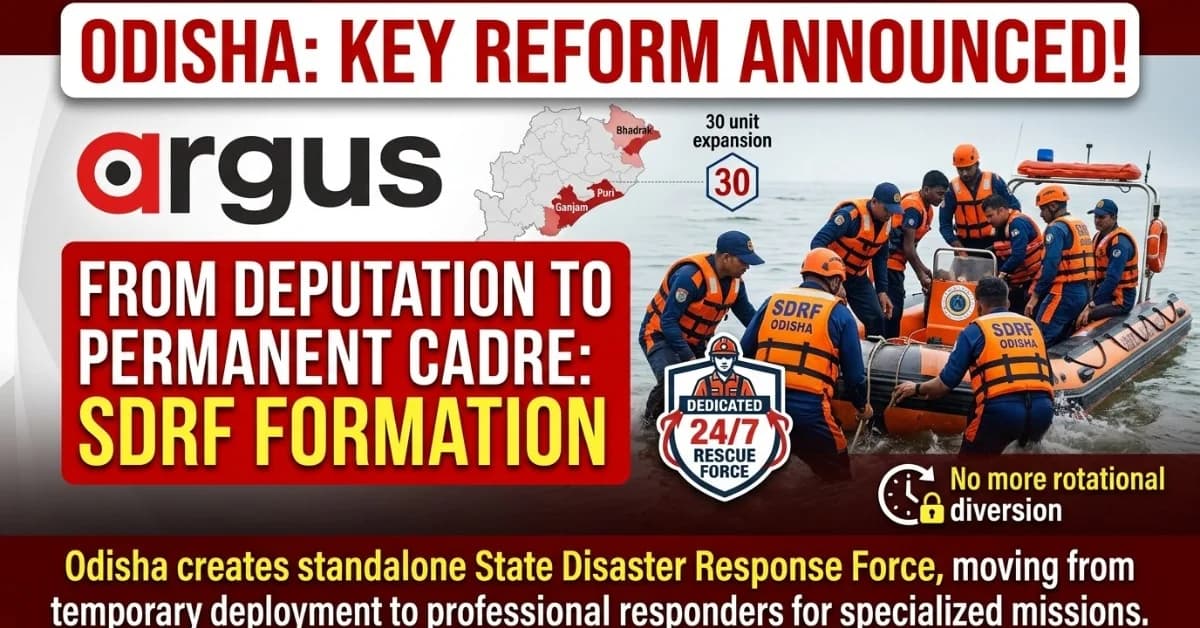
The Odisha government's decision Tuesday to upgrade the Odisha Disaster Rapid Action Force (ODRAF) into an independent SDRF marks a shift from a deputation-based rescue model to a permanent, professionally trained disaster response cadre.
The transition also aligns Odisha with states such as Uttarakhand, Assam, Maharashtra, Uttar Pradesh, Gujarat and Bihar, which had already institutionalised standalone SDRF battalions.
Why SDRF When ODRAF Was Already Delivering?

📱 Get Argus News App
✨The obvious question is: if Odisha's ODRAF has earned national and international recognition for handling cyclones, floods and other calamities, why create another force?
The answer lies in the structural limitations of ODRAF.
Unlike a dedicated disaster force, ODRAF personnel are drawn from Odisha Armed Police battalions on deputation.
Consequently, they are periodically diverted for elections, law-and-order deployment, VIP security and other policing responsibilities. This rotational system often results in the loss of highly trained disaster responders just when experience matters most.
The proposed SDRF seeks to end this cycle by creating an independent battalion with its own command structure, dedicated personnel and exclusive disaster-response mandate.
Experts believe this will help retain specialised skills in deep-water rescue, collapsed-structure operations, chemical and industrial disasters, and other high-risk rescue missions that require years of continuous training.
What Would Have Changed During Odisha's 2026 Floods?
The recent floods provided perhaps the strongest justification for a dedicated SDRF.
ODRAF teams remained deployed continuously for nearly 490 hours, conducted around 58 hours of night rescue operations, and evacuated 1,393 stranded people across multiple districts. While the operation was widely appreciated, it also exposed the limitations of relying on personnel drawn from conventional police battalions.
According to the government's assessment, a dedicated SDRF with 30 strategically positioned units could significantly reduce response time through pre-positioned deployments, ensure uninterrupted troop rotation to avoid fatigue, strengthen engineering support for embankment protection, and improve coordination through an integrated command system.
The expansion from the existing 20 units to 30 units is also expected to plug geographical gaps by locating new battalions in vulnerable districts such as Gajapati, Malkangiri, Kalahandi, Bhadrak, Kendrapada, Puri, Ganjam, Cuttack, Keonjhar and Sambalpur.
Cadre Rules & Recruitment: From Deputation to Professional Career
The biggest reform lies in the proposed cadre rules.
Instead of continuing the present deputation model, the government plans to create a standalone disaster-response cadre. Existing ODRAF personnel will initially be offered permanent absorption into the new SDRF, ensuring that experienced rescuers remain within the force rather than returning to general policing duties.
Future recruitment will gradually shift towards specialised direct induction, where candidates possessing skills such as swimming, scuba diving, paramedical expertise, heavy machinery operation and technical rescue qualifications will receive preference.
The government is also proposing a separate promotion hierarchy, with career advancement linked to disaster-response experience, rescue certifications and specialised technical competence rather than conventional policing seniority.
Every recruit is expected to undergo structured disaster-management training on the lines of the National Disaster Response Force (NDRF), while the upcoming Rs300-crore Disaster Management Complex in Bhubaneswar will eventually house GIS, satellite communication and other technology-driven capabilities.
Challenges Ahead: Success Will Depend on Execution
While the decision has been widely viewed as a long-overdue institutional reform, several challenges remain.
The foremost concern is ensuring that SDRF does not become merely a renamed ODRAF. Unless the government establishes a genuinely independent recruitment system and permanent disaster-response cadre, many of the existing structural weaknesses may continue.
Another challenge is building sufficient technical expertise. Modern disaster response increasingly depends on GIS-based mapping, satellite communication, drone operations and advanced rescue technologies, requiring continuous investment in specialised training infrastructure.
Equally significant is the implementation timeline. Since the transition will be rolled out in phases over the next two years, Odisha will continue to depend largely on the existing ODRAF framework during upcoming monsoon seasons. That leaves a critical window when one of India's most disaster-vulnerable states remain exposed while the new institutional structure is still taking shape.
Bottom Line
Odisha may have entered the dedicated SDRF club later than several other disaster-prone states, but the reform represents one of the most significant institutional overhauls in the state's disaster management history.
If implemented with an independent cadre, specialised recruitment and sustained training, the SDRF could transform Odisha's globally acclaimed disaster response model from an efficient emergency force into a permanent, technology-driven disaster management institution.
The real
test, however, will be whether the state builds an entirely new professional
rescue service or merely rebrands the existing system.
Also Read: Odisha Floods 2026: Does the First BJP Government Pass the Flood Test| Exclusive Analysis
Related Topics
Explore more stories