



Odisha Floods 2026: Does the First BJP Government Pass the Flood Test| Exclusive Analysis
Key Points
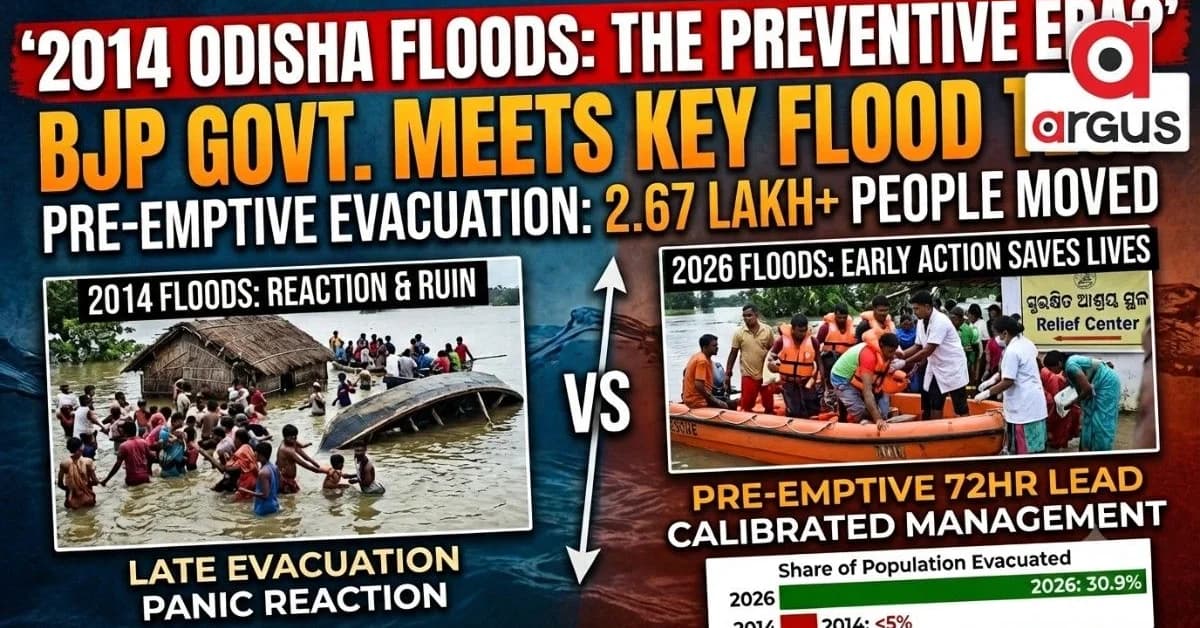
Over 2.67 lakh people were successfully evacuated prior to peak floodwaters, marking a shift to a prevention-based model.
The 2026 floods impacted 22 districts and affected 8.63 lakh residents, showing a medium intensity compared to past disasters.
Pre-emptive planning, multi-agency deployments, and immediate SDRF funding helped minimize disaster risks across vulnerable regions.
Bhubaneswar: With floodwaters steadily receding across the Mahanadi delta and northern coastal districts, Odisha is gradually returning to normalcy.
Unlike the devastating floods that scarred the State over the past decade, including the widely criticised man-made floods of 2011 and 2014, as of now, it seems the first BJP government have successfully negotiated its biggest flood challenge.
While the July-August 2026 floods spread across 22 districts, affecting 8.63 lakh people, they did not spiral into a humanitarian catastrophe.
The defining feature of this year's flood management was speed, particularly the unprecedented pace of evacuation.

📱 Get Argus News App
✨Instead of waiting for rivers to breach embankments, authorities shifted over 2.67 lakh people before peak floodwaters arrived, marking Odisha's transition from a rescue-based approach to a prevention-based flood response.
2026 Flood: Medium in Scale, Big on Management
Unlike the catastrophic floods of 2011 or 2014, the current flood remained a medium-intensity event despite affecting a large geographical area.
According to official figures, floodwaters impacted 22 districts, with Bhadrak, Balasore and Jajpur emerging as the worst-hit regions. Around 8.63 lakh people were affected, while 2,67,301 persons were evacuated to safety before rivers reached their highest levels.
The government deployed 24 ODRAF teams, six NDRF teams and 46 Fire Service units, backed by relief camps, medical teams, baby food supplies and cattle feed. Financial assistance was simultaneously activated through SDRF funds, reducing delays in relief distribution.
How 2026 Compares With Odisha's Six Major Floods
Since the catastrophic flood of 2011, Odisha has experienced six major flood episodes. In terms of affected population, the present flood ranks below the disasters of 2011, 2014 and 2020, and is broadly comparable to 2022.
|
Flood Year |
Districts Affected |
Population Affected |
Relative Severity |
|
2013 |
12 |
Over 10 lakh |
Severe |
|
2014 |
23 |
Around 34 lakh |
Very Severe |
|
2019 |
13 |
Around 5 lakh |
Moderate |
|
2020 |
20 |
Around 14.5 lakh |
Severe |
|
2022 |
24 |
Around 9.5 lakh |
High |
|
2026 |
22 |
8.63 lakh |
Medium, well-managed |
What distinguishes 2026 is that a relatively wide geographical spread did not translate into proportionately high human losses. The extensive evacuation and calibrated reservoir management ensured that floodwaters were largely contained without triggering the cascading disasters witnessed in previous years.
The Biggest Difference: Evacuation Before Inundation
The most significant departure from Odisha's earlier flood management has been the shift from reactive rescue to pre-emptive evacuation.
Historically, large-scale evacuations were initiated after villages were marooned or embankments breached.
This year, however, evacuation began nearly 48 to 72 hours before rivers reached peak levels, allowing authorities to move vulnerable populations while road connectivity remained intact.
Nearly 31% of the affected population was relocated to relief centres, far exceeding previous flood responses.
Evacuation: 2026 vs Earlier Major Floods
|
Parameter |
2026 Flood |
2022 Flood |
2020 Flood |
2011 Flood |
|
People evacuated |
2,67,301 |
~60,000 |
~32,000 |
~1,50,000 |
|
Affected population |
8,63,909 |
~9.5 lakh |
~14.5 lakh |
34 lakh+ |
|
Share of affected population evacuated |
30.9% |
6.3% |
2.2% |
4.4% |
|
Evacuation approach |
Pre-emptive (72-hour lead) |
Reactive |
Reactive |
Emergency response |
|
Trigger |
IMD forecasts & river modelling |
Post reservoir releases |
After villages marooned |
During embankment failures |
Source: Official data compiled from Revenue & Disaster Management Department and historical flood records.
What Changed in 2026 That Earlier Floods Missed
Beyond faster evacuation, several operational improvements distinguish this year's response.
|
2026 Initiative |
Earlier Flood Scenario |
|
Evacuation initiated before flood peak |
Evacuation largely began after inundation |
|
Police patrolled evacuated villages to prevent theft |
Fear of property theft discouraged evacuation |
|
Women police deployed in relief camps |
Dedicated protection measures largely absent |
|
Baby food and cattle feed supplied in camps |
Farmers often returned to flooded villages for livestock |
|
Multi-agency deployment planned in advance |
Rescue forces mobilised after flood situation worsened |
|
Immediate SDRF funding for districts |
Relief spending often followed damage assessment |
These interventions addressed one of Odisha's longstanding challenges – people refusing evacuation because of concerns over homes, livestock and personal security. By reducing that resistance, authorities substantially increased evacuation compliance.
Lessons Learnt From 2011 and 2014
The floods of 2011 and 2014 continue to serve as reminders of how reservoir management can aggravate natural disasters.
Both events drew criticism because sudden large-scale releases from Hirakud Dam, following delayed discharge decisions, intensified downstream flooding. The 2014 flood was subsequently criticised by, even, CAG for violating reservoir rule-curve principles.
This year, however, authorities adopted a more calibrated strategy. Reservoir releases were regulated in phases while downstream river flows were continuously monitored, avoiding the panic discharge situations that characterised previous disasters.
The Takeaway
The July-August 2026 flood was certainly not Odisha's largest flood in terms of either geographical spread or affected population. Yet it could become a watershed in the State's disaster-management history.
The first BJP government faced its toughest flood challenge within years of taking office. Instead of allowing the crisis to evolve into another 2011 or 2014, it relied on early forecasts, rapid mobilisation and pre-emptive evacuation.
The result is evident in the numbers: over 2.67 lakh people moved to safety before floodwaters peaked, nearly one-third of all affected residents evacuated, and a disaster that remained largely manageable despite covering 22 districts.
If earlier
floods were remembered for panic rescue operations, the 2026 flood may be
remembered for proving that prevention is far more effective than rescue.
Also Read: Mahanadi Flood: Odisha Braces for 5-Foot Inundation in Bhubaneswar, Jagatsinghpur & Puri Pockets Sunday-Monday| Exclusive
Related Topics
Explore more stories