



195 GLOF Ticking in India, Govt Pulls Up Socks for 2027–30 Risk Window| Special Report
Key Points
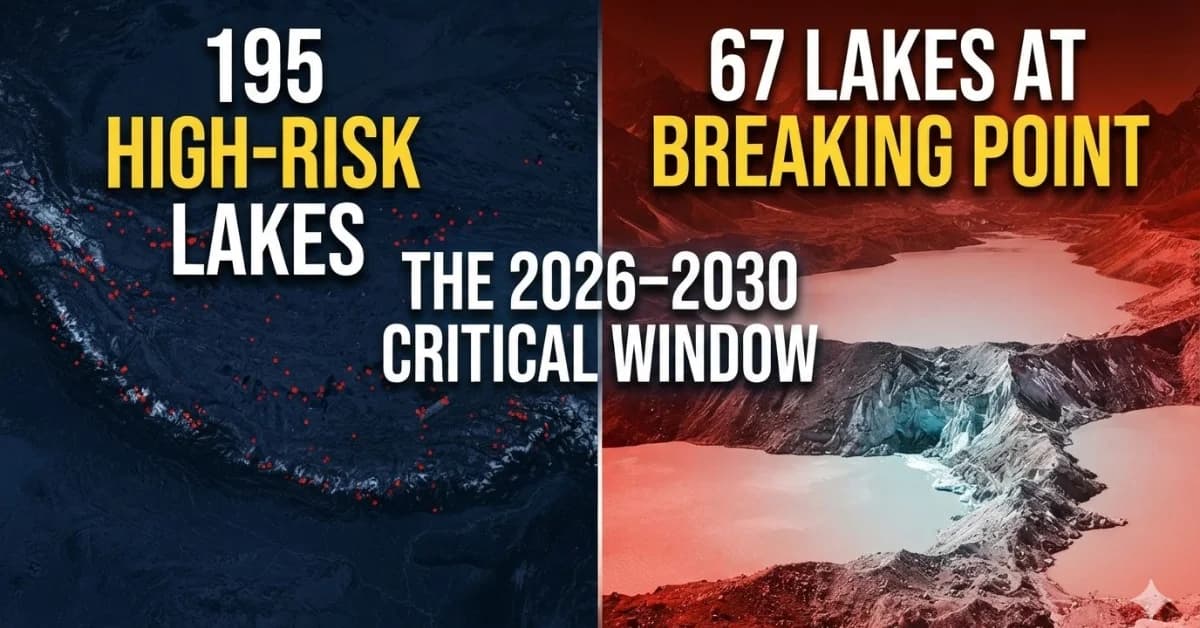
The Union Home Ministry convened a high-level review targeting 195 vulnerable Himalayan glacial lakes, with 67 placed in the very-high-risk Category-A bracket.
Accelerated glacier mass loss in the Hindu Kush Himalaya, which has nearly doubled since 2000, is continuously fueling new high-altitude flood risks.
India is upgrading its defense systems by deploying protected high-elevation telemetry with C-DAC, satellite change-detection alerts, and localized community drills.
Bhubaneswar: Nepal’s catastrophic glacial outburst disaster has brought home a warning that India’s Himalayan states can no longer afford to treat as a distant climate threat.
On September 3, the Union Home Ministry convened a high-level meeting with the Himalayan states and key agencies to review preparedness for Glacial Lake Outburst Floods (GLOFs), with 195 high-risk glacial lakes now under the national risk-management lens.
The concern is not merely the number of lakes, but the speed at which the Himalayan cryosphere is changing.
The newly released ICIMOD HKH Glacier Outlook 2026, based on 50 years of glacier observations, finds that mean glacier mass wastage in the Himalaya has nearly doubled after 2000 – from 0.31 metre water equivalent per year before 2000 to 0.66 metre after 2000. Cumulative glacier mass loss since 1974 has reached nearly 24 metres of water equivalent, while the rate of annual mass loss has accelerated by about 9 cm water equivalent per decade.

📱 Get Argus News App
✨195 Lakes, But 67 in the Highest-Risk Zone
The NDMA’s risk matrix puts the immediate focus on 195 vulnerable glacial lakes. Of these, 67 are classified as Category A, placing them in the very-high-risk bracket; another 48 are in Category B, while 74 are in Category C, with six awaiting classification pending field validation.
The Category-A lakes are particularly significant because they combine rapid lake expansion with vulnerability of the natural moraine dams and proximity to downstream infrastructure.
The meeting Thursday identifies Gepang Gath and Samudra Tapu in Himachal Pradesh, and South Lhonak, Gurudongmar and Shako Chho in Sikkim, among the critical hotspots.
State-Wise Risk Mapping: The "Ticking Time Bombs"
|
State / Union Territory |
Vulnerable Lakes (NDMA) |
Category-A (Very High Risk) Lakes |
Prime Hotspots & Key Examples
Himachal Pradesh
48
Multiple
Gepang Gath, Samudra Tapu
Sikkim
41
Multiple
South Lhonak Lake, Gurudongmar, Shako Chho
Ladakh
34
Multiple
Gya Lake
Arunachal Pradesh
32
Multiple
Lakes in Mago Chu Basin, Rani Lake
Jammu & Kashmir
27
Multiple
Bram Sar
Uttarakhand
13
Multiple
Lakes in Chamoli & Bhagirathi basins
|
What Failed in Nepal |
How It Can Be Corrected in India |
|
Fragile Early Warning Systems: Automated water gauges in Nepal were physically destroyed by the initial avalanche debris before they could relay warning data downstream. |
Redundant & Protected Telemetry: India's NDMA is partnering with C-DAC to deploy reinforced, high-elevation telemetry stations positioned safely out of the immediate impact line of rockflows. |
|
Transboundary Data Silos: Delays in formal cross-border data-sharing agreements between China and Nepal meant crucial minutes were lost during detection. |
Satellite-Based Automated Threshold Alerts: India is bypassing ground-data gaps by setting up automated satellite-change alerts with state disaster rooms. |
|
Warning Disconnect: People in downstream towns did not receive or understand evacuation alerts until debris hit. |
Last-Mile Localized Drills: The MHA's new mandate requires states to convert high-altitude data into immediate sirens and text notifications, accompanied by community mock drills in local languages. |
2026–30: The Critical Risk Window
There is, however, no scientifically defensible calendar date for when a particular glacial lake will burst. A GLOF can be triggered suddenly by a rockfall, avalanche, extreme rainfall event or other destabilising event even after years of apparently gradual lake expansion.
What authorities can identify are high-probability operational windows. The current assessment places the most immediate concern on 2026–2030, when rapidly expanding Category-A lakes could cross structural thresholds if mitigation is delayed or proves inadequate. The annual danger also rises during the July–October period, when intense glacier melt can combine with monsoon cloudbursts and destabilise moraine dams.
This means 2026–30 should not be read as a prediction that 67 lakes will burst during those years. Rather, it is the period in which authorities are treating the existing high-risk inventory as requiring urgent mitigation.
The longer-term warning is even broader. ICIMOD has placed the region within the 2025–2034 Decade of Action for Cryosphere Science, as continued glacier retreat can generate new proglacial lakes that may not yet feature in existing hazard inventories.
Why Nepal Has Changed The Indian Risk Equation
The Nepal disaster has sharpened the focus on what happens after a lake bursts. The danger is not confined to the glacial lake itself. A sudden outburst can send a high-energy flood wave carrying boulders, debris and sediment into narrow Himalayan valleys, threatening settlements, roads, bridges and hydropower infrastructure.
India has already experienced the cascading consequences. On October 3, 2023, the South Lhonak Lake GLOF in Sikkim triggered by an upstream rock avalanche and heavy rain caused catastrophic downstream damage, including the destruction of the 1,200-MW Teesta-III dam.
That experience has changed the risk calculation: a glacial lake is no longer being viewed in isolation from the infrastructure sitting downstream.
Glacier Loss Is Filling The Risk Reservoir
The ICIMOD findings provide the scientific backdrop to this heightened concern. Of approximately 63,700 glaciers in the Hindu Kush Himalaya, only 38 have field observations, highlighting how limited direct, long-term monitoring remains compared with the scale of the region.
Those 38 glaciers have produced 302 annual mass-balance observations since 1974, with 270 negative-mass-balance years against only 32 positive years. The latest decade has also seen increasingly frequent extreme melt years, culminating in exceptional glacier losses in 2021/22.
For India, this matters because continuing ice loss means more unstable high-altitude landscapes and changing runoff patterns. The formation and expansion of glacial lakes can increase GLOF exposure even as the long-term water-storage capacity of glaciers declines.
From Satellite Watch To Ground-Level Warning
The government’s response is therefore moving beyond simply counting lakes. The September 3 review has pushed the Himalayan states towards continuous monitoring of vulnerable glacial lakes and avalanche-prone corridors, including mapping potential flood-flow paths and downstream high-risk zones.
The next layer is early warning. Automated sensors and threshold-based alerts are being prioritised so that a warning generated high in the mountains can reach downstream populations before roads, bridges or communication networks are severed. The assessment also stresses the need to strengthen the last-mile delivery of warnings and evacuation instructions.
Siphoning, Dam Redesign And Early-Warning Systems
The response is also turning increasingly engineering-oriented. In Sikkim, high-altitude pumping and siphoning interventions are being used to lower water levels in vulnerable lakes such as Shako Chho, while similar mitigation is being pursued at critical hotspots.
The CWC is also pushing specialised GLOF assessments for proposed and under-construction dams in Himalayan catchments, alongside reviews of existing spillway capacity so that infrastructure can withstand the combined impact of extreme floods and a GLOF.
Technology is becoming another line of defence, with automated weather and water monitoring, water-spread surveillance and threshold-based warning systems being developed with scientific and technology agencies. The government is simultaneously pressing states to accelerate GLOF mitigation projects sanctioned in 2024.
The Bigger Warning: 2026–34
The immediate government response is therefore centred on the 2026–30 risk window, but the scientific warning runs much deeper.
ICIMOD’s 50-year record shows that the Himalayan glacier system is undergoing sustained and accelerating mass loss. The report estimates cumulative glacier storage depletion at 23.95 ± 1.44 metres water equivalent between 1974 and 2023.
That makes the GLOF threat a moving target. Some of the lakes on today’s risk list may be mitigated, while new lakes can emerge as glaciers retreat.
For India, therefore, the challenge after Nepal is no longer simply whether another GLOF will happen. It is whether the country can identify the next unstable lake early enough, drain or stabilise it where feasible, redesign exposed infrastructure and get an evacuation warning to people downstream before the first debris wave arrives.
The
195 lakes are the present inventory. The 2026–30 window is the
immediate preparedness test. The 2025–34 cryosphere decade is the
much larger strategic challenge.
Also Read: Nepal Catastrophe Explained: Not Rain, Disaster Triggered by a 4.4 Quake; China Could Have Saved Lives & The India Lessons| Exclusive
Related Topics
Explore more stories