



Puri Rath Yatra 2026: India’s First ‘Asset-Based Mobile Command’ Puts Top Officials on Chariot Wheels| Exclusive
Key Points
* Response to Crises: The transition to autonomous, asset-based mobile command is a direct tactical response to the communication bottlenecks and crowd challenges witnessed during the 2024 and 2025 festivals.
* Zero Command Latency: Embedding the district's absolute executive and technical decision-making authority directly onto the wheels eliminates communication delays, allowing real-time response to on-ground disruptions.
Bhubaneswar: When the gigantic wooden wheels of Lord Jagannath's Nandighosa begin rolling down Puri's Bada Danda next Thursday, devotees may not immediately notice the biggest change introduced in this year's Rath Yatra.
It will not be a new barricade.
Nor another surveillance camera.
Instead, the most significant transformation will quietly travel with the three chariots themselves.
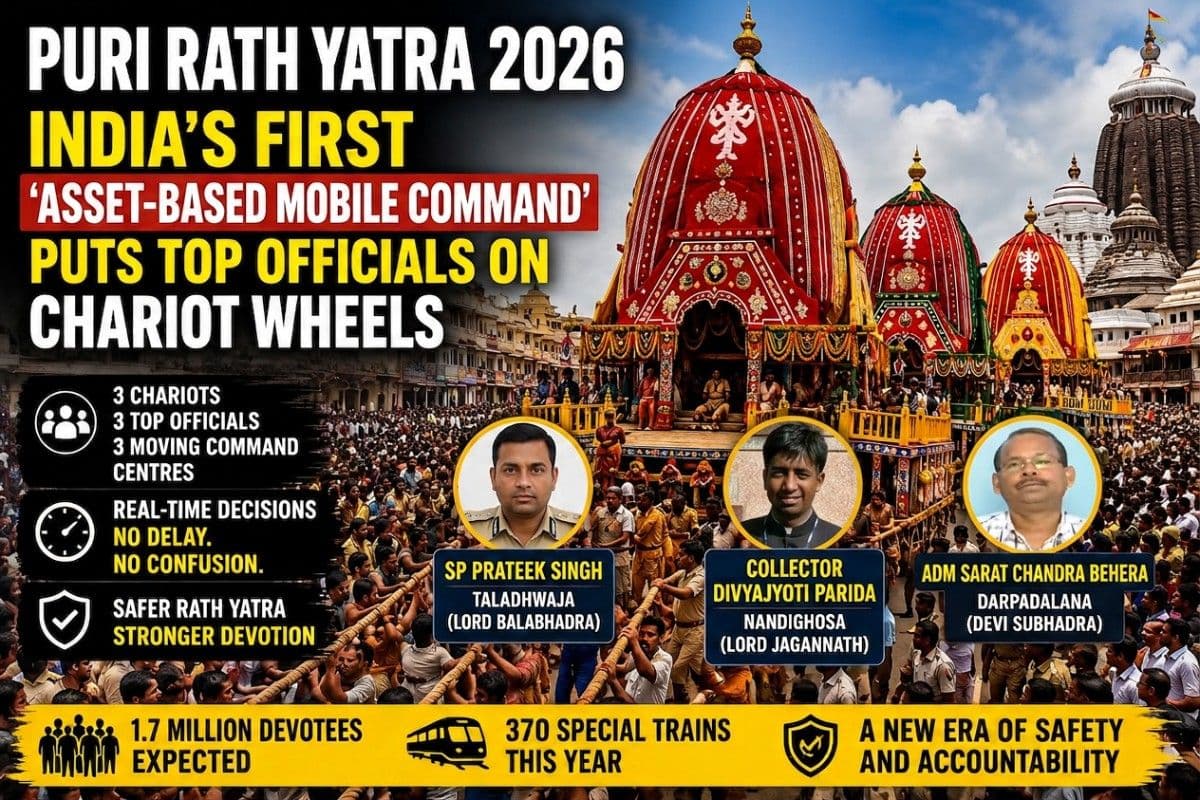
For the first time in the modern administrative history of the Rath Yatra, Odisha's top district administrators will no longer supervise the festival primarily from a central command structure. They will physically move with individual chariots, effectively converting each chariot into an independent operational command centre.
The Shree Jagannath Temple Administration (SJTA) has assigned Puri Collector Divyajyoti Parida to Lord Jagannath's Nandighosa, Superintendent of Police Prateek Singh to Lord Balabhadra's Taladhwaja and Additional District Magistrate Sarat Chandra Behera to Devi Subhadra's Darpadalana.
The change may appear administrative on paper.
In reality, it marks a complete shift in the philosophy of managing one of the world's largest religious congregations.
A Reform Born Out of Two Painful Lessons
The decision did not emerge in isolation.
It is the direct administrative response to two back-to-back crises that exposed vulnerabilities in Rath Yatra management.
In 2024, the ceremonial Pahandi procession witnessed the shocking fall of Lord Balabhadra's idol while descending from the chariot, triggering nationwide concern over coordination during one of the festival's most delicate rituals.
Barely a year later, tragedy struck again.
A stampede outside Gundicha Temple claimed three lives and left several devotees injured after crowd movement continued despite ritual restrictions, exposing communication gaps between servitors, temple administration and police personnel deployed on the ground.
Together, the two incidents demonstrated that managing nearly 1.7 million pilgrims through a single macro-command system was becoming increasingly inadequate.
From Centralised Control to Decentralised Command
For decades, Rath Yatra administration largely functioned through a traditional hierarchy.
The Collector, SP and SJTA Chief Administrator monitored the entire Grand Road from central control rooms while subordinate magistrates and police officers handled individual locations.
Whenever emergencies arose, decisions often travelled through multiple administrative layers before reaching the ground.
This year, that hierarchy has been fundamentally altered.
Instead of dividing Puri geographically, the administration has divided responsibility according to the festival's three highest-risk assets – the three moving chariots.
Each chariot will now function as a self-contained administrative jurisdiction, with executive authority, police command and technical supervision travelling together.
It effectively transforms three wooden chariots into three moving command centres.
Eliminating the Biggest Risk: Decision Delay
Crowd disasters rarely begin with a single mistake.
They usually result from delayed decisions.
A broken axle.
A snapped pulling rope.
Unexpected ritual delay.
Sudden surge of devotees.
Servitor-police disagreement.
Each demands immediate executive intervention.
Under previous arrangements, junior officers often had to communicate upward before receiving approval.

📱 Get Argus News App
✨Now, the officer empowered to take the decision will already be standing beside the chariot.
That removes what disaster-management experts describe as "command latency" – the delay between identifying a crisis and authorising a response.
During an event where crowd dynamics can change within seconds, those saved minutes may prove invaluable.
Chariots Become Autonomous Operational Units
The innovation also changes how technical supervision will function.
Each Rath is not merely a ceremonial vehicle but a massive moving engineering structure weighing several hundred tonnes, supported by wooden axles, wheels, braking systems and thousands of devotees pulling thick ropes.
Traditionally, technical teams monitored structural issues while administrative officers coordinated separately.
This year both systems converge.
Engineers, Works Department personnel, servitors and senior administrators will operate together around each chariot, enabling technical warnings to immediately translate into executive action.
The result is a unified decision-making mechanism instead of fragmented coordination.
A Festival That Has Outgrown Old Systems
The timing of the reform also reflects the festival's changing scale.
The Rath Yatra that once attracted six to seven lakh pilgrims two decades ago is now projected to draw nearly 17 lakh visitors.
The Double Engine Government has arranged around 370 special trains this year compared with nearly 250 last year, signalling expectations of unprecedented inflow from across India.
Improved highways, expanded railway connectivity, digital travel platforms and post-pandemic religious tourism have steadily transformed the festival into a global mega-gathering.
Managing such volumes using administrative models designed decades ago increasingly posed operational risks.
The old system was built for lakhs.
The new reality demands management for millions.
Borrowing National Best Practices – With an Odisha Innovation
Interestingly, the underlying philosophy resembles crowd-management models used during the Kumbh Mela, where vast gatherings are divided into autonomous sectors with dedicated magistrates and police commanders.
Odisha, however, has adapted that principle uniquely.
Instead of assigning officers to fixed geographical sectors, it has assigned them to moving religious assets.
The jurisdiction itself moves with the procession.
In administrative terms, this may be one of India's first examples of "asset-based mobile command" for a religious procession.
What Devotees Will Notice on Rath Yatra Day
Ironically, if the strategy succeeds, devotees may notice very little.
There should be fewer sudden crowd surges.
Ritual-related pauses can be enforced more systematically.
Police responses around each chariot may appear quicker.
Potential disputes between servitors and officials can be resolved immediately without waiting for instructions from distant control rooms.
Most importantly, decisions affecting crowd movement will originate at the exact location where risks emerge rather than from a remote command centre.
More Than a One-Year Experiment
The move also appears to fit into Odisha's broader effort to modernise Rath Yatra administration.
The State Government has already initiated work towards replacing the four-decade-old Rath Code with a contemporary operational framework by 2027.
This year's decentralised command model could become the template for that larger reform.
For an event where faith meets engineering, ritual intersects with disaster management and millions converge on a narrow ceremonial corridor, the administration is signalling that tradition need not prevent institutional innovation.
When Lord Jagannath's chariot begins its journey next Thursday, three wooden Raths will carry the deities.
For the
first time, they will also carry the State's highest executive authority – turning
each chariot into a moving command post designed to ensure that the world's
largest spiritual procession moves with greater safety than ever before.
Also Read: 473 CCTV Cameras, 370 Special Trains, Medical Camps on Both Sides of Badadanda: How Puri Is Building Its Safest-Ever Rath Yatra for 2026 | Special Report
Related Topics
Explore more stories