



473 CCTV Cameras, 370 Special Trains, Medical Camps on Both Sides of Badadanda: How Puri Is Building Its Safest-Ever Rath Yatra for 2026 | Special Report
Key Points
* 370 special trains mark one of the biggest railway operations ever planned for the festival.
* Medical camps on both sides of Badadanda aim to ensure rapid emergency care amid massive crowds.
Bhubaneswar: The second Rath Yatra coordination meeting chaired by Odisha Law Minister Prithiviraj Harichandan on Tuesday may have appeared to be another routine administrative review. Yet the details emerging from the meeting point to something much significant.
For Rath Yatra 2026, Odisha is quietly assembling what may be the most extensive security, surveillance, transport and emergency-response architecture ever deployed for the world famous and sacred annual chariot festival of Lord Jagannath and his siblings Lord Balbhadra and Goddess Subhadra.
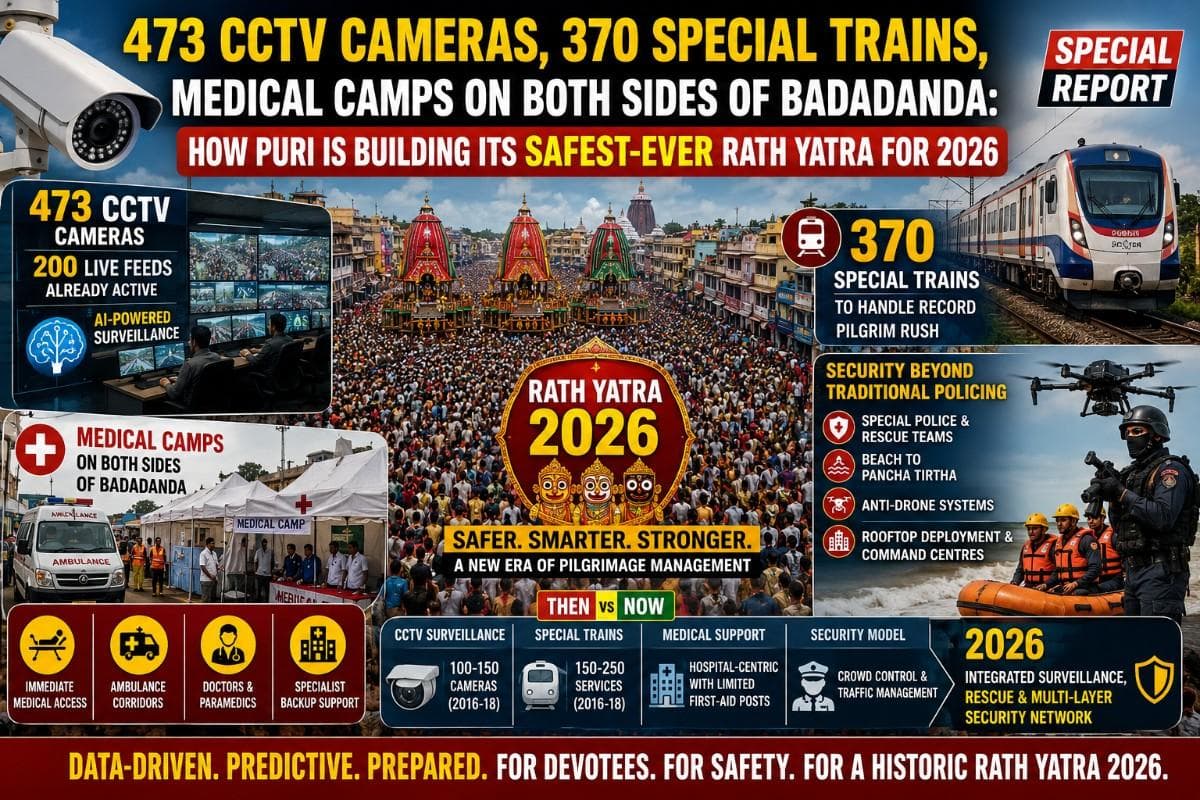
With 473 CCTV cameras, 370 special trains, temporary medical camps lining both sides of the Grand Road, and dedicated rescue teams covering the entire stretch from the Puri beach to the Pancha Tirtha, the state's preparations reflect a dramatic shift in how one of the world's largest religious congregations is managed.
The numbers tell a larger story: Puri's Rath Yatra management has undergone a transformation from a largely reactive crowd-control exercise a decade ago into a data-driven, predictive and technology-backed operation.

📱 Get Argus News App
✨The CCTV Revolution
Among the most striking features of the 2026 plan is the surveillance network.
Officials informed the coordination meeting that 473 CCTV cameras will be operational during the festival, with live feeds already activated for 200 cameras.
The situation changed significantly over the past two years (2024-25) as AI-enabled surveillance systems began entering the festival management framework.
By 2025, authorities had expanded coverage to around 275 intelligent cameras capable of monitoring crowd density, detecting abnormal movement patterns and identifying bottlenecks.
The jump to 473 cameras in 2026 effectively creates a city-wide monitoring grid capable of tracking crowd behaviour in real time.
The significance here is, rather, than merely recording incidents, the system is increasingly designed to anticipate them.
Medical Care Moves Closer to Devotees
Healthcare preparedness has undergone an equally significant evolution.
Historically, medical support during Rath Yatra centred around Puri District Headquarters Hospital, a limited number of first-aid centres and volunteer organisations.
The challenge was simple: once the chariots entered Badadanda and millions of devotees packed the corridor, reaching patients often became difficult.
The 2026 strategy directly addresses this problem.
How this addresses?
Temporary medical camps will be established on both sides of the Grand Road, ensuring healthcare facilities remain accessible even when crowd movement becomes restricted by the chariot procession.
The bilateral deployment model means emergency care can reach patients locally without requiring movement across densely packed sections of the festival route.
The arrangement complements broader emergency systems developed in recent years, including ambulance corridors, expanded paramedic deployment and specialist backup support from tertiary healthcare institutions.
370 Special Trains Reflect Growing Pilgrim Pressure
Transport management remains one of the biggest logistical challenges for Rath Yatra.
To handle the expected surge of pilgrims, Indian Railways will operate 370 special trains during the festival period.
The number is significant.
For much of the past decade, special train operations generally ranged between 150 and 250 services depending on expected footfall.
Even during some of the largest recent pilgrim rushes, special train deployment typically remained below 320 services.
The planned operation of 370 trains signals authorities' expectation of exceptionally high attendance while also reflecting improvements in railway coordination and passenger-flow management.
The objective is clear: reduce congestion at Puri station while improving the speed of pilgrim dispersal after major rituals.
Security Expands Beyond Traditional Policing
Perhaps the most important change is philosophical.
Ten years ago, Rath Yatra security largely focused on crowd control, traffic regulation and petty crime prevention.
Today's security architecture is far more complex.
The deployment of special police teams and rescue units from the beach to the Pancha Tirtha demonstrates how authorities now view the festival as a multi-dimensional risk-management exercise.
The security perimeter extends beyond the chariot route itself to encompass pilgrimage circuits, water bodies, coastal zones and congregation points across the city.
In recent years, Odisha has also incorporated technologies and specialised capabilities that were virtually absent a decade ago, including anti-drone monitoring systems, advanced command-and-control centres, rooftop tactical deployments and disaster-response drills involving specialised agencies.
The emphasis is no longer merely on responding to emergencies but preventing them before they occur.
From Reactive Administration to Predictive Management
The comparison between then and now highlights the scale of transformation.
|
Management Area |
Around 2016-18 |
Rath Yatra 2026 |
|
CCTV Surveillance |
100-150 standard cameras |
473 cameras, 200 live feeds active |
|
Special Trains |
150-250 services |
370 special trains |
|
Medical Support |
Hospital-centric with limited first-aid posts |
Medical camps on both sides of Badadanda |
|
Security Model |
Crowd control and traffic management |
Integrated surveillance, rescue and multi-layer security network |
The emerging picture is that Odisha is no longer preparing for Rath Yatra as a single-day crowd event.
Instead, the administration is managing it as a large-scale urban operation involving transportation, healthcare, surveillance, disaster response and real-time intelligence systems operating simultaneously.
If
executed as planned,
Rath Yatra 2026 could mark a defining moment in the evolution of
pilgrimage management in India – where technology, logistics and public safety
converge to handle one of the world's largest annual religious gatherings.
Also Read: NIUA's ‘Functional Urban Settlements’ Formula Could Transform Odisha: Check How Your Village May Soon Get City-Like Facilities| Exclusive
Related Topics
Explore more stories