




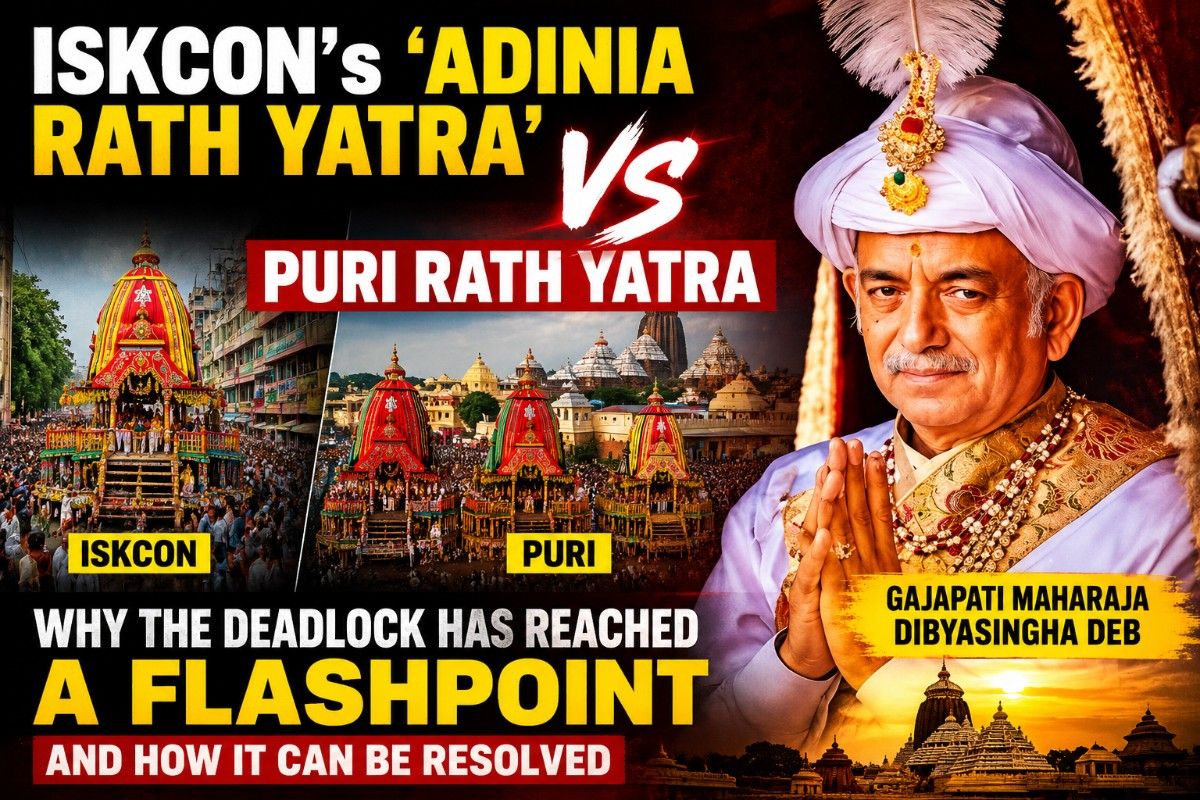
ISKCON's 'Adinia Rath Yatra' vs Puri Rath Yatra: Why the Deadlock Has Reached a Flashpoint and How It Can Be Resolved| Special Report
Key Points
* Current Flashpoint: The dispute has escalated into a major institutional standoff following ISKCON's formal refusal to reopen dialogue with Gajapati Maharaja Dibyasingha Deb, just days before the traditional festival begins.
*Resolution Framework: Experts and the Odisha Forum suggest potential pathways to a resolution, including seeking UNESCO Intangible Cultural Heritage status for Puri, diplomatic intervention by the MEA, or rebranding off-season processions under a distinct global nomenclature.
Bhubaneswar: Barely days remain before the sacred wheels of Lord Jagannath's Rath Yatra roll out of the 12th-century shrine in Puri on July 16, yet a theological dispute that has simmered for nearly six decades has now reached its most delicate and emotionally charged phase.
ISKCON's formal refusal to reopen dialogue with Puri Gajapati Maharaja Dibyasingha Deb, revered as the Adyasevaka (first servitor) of Lord Jagannath, was seen as a sort of defiance to Adyasevaka of Lord Jagannath. Moreover, it has now transformed what was once an internal doctrinal disagreement into a wider debate over the preservation of Sanatana Dharma's oldest living traditions.
At stake is not merely the date of a festival, but the authority of the original Jagannath tradition, the divine ordainments guided by scriptures, and also the universality of Srila Prabhupada's missionary vision, and whether India's highest constitutional offices may yet help bridge two institutions devoted to the same Lord at divergence.
The Genesis: Why ISKCON's Rath Yatra Travels Beyond the Sacred Tithi
To understand today's deadlock, one must return to 1967, when A.C. Bhaktivedanta Swami Srila Prabhupada introduced Lord Jagannath's Rath Yatra to the streets of San Francisco.
It was the first public Jagannath procession outside India. Unlike Puri, however, it was not held on Ashadha Shukla Dwitiya, the scripturally ordained day of Rath Yatra. Instead, it was organised on a date determined by civic permissions, public participation and logistical feasibility.
ISKCON claims, this was not a departure from devotion but an application of an ancient Vaishnava principle – Desh, Kala and Patra (place, time and circumstance). Srila Prabhupada believed that spreading Krishna consciousness globally sometimes required adapting external circumstances while preserving the essence of bhakti.
That precedent gradually became institutional practice.
As ISKCON expanded across North America, Europe, Australia, Russia and South America, Rath Yatras increasingly came to be held on weekends, during summer holidays or on dates approved by municipal authorities rather than strictly following the lunar calendar observed in Puri.
Today, hundreds of ISKCON centres organise Rath Yatras across the globe under this framework, making the San Francisco precedent the ideological cornerstone of the movement's global outreach.
Why Prabhupada Chose Adaptation Over Literal Replication
ISCKON claims that Srila Prabhupada's objective was never to recreate Puri in every city.
His larger vision was to ensure that Lord Jagannath reached those who could never undertake a pilgrimage to Odisha.
Unlike Puri, where only Hindus may enter the sanctum, ISKCON's public Rath Yatras bring Lord Jagannath into city streets, allowing millions – irrespective of nationality, religion or race – to have darshan.
ISCKON literature shows its founder Prabhupada considers that the chariot itself became a vehicle of compassion.
It also reasons that holding the festival on a weekend, when thousands could participate, was viewed as spiritually more meaningful than conducting it on the precise tithi before empty roads because local authorities denied permissions.
Municipal regulations in cities such as London, New York, Moscow or Sydney often require parade permissions nearly a year in advance, with road closures generally approved only on weekends. Extreme climatic conditions in several countries also make strict adherence to the lunar calendar impractical, asserts the ISCKON sources.
Thus, ISKCON considers the altered schedule not as rejection of tradition but as an extension of Jagannath's universal mercy.
This theological reasoning continues to guide the Governing Body Commission (GBC), which recently reiterated that while Indian ISKCON temples now generally follow Puri's calendar, overseas chapters cannot uniformly do so because of practical constraints.
Why Puri Considers the Tithi Non-Negotiable
The position of Puri rests on an entirely different theological foundation.
For the Jagannath Temple, Snana Purnima and Rath Yatra are not commemorative festivals but divinely ordained rituals rooted in the Skanda Purana's Purushottama Kshetra Mahatmya, centuries of temple tradition and an uninterrupted ritual lineage.
According to the scriptures, Snana Purnima, observed on the full moon day of Jyestha, marks the ceremonial appearance day of Lord Jagannath following His installation by King Indradyumna. On this sacred day, the deities receive the grand ceremonial bath with 108 pots of sanctified water, initiating a sequence of rituals culminating in Rath Yatra.
The subsequent observances – including Anasara, Nava Jaubana Darshan, Netrotsava, and finally Rath Yatra on Ashadha Shukla Dwitiya – form one continuous divine cycle.
For the custodians of Puri, these are not dates chosen by tradition but expressions of divine will.
Changing them for administrative convenience would, in their understanding, alter the cosmic order prescribed in the scriptures.

📱 Get Argus News App
✨The Gajapati Maharaja, the Mukti Mandap scholars and Govardhan Peeth have therefore consistently argued that while cultural adaptations are understandable, the names Snana Yatra and Rath Yatra, intrinsically linked to these sacred tithis, cannot be detached from their scriptural calendar without diluting their original sanctity.
To them, the issue is not organisational autonomy but preservation of the Moola Peetha – the original seat of Lord Jagannath worship.
From Theological Difference to Institutional Flashpoint
The disagreement has steadily intensified over the years.
The first objections from Puri reportedly emerged in the 1980s.
Subsequent resolutions by the Shree Jagannath Temple Administration urged ISKCON to synchronise overseas Rath Yatras with the traditional calendar.
A significant breakthrough came in 2025, when ISKCON agreed that temples within India would organise Rath Yatras only within the traditional nine-day window observed in Puri.
However, the exemption for overseas centres remained.
The latest flashpoint began when Gajapati Maharaja Dibyasingha Deb wrote to President Droupadi Murmu and Prime Minister Narendra Modi, seeking intervention to preserve the sanctity of the original Jagannath traditions globally.
A fresh appeal was also sent to ISKCON's Mayapur headquarters requesting dialogue.
But just days before this year's Rath Yatra, GBC Chairman Madhusevita Dasa politely declined further discussions, stating that the organisation had already conveyed its position and considered the matter closed.
That response has been perceived by Jagannath devotees and ambassadors of Jagannath culture as a deadlock and defiance to Sanatana Dharma’s traditional practice.
Odisha Forum's UNESCO Pitch: Protecting the Original
Amid the impasse, the issue has acquired a new international dimension.
Representatives of the Odisha Forum recently met President Droupadi Murmu, urging the Union Government to seek UNESCO Representative List of the Intangible Cultural Heritage of Humanity status for the original Puri Rath Yatra.
The demand holds a probable solution to the standoff.
The UNESCO recognition would formally establish the Puri Rath Yatra – with its scripturally prescribed tithis, rituals and uninterrupted tradition –as the globally acknowledged original heritage framework.
Such recognition then would strengthen India's cultural diplomacy and distinguish the original festival from later adaptations organised elsewhere.
While UNESCO recognition would not legally prevent ISKCON from conducting overseas Rath Yatras, it could provide moral and cultural recognition to the Puri tradition as the authentic source, and can be prevailed upon foreign civic authorities to grant permission to ISCKON to hold the ancient traditional festivals on the same thitis.
Can the Deadlock Be Resolved?
In pure legal terms, neither the President nor the Prime Minister can direct a religious institution to alter its rituals, particularly outside India.
Yet both offices possess considerable moral influence to make this happen.
Several pathways have emerged:
- Institutional dialogue between the Puri Gajapati and ISKCON's global leadership.
- Cultural mediation facilitated through constitutional offices.
- Diplomatic engagement by the Ministry of External Affairs with overseas Indian missions. (especially in the US, UK, and Russia) to work with local municipal corporations.
- Indian consulates can quietly communicate to local Western governments that certain proposed dates for public processions run contrary to established Indian cultural calendars, subtly influencing local permit approvals.
- UNESCO recognition of the original Puri Rath Yatra.
- Development of a distinct global nomenclature for off-calendar processions while preserving the scriptural identity of Puri's Rath Yatra.
These approaches may bring an end to the six decade old row between ISCKON and Jagannath Puri.
After all, both institutions proclaim devotion to Lord Jagannath; the disagreement concerns the manner of observance, not the object of worship.
Bottom Line
The current impasse now has acquired the status of a contest between mission and tradition and Odisha and ISKCON.
While one traced its authority to Srila Prabhupada's missionary vision of taking Jagannath to the world through adaptation, the other draws legitimacy from millennia-old scriptural injunctions, where every ritual – from Snana Purnima to Rath Yatra – is inseparably bound to sacred tithis and the ritual sovereignty of Puri, the original abode of Lord Jagannath.
How this decades-old divergence finally finds common ground depend more on mutual accommodation – one that honours both Prabhupada's global spiritual mission without transgressing Puri's timeless ritual tradition.
If the moral
authority of the President, the persuasive influence of the Prime Minister
Office, and the goodwill of both institutions and MEA converge, a curtain could
well be seen soon over the six decade old confrontation —ensuring that the Lord
who is worshipped as the Jagatara Nath, the Lord of the Universe,
continues to unite rather than divide.
Also Read: Puri Rath Yatra 2026: India’s First ‘Asset-Based Mobile Command’ Puts Top Officials on Chariot Wheels| Exclusive
Related Topics
Explore more stories