



Special Report| Rath Yatra 2027: CS Anu Garg scripts history with 8.5-month buffer, but misses Marichikote Chhak lessons
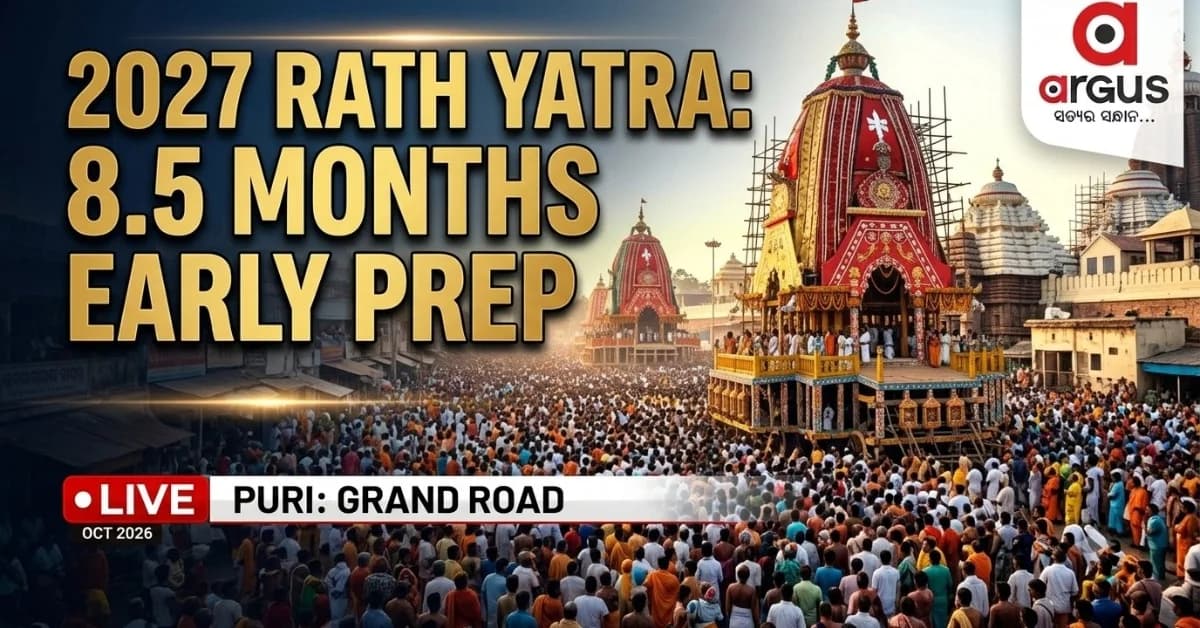
Key Points
- Historic Timeline: Chief Secretary Anu Garg shatters Odisha’s traditional four-month governance rulebook by launching the 2027 Rath Yatra preparations an unprecedented 8.5 months early.
- The Strategy Gap: The newly minted administrative blueprint aggressively expands physical infrastructure and high-tech surveillance but completely omits dynamic ground-level crowd control protocols.
- Marichikote Blindspot: Despite the fatal 2026 stampede-like compression at Marichikote Chhak, the 2027 agenda fails to incorporate vital expert recommendations like batch-wise releases or temporary holding gates.
Bhubaneswar: Scripting an unprecedented milestone in the administrative history of Odisha, the State for the first time in history has held its first preparatory meet for 2027 Rath Yatra – 8.5-months vis-à-vis the normal trend of 4 months ahead of Rath Yatra.
By convening the inaugural state-level preparatory meeting in October 2026 for a festival slated for July 2027, Chief Secretary Anu Garg has shattered the traditional, reactive governance timelines of the state.
Yet, beneath this masterstroke of early mobilization lies a glaring, uncomfortable paradox: the grand blueprint for 2027 remains heavily anchored in concrete, cables, and cameras, while completely bypassing the critical crowd-dynamics lessons of the tragic 2026 Marichikote Chhak stampede.
Breaking the Four-Month Myth – How CS Anu Garg Scripted a New Trend

📱 Get Argus News App
✨For decades, the administrative machinery of Odisha adhered to an unwritten rulebook.
High-level coordination meetings for the Rath Yatra – the world's largest moving religious congregation – were traditionally squeezed into a standard four-month window prior to the festival. It was a timeline built for a simpler era, one where crowd numbers were predictable and urban constraints were less acute.
However, the consecutive tragedies of recent years proved that the old timeline was no longer viable.
The 2025 Rath Yatra, which saw a standard two-month preparation crunch, suffered a devastating crowd surge near the Gundicha Temple that claimed three innocent lives.
Recognizing the crisis, the administration pushed the 2026 preparations to January of that year – a six-month buffer designed to absorb the lapses of the past. Yet, even that early window failed to prevent the horrific crowd compression at Marichikote Chhak in July 2026.
Faced with structural vulnerabilities that simple seasonal fixes could not solve, Chief Secretary Anu Garg decided to completely rewrite the state's administrative calendar.
By taking the wheel on October 22, 2026, Garg initiated the earliest-ever preparatory assembly in the history of the festival -a massive 8.5 months before the chariots roll on July 5, 2027. This move is not merely a calendar adjustment; it is a strategic shift aimed at transforming Rath Yatra management from crisis response to long-term engineering.
Garg’s new trend forces line departments to abandon the chaotic "tender rushes" of late spring.
By ordering the Public Works Department (PWD), the Housing and Urban Development Department, and energy utilities to submit actionable proposals before the winter sets in, the Chief Secretary has effectively decoupled long-term urban overhauls from the immediate pressure of the festival.
Major interventions – such as the completion of Phase II of the Integrated Control and Command Centre (ICCC) by March 2027, the permanent relocation of the District Headquarters Hospital, and the creation of multi-level parking zones – are now being executed as structured municipal projects rather than panicked, last-minute infrastructure patches.
This proactive window has also allowed the state to seamlessly synchronize with federal projects.
The announcement that the state-of-the-art redevelopment of the Puri Railway Station will be completed well in advance for a prime ministerial inauguration is a direct result of this extended runway.
CS Anu Garg has successfully established a new standard for mega-event governance in India: one where time is weaponized as an asset, not feared as a constraint.
Chasm Between Surveillance and Strategy – The Missing Chhak Lessons
Despite the administrative brilliance of starting 8.5 months early, a critical analysis of the official agenda reveals a deep, systemic disconnect.
The 2026 tragedy at Marichikote Chhak proved that the primary threat to pilgrims is no longer an infrastructure deficit or a lack of eyes on the ground; it is a failure of dynamic crowd management.
During the 2026 festival, the Grand Road was equipped with a dense web of AI-enabled cameras, drone fleets, and 26 designated safe zones.
Yet, when the heavy wooden chariots ground to a halt, the moving sea of humanity behind them kept surging forward. Marichikote Chhak, a historical bottleneck compressed by ancient structures and narrow intersecting lanes, became a lethal pressure cooker.
Digital screens flashed warnings at the central command center, but ground personnel lacked the structural mechanisms to immediately halt the influx or open lateral release valves. The result was fatal crowd compression and asphyxiation.
When we place the decisions of the newly minted October 2026 meeting against the stark realities of the 2026 failure, the gaps are highly concerning.
The administration appears to be treating a failure of human crowd dynamics as a failure of technology, doubling down on the very surveillance tools that failed to save a life just three months ago.
The table below highlights what this historic first meeting completely missed regarding the Marichikote Chhak lessons:
Puri Rath Yatra Crowd Management: Gap Analysis
1. Real-Time Ground Intervention
- 2026 Pitfall: AI cameras detected dangerous density at Marichikote Chhak, but ground police failed to physically halt crowd inflow.
- 2027 Admin Action: Rushing ICCC Phase II completion by March 2027 to monitor crowds, traffic, and fire safety.
- Status: MISSED — Doubles down on passive surveillance. More screens do not fix the lack of ground enforcement protocols to act on digital alerts.
2. Geographical Choke Points
- 2026 Pitfall: Grand Road narrows naturally at Marichikote due to historic structures, street vendors, and converging side alleys.
- 2027 Admin Action: Puri District Collector directed to launch anti-encroachment drives to clear vendors and upgrade side lanes.
- Status: PARTIALLY ADDRESSED — Clearing vendors removes main-road obstructions, but upgrading side alleys without access restrictions could channel more crowds into the bottleneck.
3. Inflow Control & Staggering
- 2026 Pitfall: Continuous streams of devotees marched forward without being held or released in managed batch intervals.
- 2027 Admin Action: Broad directives issued for early crowd control protocols and early police mobilization.
- Status: MISSED — Lacks concrete structural crowd-engineering tools like temporary holding gates or strict batch-release mechanisms.
4. Utilization of Safe Zones
- 2026 Pitfall: The 26 "Safe Zones" along Grand Road remained passive spaces instead of active holding/staggering points.
- 2027 Admin Action: Developing multi-level parking, dedicated LMV zones, and major bus terminals.
- Status: MISSED — Parking upgrades only manage peripheral city transit, completely ignoring dynamic holding zones along the actual procession path.
5. Chariot & Crowd Synchronization
- 2026 Pitfall: When chariots halted, pedestrian flow continued forward, creating severe compression from behind.
- 2027 Admin Action: Real-time monitoring of traffic, public transport, and weather through the upgraded command center.
- Status: MISSED — No protocol established to synchronize pedestrian movement with real-time chariot stops and movements.
6. Emergency Lateral Escape Routes
- 2026 Pitfall: Narrow side lanes at Marichikote were obstructed, blocking emergency pressure-release corridors.
- 2027 Admin Action: Early identification and training of volunteer groups and stretcher-bearers for patient movement.
- Status: PARTIALLY ADDRESSED — Medical training helps post-incident response, but misses the preventative need to keep lateral escape routes clear for crowd decompression.
The Real Story
The contrast between the two halves of the administration’s strategy is stark. On one hand, the state has shown exemplary foresight by creating a massive medical safety net for 2027. Operating a new permanent hospital at the Malatipatpur Bus Stand, transitioning the Puri District Headquarters Hospital into a modernized building with dedicated green corridors, and training stretcher-bearers months in advance are deeply compassionate, necessary steps.
Similarly, the decision to erect 25 permanent telecom towers to prevent cellular drops means that devotees will not lose communication during a crisis. The installation of massive public announcement systems and LED screens at transit points reflects an understanding of the need for information dissemination.
Yet, when you look at the core of the meeting's agenda, the empty space where crowd policy should be speaks volumes.
By dedicating the inaugural meeting almost exclusively to civil construction, anti-encroachment drives, utility management, and the expansion of surveillance infrastructure, the state has revealed its comfort zone. It is far easier to build a new hospital, pave a road, or install an AI camera than it is to fundamentally restructure crowd control protocols, train thousands of police personnel in dynamic crowd dynamics, and enforce strict, unpopular density limits on an emotional, faith-driven crowd.
Even though this has only been the first preparatory meet of the season, the menu not having the policy lacunae tells a clear tale. It tells a tale of an administration that focuses big on the logistics of time and infrastructure, but glosses over to confront the complex, human realities of crowd behavior.
An early start is a
magnificent asset, but it is ultimately just a canvas. If the state spends the
next eight months merely building bigger structures and buying smarter cameras,
without fundamentally altering the operational physics of how crowds move along
the Grand Road, the ghosts of Marichikote Chhak will continue to hover over the
holy town.
Also Read: Puri Rath Yatra 2026: Why AI, Drones and 26 Safe Zones Could Not Prevent a Stampede like Situation at Marichikote Chhak | Special Report
Related Topics
Explore more stories