



Puri Rath Yatra 2026: Why AI, Drones and 26 Safe Zones Could Not Prevent a Stampede like Situation at Marichikote Chhak | Special Report
Key Points
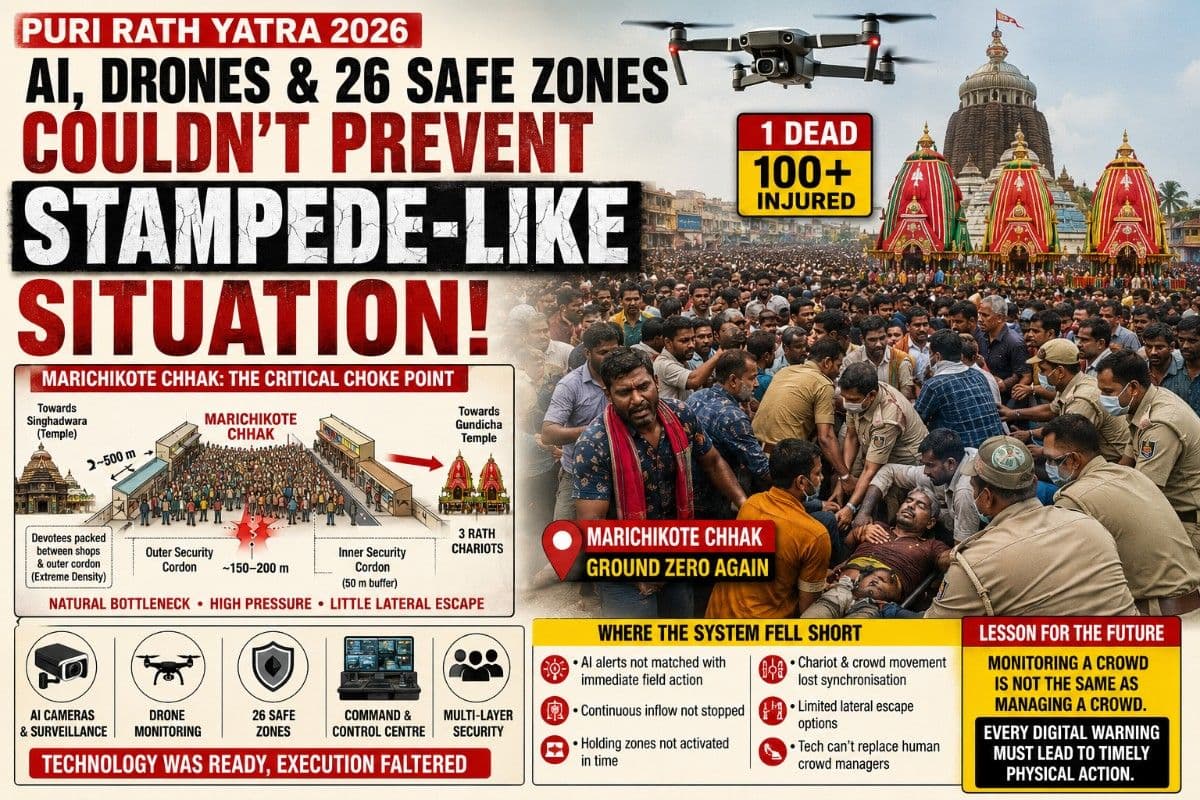
The Technology Gap: While AI and drones provided real-time density data, the tragedy highlights a critical failure in translating digital warnings into immediate physical crowd control interventions.
The Bottleneck Reality: Marichikote Chhak, a historically identified high-risk zone, became a deadly pressure cooker due to continuous inflow and lack of synchronized movement during chariot halts.
Beyond Surveillance: Experts argue that for future events, the administration must move beyond passive monitoring and adopt dynamic, sector-wise crowd management models to prevent dangerous compression.
Bhubaneswar/Puri: Twenty-six safe zones along the entire 3-km Grand Road. Hundreds of AI-enabled cameras. Drone surveillance feeding real-time crowd density data to an Integrated Command and Control Centre. Multi-layer security cordons, dedicated emergency corridors and one of the most technology-intensive crowd management plans ever attempted during the Puri Rath Yatra.
Yet, despite this elaborate safety architecture, the 2026 Rath Yatra could not remain incident-free.
A stampede-like situation at Marichikote Chhak claimed the life of one devotee, reportedly due to asphyxiation, while more than 100 others sustained injuries or were hospitalised, according to the latest official and hospital reports. The tragedy has once again exposed the difference between monitoring a crowd and managing a crowd.
Ground Zero: Understanding Marichikote Chhak

📱 Get Argus News App
✨Situated roughly midway (around 500 mts) along the Grand Road between the Shree Jagannath Temple and the chariots during the initial phase of the procession, the junction has long been recognised as one of the most vulnerable pressure points of the Rath Yatra.
Although the Grand Road appears broad, the effective pedestrian movement narrows around the intersection because of adjoining commercial establishments, historic structures and converging side lanes.
The result
is a natural bottleneck where moving devotees often encounter stationary crowds
waiting for darshan. History shows that this stretch has repeatedly emerged as
a high-risk zone whenever crowd density rises beyond manageable levels. (See
the graphic image below)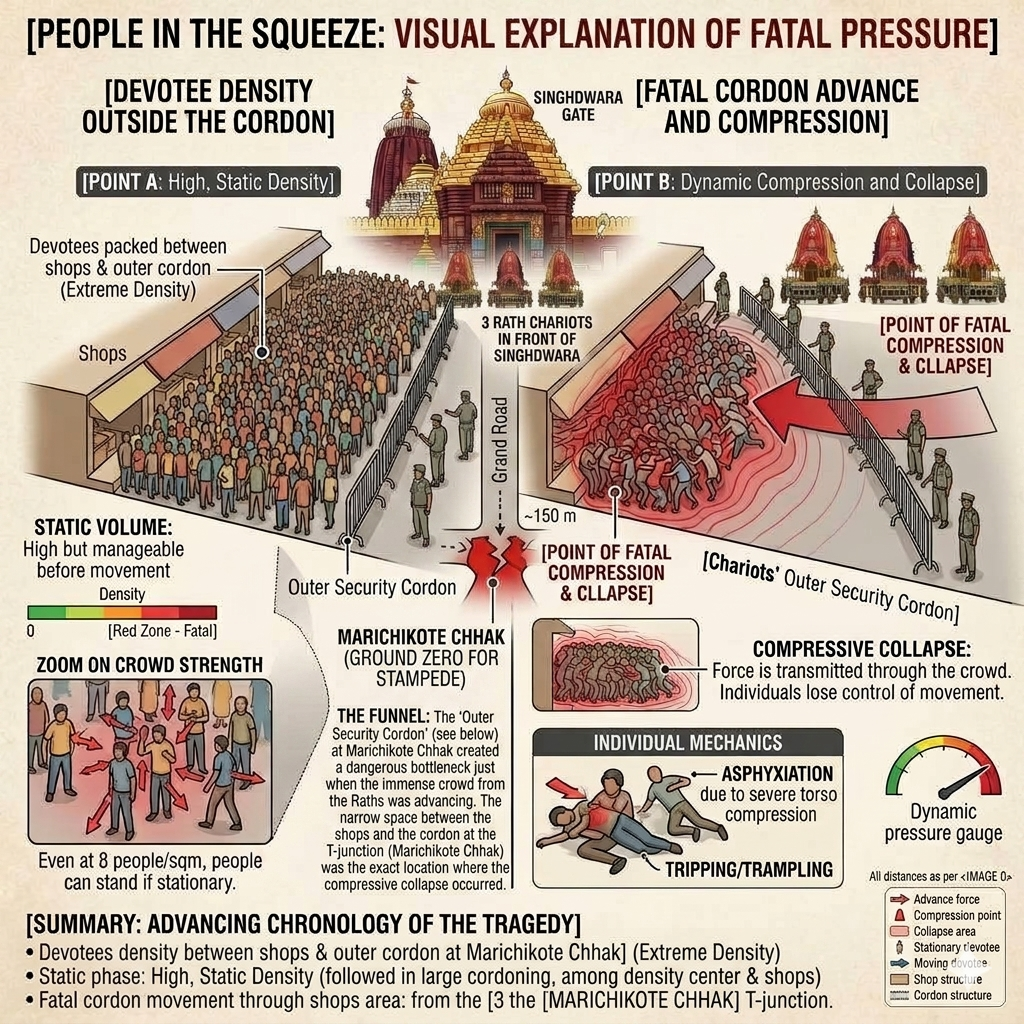
Why is Marichikote Chhak so vulnerable?
Although the Grand Road is nearly 75 metres wide, Marichikote Chhak functions as a geographical choke point because:
- Historic buildings and monasteries compress pedestrian movement.
- Several narrow lanes merge with the Grand Road here.
- Devotees arriving from Singhadwara meet people who have already stopped for darshan.
- Crowd movement slows whenever the chariots halt ahead.
- Pressure builds from both the front and the rear, leaving little room for lateral dispersal.
Crowd engineers describe such locations as "high-pressure convergence zones", where even a minor disruption can trigger dangerous crowd compression.
Rath Yatra Stampede History (1993–2026)
|
Year |
Deaths |
Location |
Immediate Trigger |
|
1993 |
1 |
Near Singhadwara |
Crowd surge during darshan |
|
2008 |
6 |
Singhadwara during Pahandi |
Massive rush during idol procession |
|
2014 |
2 |
Grand Road near chariots |
Crowd crush near moving chariots |
|
2015 (Nabakalebara) |
2 |
Marichikote Chhak |
Counter-flow, overcrowding and trampling |
|
2025 |
3 |
Near Gundicha Temple |
Heavy rush during darshan |
|
2026 |
1* |
Marichikote Chhak |
Stampede-like crowd compression and asphyxiation |
*Latest official reports at the time of writing indicate one confirmed death. Investigation is continuing.
Key takeaway: Of the six major crowd-crush incidents during the past five decades, Marichikote Chhak has figured twice as the primary ground zero, highlighting its status as one of the Rath Yatra's most vulnerable locations
The Big Question: If Administration Knew the Vulnerable Point, Why Did the Tragedy Occur?
Marichikote Chhak has never been an unknown danger spot.
It has featured in previous crowd management reviews.
It has witnessed a fatal incident before.
It has consistently been identified as one of the highest-density zones during the Rath Yatra.
That naturally raises a difficult but legitimate question:
If the administration already knew this junction was vulnerable, could this tragedy have been prevented?
While the answer will emerge only after an official inquiry, crowd-management experts generally agree that tragedies at identified bottlenecks are often preventable through timely regulation of crowd density rather than post-facto emergency response.
Where the Safety Architecture Appears to Have Fallen Short
Technology was available.
The challenge lay in translating technology into immediate action.
The apparent gaps include:
1. AI Detected Density, But Physical Intervention Lagged
- AI cameras and drones can identify overcrowding.
- They cannot disperse a crowd.
- Ground personnel must immediately regulate inflow once danger thresholds are crossed.
2. Continuous Inflow Was Not Interrupted
Crowd management SOPs generally recommend:
· temporarily stopping fresh inflow
· releasing people in batches
· creating breathing space
Instead, continuous inflow appears to have increased pressure at the bottleneck.
3. Dynamic Holding Zones Were Not Activated
Safe zones existed.
But once density rapidly increased, there appears to have been insufficient staggering of incoming crowds before they reached Marichikote Chhak.
4. Chariot Movement and Crowd Movement Lost Synchronisation
Whenever chariots halt,
the crowd naturally stops.
If incoming devotees continue moving,
compression builds rapidly from behind.
Maintaining synchronisation between procession movement and pedestrian flow is therefore critical.
5. Limited Lateral Escape
Marichikote Chhak has several narrow side lanes.
During high-density situations,
these need to function as emergency pressure-release corridors.
If they remain obstructed or inaccessible,
crowd pressure has nowhere to dissipate.
6. Technology Cannot Replace Human Crowd Managers
AI provides information.
Police create movement.
Barricades regulate density.
Volunteers calm panic.
Technology succeeds only when each of these works together.
Should Puri Borrow Yogi Adityanath's Mahakumbh Crowd Model?
The latest tragedy is expected to revive discussions on adopting the crowd-management model used during the Mahakumbh in Uttar Pradesh.
However, experts caution against a direct comparison.
|
Mahakumbh |
Puri Rath Yatra |
|
Vast riverfront spread across kilometres |
Single 3-km Grand Road |
|
Multiple bathing ghats |
One linear viewing corridor |
|
Crowd distributed across many locations |
Millions converge on one moving procession |
|
Large holding zones possible |
Limited urban space |
Instead of copying the Mahakumbh model, experts suggest adapting its principles to Puri's unique geography through:
- Dynamic sector-wise crowd compartments
- Controlled batch-wise movement
- Temporary holding gates
- AI-triggered diversion plans
- Better utilisation of side lanes as emergency evacuation corridors
- Strict density limits at Marichikote Chhak
The Bottom Line
The 2026 Rath Yatra demonstrated that surveillance technology alone cannot guarantee crowd safety.
The Puri administration had AI, drones, integrated command centres, emergency corridors and an unprecedented technological ecosystem at its disposal.
What the tragedy at Marichikote Chhak appears to underline is that technology must remain an aid – not a substitute – for disciplined crowd management on the ground.
Ultimately, crowd safety depends on maintaining safe density, regulating inflow, ensuring uninterrupted movement and enforcing Standard Operating Procedures in real time.
For one of
the world's largest annual religious congregations, the lessons from
Marichikote Chhak are likely to shape the next generation of Rath Yatra crowd
management. The challenge before the administration is not merely to deploy
more technology, but to ensure that every digital warning translates into
timely physical action before pressure builds into tragedy.
Also Read: Rath Yatra 2026: Why Lord Jagannath's Tahiya Fell During Pahandi Amid Rain; A 50-Year Weather & Tradition Exclusive Analysis
Related Topics
Explore more stories