



Special Report | As Omfed Ghee Prices Hit Puri Mahaprasad in Kartika Month, How Tirupati Stays Immune to Inflation
Key Points
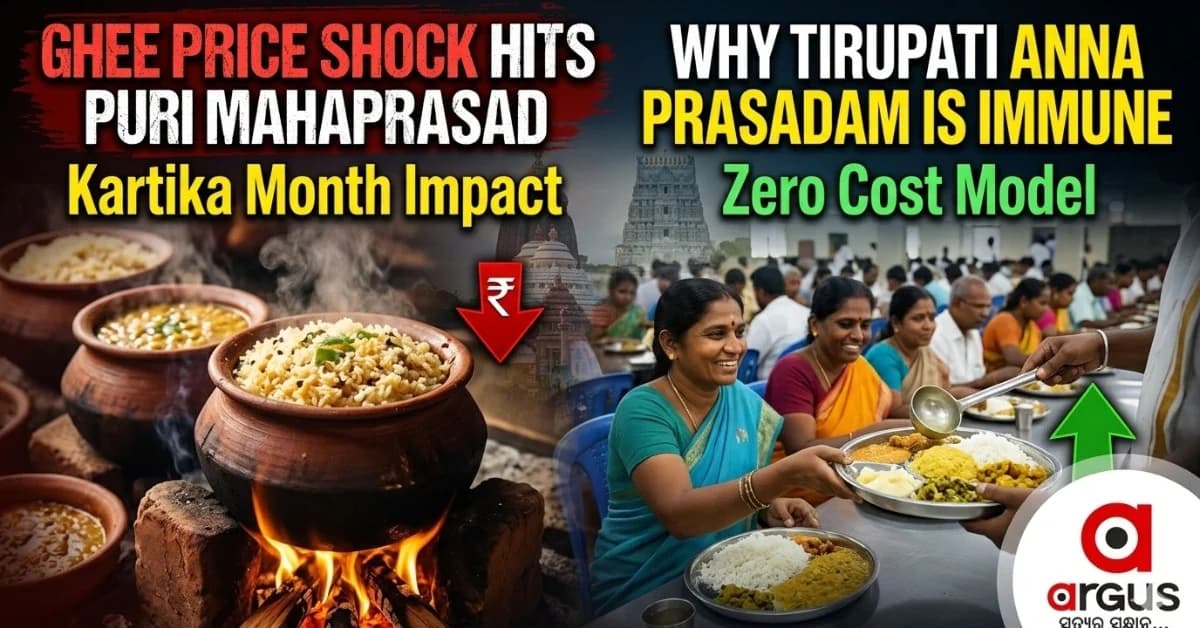
Rising OMFED ghee prices and strict post-2024 purity mandates have sparked a major pricing crisis for Puri’s Mahaprasad ahead of the holy month of Kartika.
Unlike Tirupati's centralized corporate model, Puri's decentralized hereditary servitors and ancient Rosha Ghara are directly exposed to open market inflation.
Emergency negotiations between the SJTA and the Suara Mahasuara Nijog are exploring subsidized ghee depots and the removal of middlemen to protect pilgrims and servitors.
Bhubaneswar: When the holy month of Kartika is hardly a few days away, the inflation seemingly has gripped the scared Puri mahaprasad.
A severe pricing crisis has hit the ancient kitchen of the Shree Jagannath Temple in Puri so hard that the Suara Mahasuara Nijog – huddled into direct emergency negotiations with the Shree Jagannath Temple Administration (SJTA).
While the Suara Nijog attributed the current inflationary wave, largely, to the cost of state-certified OMFED ghee increasing its prices three separate times in rapid succession, as the kartika month all set to roll, thousands of devotees, including vulnerable Habishyali mothers, feel concerned.
However, devotees flocking the Tirumala Tirupati Devastahanam in Andhra Pradesh during the upcoming month of Kartika, stay immune from the inflationary wave hitting Puri Kitchen.

📱 Get Argus News App
✨The Anatomy of the Puri Ghee Crisis
The root of the contemporary price escalation in Puri traces back to late 2024, when the national controversy surrounding the alleged use of animal fats in the Tirupati laddu kitchen triggered a sweeping institutional overhaul of temple food safety across India. In response, the Odisha government and the SJTA implemented a strict purity mandate. All individual, unverified ghee labels previously sourced on the open market by independent cooks were banned overnight. Instead, the temple kitchen was ordered to exclusively use premium, certified dairy fat supplied by the Odisha State Cooperative Milk Producers' Federation (OMFED).
While the mandate guaranteed absolute ritual cleanliness, it fundamentally disrupted the baseline microeconomics of the Rosha Ghara (the world’s largest earthen kitchen). Ghee is not merely a supplementary seasoning in Puri; it is the vital medium used to fry dry delicacies like Khaja and to enrich the massive pots of traditional lentils and rice.
Since that structural transition, OMFED has increased its milk and dairy product retail prices multiple times – most recently enacting back-to-back baseline spikes in mid-2026 and October 2026 to compensate for rising cattle feed costs and farmer procurement adjustments.
With wholesale ghee costs soaring alongside standard market inflation for traditional commodities like Harada dal, local sweet potatoes, and raw firewood, the kitchen servitors reached a breaking point. The baseline cost of preparing a standard Abadha meal ticket has mounted drastically, shifting the price burdens entirely onto incoming pilgrims at the point of sale in Ananda Bazar
Two Spiritual Giants, Two Opposite Economic Realities
To understand why a rise in commercial dairy prices strains Puri while leaving Tirupati relatively unbothered, one must examine the contrasting core systems behind their financial management, labor structure, and culinary engineering.
|
Structural Category |
Puri Jagannath Temple (Mahaprasad / Abadha) |
Tirupati Srivari (Laddu & Anna Prasadam) |
|
Operational & Financial Custody |
Decentralized, hereditary micro-enterprises run privately by the Suara Mahasuara Nijog. |
Centralized, multi-billion-dollar corporate trust management run exclusively by the TTD Board. |
|
Labor & Compensation Model |
Servitors receive no state salary; their family livelihoods depend on the direct profits of Prasad sales. |
Kitchen personnel are salaried institutional employees or dedicated volunteers (Srivari Sevakulu). |
|
Kitchen Infrastructure |
Ancient, non-mechanized Rosha Ghara using exclusively firewood and stacked clay pots. |
Highly automated mega-facilities using steam boilers, stainless-steel vats, and mechanical conveyor belts. |
|
Grocery Sourcing Framework |
Servitors buy raw components directly from the fluctuating open wholesale market. |
TTD utilizes massive long-term bulk institutional procurement and direct multi-million-dollar devotee crop donations. |
|
Consumer Pricing Mechanism |
Fluidly adjusts day-by-day based on real-time operational costs and supply-demand shifts. |
Fixed, locked, and heavily subsidized or completely free via massive trust corpus insulation. |
Why Puri Cannot Adopt the Tirupati Model
The contrasting attributes in the table explain why Puri is systematically vulnerable to market inflation. The barriers preventing Puri from absorbing these costs are deeply rooted in heritage, civil law, and structural finance.
1. Livelihood vs. Corporate Philanthropy
The single greatest differentiator is the nature of the workforce. TTD functions as a centralized corporate bureaucracy. The cooks operating its massive kitchens receive steady monthly paychecks from the trust's massive treasury. The trust intentionally runs the Srivari Laddu distribution at a massive financial loss every single year, covering the deficit through extensive revenue generated by darshan tickets, accommodation, and hair auctions.
In sharp contrast, the Puri kitchen is powered by roughly 500 family lineages of traditional servitors. Under the legally binding Record of Rights (RoR) of the Jagannath Temple Act, these families hold the hereditary, exclusive monopoly over cooking inside the shrine. Because the state does not pay them a baseline salary, the preparation of Mahaprasad is their primary business enterprise. They must put up their own upfront capital to purchase the OMFED ghee, clay pots (kudua), and wood logs. If the price of OMFED ghee jumps, their manufacturing cost spikes instantly. They cannot simply absorb the loss like a corporate entity; they must adjust their consumer prices to keep their families fed.
2. The Scale of the Institutional Cushion
TTD manages an immense annual institutional budget, routinely hovering between ₹3,000 Crore and ₹4,000 Crore. Furthermore, its dedicated Sri Venkateswara Anna Prasadam Trust receives vast streams of individual corpus donations, allowing it to provide free, unlimited, hot satvik lunch and dinner platters to tens of thousands of daily visitors without touching its core capital reserves.
The Puri SJTA operates with a vastly more modest liquid budget. While the deity technically owns tens of thousands of acres of land across Odisha, a substantial percentage of these real estate assets remains tied up in protracted tenancy legal disputes and unauthorized encroachments, yielding very little active rental cash flow. Without an expansive liquid corpus, the administration simply lacks the capacity to purchase thousands of liters of dairy fat daily out of pocket to insulate the public from price shocks.
3. Ritual Law vs. Industrial Automation
Tirupati’s culinary efficiency relies heavily on modern industrial engineering. The use of automated steam infrastructure drastically reduces labor times, limits raw ingredient wastage, and completely removes dependence on volatile fossil fuels like specialized wood blocks.
Puri's Rosha Ghara, however, is a living museum of ancient culinary tradition. By strict religious decree, no modern energy source, metal container, or mechanical automation is permitted past the threshold. Food must be painstakingly slow-cooked over open wood fires inside porous, single-use clay pots stacked on top of one another. This process demands immense physical labor and uses raw materials that are highly susceptible to environmental inflation. Earthenware production and firewood transport have both grown significantly costlier due to local climate regulations and rising labor wages.
The Path Forward: A Unique Puri Solution
Because the free-distribution corporate model of Tirupati is structurally incompatible with Puri's heritage, the SJTA is forced to map out a alternative path. The ongoing discussions between the administration and the Suara Mahasuara Nijog focus on structured market interventions.
Rather than attempting to eliminate the servitors' necessary profit margins, the government is focusing on streamlining the supply chain.
Key initiatives under
evaluation include the establishment of a dedicated subsidized OMFED ghee
depot directly inside the temple compound, which would allow servitors to
buy their vital cooking mediums at controlled, wholesale prices rather than
standard retail rates. Concurrently, the administration is deploying security
personnel to clean out the unauthorized networks of aggressive middlemen
operating inside Ananda Bazar. These steps ensure that while the Sevayats
can comfortably protect their ancient livelihood against macroeconomic
inflation, everyday pilgrims are shielded from exploitative overcharging at the
feet of the Lord.
Also Read: Special Report| Rath Yatra 2027: CS Anu Garg scripts history with 8.5-month buffer, but misses Marichikote Chhak lessons
Related Topics
Explore more stories