



Rath Yatra 2026: President Droupadi Murmu Invokes Lord Jagannath’s ‘Unblinking Eyes’ to Give India a Moral Message on Equality, Service and Leadership | Special
Key Points
The Unblinking Gaze: President Murmu interprets Lord Jagannath’s iconic eyes as a divine symbol of impartial vigilance and unconditional equality for all citizens.
Leadership as Seva: By framing the Presidency as an act of service, she challenges the nation to prioritize humility over the exercise of political power.
Democracy on the Grand Road: Her barefoot walk on Bada Danda serves as a powerful metaphor for dissolving hierarchy and embracing spiritual equality in public life.
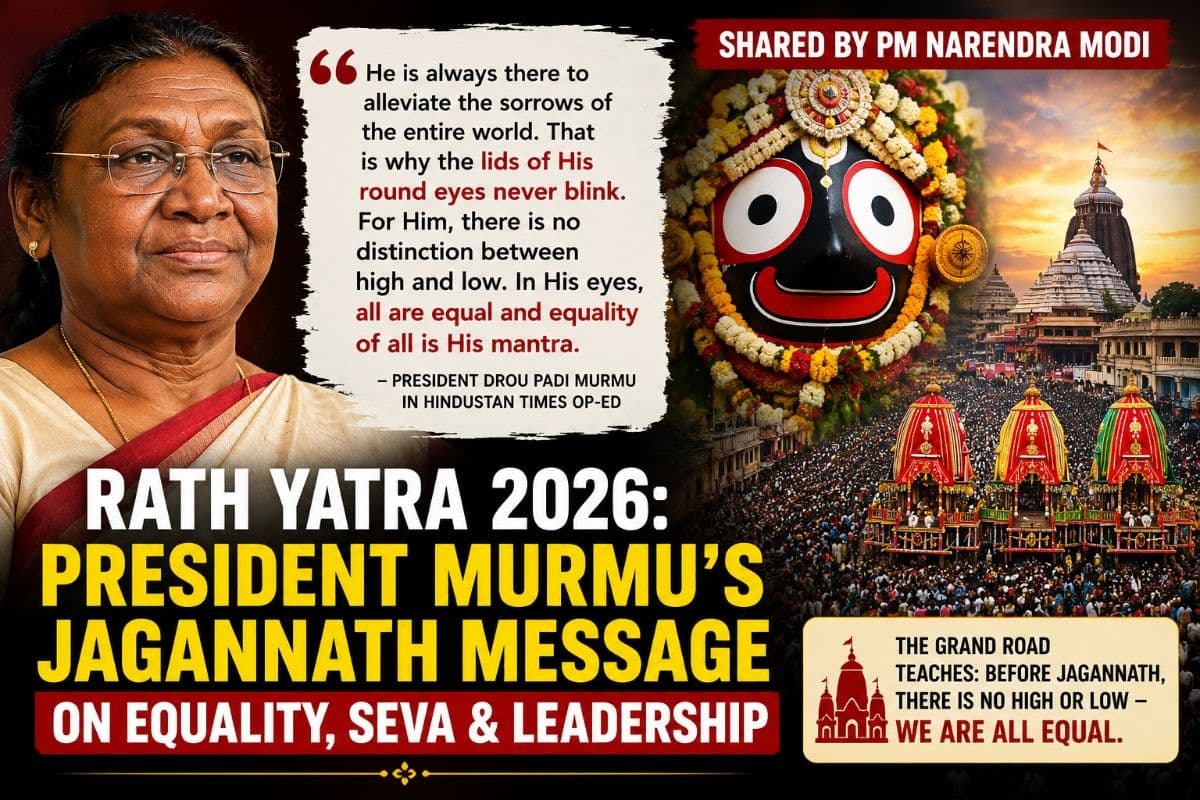
Bhubaneswar: President Droupadi Murmu's deeply personal Hindustan Times op-ed on Lord Jagannath is much more than a devotional reflection timed with Rath Yatra. Shared by Prime Minister Narendra Modi, the article emerges as a moral message to the nation, using the philosophy of Mahaprabhu Jagannath to define what leadership, governance and citizenship should look like in modern India.
Unlike a conventional festival greeting, the President transforms her own life journey – from the tribal village of Uparbeda in Odisha's Mayurbhanj district to Rashtrapati Bhavan – into a civilisational narrative rooted in the values of Jagannath culture. Every milestone of her public life, she writes, was guided by Mahaprabhu's blessings. But it is in the concluding passages of the op-ed that she delivers her most profound message.
The 'Unblinking Eyes' as India's Moral Compass
Perhaps the most striking line in President Murmu's article is her interpretation of Lord Jagannath's iconic large, round eyes.

📱 Get Argus News App
✨"He is always there to alleviate the sorrows of the people of the entire world. That is why the lids of His round eyes never blink. For Him, there is no distinction between high and low. In His eyes, all are equal and equality of all is His mantra."
This is far more than a theological explanation of Jagannath's unique iconography.
The President elevates the deity's unblinking gaze into a constitutional philosophy.
Her interpretation suggests that Jagannath's eyes never close because the Lord never turns away from human suffering. His gaze remains fixed equally upon the rich and the poor, the powerful and the powerless, the privileged and the marginalised. In one sentence, she bridges Odisha's Jagannath philosophy with the constitutional promise of equality before law.
For a President entrusted with safeguarding the Constitution, the symbolism is unmistakable.
The message is directed not merely at devotees but equally at politicians, bureaucrats, public servants and citizens: governance must remain as impartial, compassionate and vigilant as the Lord's unblinking eyes.
Leadership is Seva, Not Power
President Murmu repeatedly portrays herself not as the holder of India's highest constitutional office but as "His daughter."
She recounts praying to Mahaprabhu before filing her nomination papers for the Presidency, seeking guidance before taking oath and attributing every important moment of her constitutional journey to divine grace.
The underlying philosophy is clear.
Power is temporary.
Service is permanent.
By framing her Presidency as an act of seva, she subtly redefines public office as a sacred responsibility rather than an exercise of authority.
In today's political discourse, where leadership is often measured by power and influence, the President reminds the nation that the highest office derives legitimacy from humility and service.
The Barefoot Walk That Broke Protocol
One of the most evocative moments in the article is her recollection of visiting Puri after becoming President in November 2022.
As her motorcade entered the Grand Road, she stopped the convoy, stepped out and walked nearly two kilometres barefoot towards the Jagannath Temple.
She asks a simple yet profound question:
"The Bada Danda belongs to Shree Jagannatha. Is there any protocol required here?"
This is perhaps the strongest symbolic statement in the entire article.
The President consciously places spiritual equality above constitutional hierarchy.
The act dissolves the distance between the country's First Citizen and an ordinary devotee.
It is an affirmation that before Jagannath, every identity – President, minister, bureaucrat or common citizen – disappears.
The Grand Road becomes not merely the route of the Rath Yatra but a metaphor for democratic equality.
Jagannath as India's Social Philosopher
President Murmu also revisits one of Jagannath culture's oldest teachings.
She writes that Mahaprabhu is the protector of the entire world and the refuge of those abandoned by society.
This expands Jagannath beyond a regional deity.
He becomes a universal guardian whose compassion transcends caste, class, language and geography.
By invoking Bhakta Salabega, village prayers, Mahaprasad, Bada Deula, Bada Danda and Mahodadhi, she reconstructs Sri Kshetra not simply as a pilgrimage centre but as a living philosophy of inclusion, which is why it is associated with the ‘Grandness’.
It is this inclusive tradition that has historically drawn saints, poets and devotees from diverse communities into Jagannath's fold.
A Message to Every Citizen
The President's op-ed carries four distinct messages for India.
First, equality is not merely a constitutional principle but a spiritual value rooted in India's civilisational traditions.
Second, humility strengthens leadership rather than diminishing it.
Third, public service should be guided by empathy instead of power.
Finally, resilience grows from faith, values and one's cultural roots.
By narrating her own struggles, personal losses and eventual rise to the Presidency, she demonstrates that devotion is not escapism but a source of inner strength.
The message is especially significant for young Indians and those from disadvantaged backgrounds – that dignity, perseverance and character can overcome structural barriers.
Why PM Modi Sharing the Op-ed Matters
Prime Minister Narendra Modi sharing the President's article lends the reflection wider national significance.
Rather than treating Rath Yatra as merely a religious celebration, the article projects Lord Jagannath's philosophy as a framework for governance and nation-building.
It also reinforces Jagannath's emergence as a national civilisational symbol whose message extends well beyond Odisha.
The Larger Meaning
President Murmu's article is, ultimately, not about her personal faith.
It is about the kind of India she believes Jagannath inspires.
Through the metaphor of the Lord's ever-watchful eyes, she asks the nation to cultivate a society that never looks away from injustice, never discriminates between people and never forgets compassion.
In doing so, she transforms Rath Yatra from an annual religious procession into a reminder that India's greatest spiritual traditions also contain its deepest democratic values.
The
President's message can perhaps be distilled into one enduring thought: if
Jagannath's eyes never blink because they remain fixed on every human being
equally, then the nation's institutions – and its citizens – must strive to
develop the same unwavering commitment to justice, equality and service.
Also Read: Puri Rath Yatra 2026: Why AI, Drones and 26 Safe Zones Could Not Prevent a Stampede like Situation at Marichikote Chhak | Special Report
Related Topics
Explore more stories