



Rath Yatra 2026: Why Lord Jagannath's Tahiya Fell During Pahandi Amid Rain; A 50-Year Weather & Tradition Exclusive Analysis
Key Points
Bhubaneswar/Puri: Pouring skies, drenched devotees – it appeared as if everything, from the mundane mortal world to nature itself, had joined the sacred journey in devotion.
Millions stood soaked under an unrelenting monsoon downpour, their probing eyes fixed on the Singhadwara, waiting for that timeless moment when the Lord of the Universe, with His big, round, sun-and-moon-like eyes, would emerge in the rhythmic sway of the Pahandi, acknowledging the sea of humanity gathered below.
But even as chants of "Jai Jagannath" rose above the sound of incessant rain, devotees noticed something unusual.
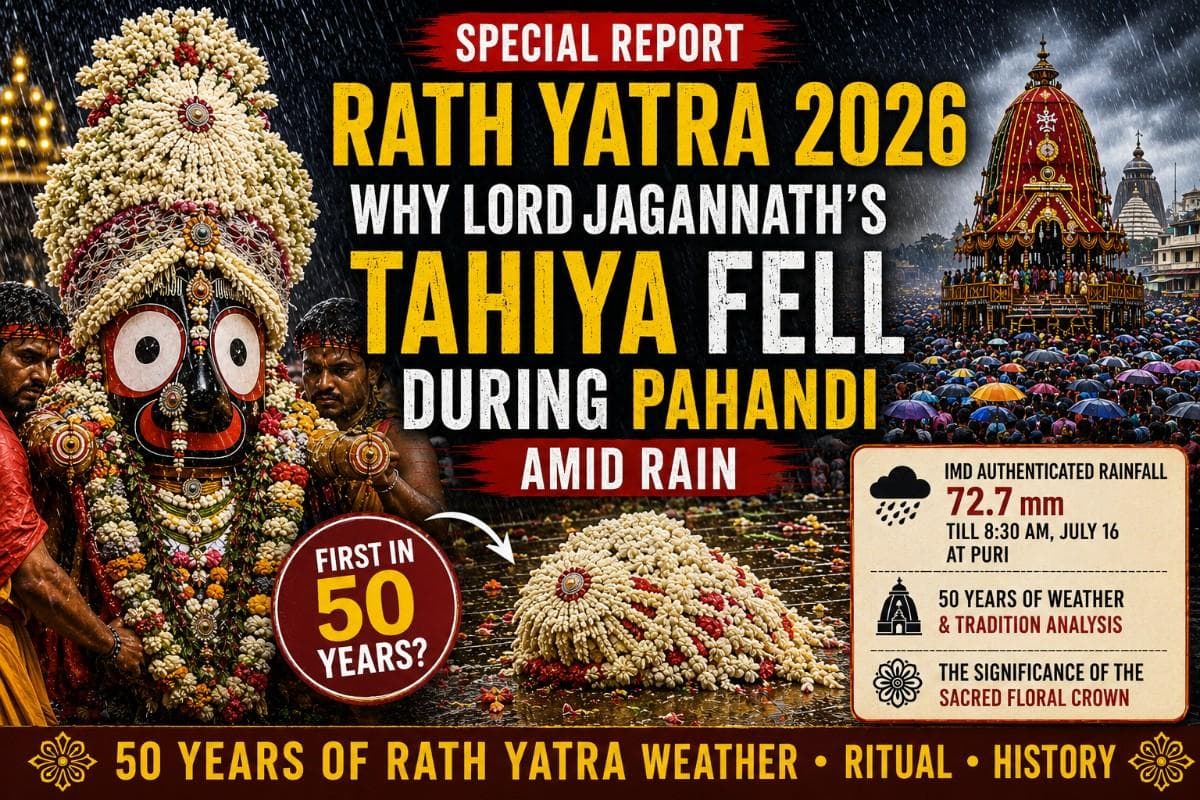
As Lord Jagannath made His way in Pahandi Bije towards His revered chariot, Nandighosa, He did so without the fragrant, bewitching Tahiya – the towering floral headgear that traditionally adorns the deity during the ceremonial procession.

📱 Get Argus News App
✨Reports from the temple suggested that the Lord's Tahiya slipped and fell near the sacred Saptapahacha during the Pahandi Bije. Temple sources attributed the incident to the relentless rain that had lashed Puri since the previous night under the influence of a monsoon low-pressure system.
Heavy rain on Rath Yatra is by no means unprecedented. Over the last five decades, several Rath Yatras have unfolded amid torrential downpours triggered by low-pressure systems, depressions and cyclonic circulations over the Bay of Bengal. However, available documented records from 1976 to 2026 suggest that this is the first reported instance in which Lord Jagannath's Tahiya came off during the forward Pahandi procession from the Srimandir to the chariot.
Rath Yatra Through the Monsoon: The Years of Heavy Downpour
Historical weather records show that the annual chariot festival has repeatedly been tested by severe monsoon conditions.
|
Year |
Meteorological Trigger |
Weather During Rath Yatra
1978
Active monsoon trough
Heavy monsoon downpour
1980
Coastal squalls
Continuous heavy rain
1983
Deep depression
Severe deluge
1986
Active monsoon system
Heavy rainfall
1988
Low-pressure system
Torrential downpour
1991
Monsoon gale
Heavy rain and strong winds
1992
Thunderstorm activity
Blinding afternoon rain
1993
Depression
Waterlogging and heavy rain
1996
Active monsoon
Torrential rain during Nabakalebara
1999
Cyclonic circulation
Continuous heavy rain
2000
Monsoon cloudburst
Waterlogged Grand Road
2002
Coastal squalls
Heavy rain and gusty winds
2007
Rain trough
Persistent rainfall
2011
Active monsoon
Heavy downpour
2012
Cloudburst
Intense rainfall
2015
Monsoon system
Heavy rain during Nabakalebara
2017
Monsoon low
Pre-festival deluge
2018
Depression
Heavy rainfall
2026
Monsoon low-pressure system
Incessant heavy rain; (nearly 72.7m rainfall in last 24 hrs)
Thus, 2026 joins a long list of rain-soaked Rath Yatras. What distinguishes this year is not merely the intensity of the rain, but the reported falling of the Lord's Tahiya during the Pahandi.
The Tahiya: More Than a Floral Crown
The Tahiya occupies a special place in Jagannath tradition. Handcrafted using bamboo, sholapith (Indian cork), flowers and other natural materials, it is prepared through hereditary ritual rights traditionally associated with the Raghab Das Matha.
Adorning Lord Jagannath during the Pahandi, the towering floral headgear moves rhythmically with the deity as the Daitapati servitors carry Him in the characteristic swaying gait. The movement of the Tahiya has long been seen as symbolising the Lord's joyful journey from the sanctum to meet His devotees.
The Tahiya also serves a practical purpose. Its carefully engineered yet lightweight structure cushions the upper portion of the deity during the physically demanding Pahandi over the temple's stone steps and gateways.
Traditionally, the Tahiya remains intact until the Lord is safely seated on the chariot. Thereafter, it is ceremonially dismantled, and fragments are distributed among devotees as sacred mementoes.
Heavy Rain Came Before. The Tahiya Stayed Intact.
Historical documentation of Rath Yatras between 1976 and 2025 indicates that despite numerous festivals witnessing heavy monsoon rain, depressions and cyclonic conditions, the Lord's Tahiya remained intact during the forward Pahandi procession.
Years such as 1978, 1980, 1983, 1986, 1988, 1991, 1993, 1996 (Nabakalebara), 1999, 2000, 2002, 2007, 2011, 2012, 2015 (Nabakalebara), 2017 and 2018 all witnessed heavy rain or monsoon disturbances. Yet available records do not indicate the Tahiya falling during the Lord's journey from the Srimandir to Nandighosa.
The 2026 Rath Yatra, therefore, appears to be the first documented instance in the modern record where the Tahiya reportedly came off during the forward Pahandi, even as the rituals themselves continued uninterrupted in accordance with temple tradition.
The Bottom Line
In Jagannath culture, the Rath Yatra is regarded not merely as a procession but as the unfolding of the Lord's own will. Every ritual – from the Pahandi to the journey from the Srimandir to the Gundicha Temple – is believed to happen according to His divine wish.
If the Lord wills, everything falls perfectly into place. If He wills otherwise, events unfold differently.
The Tahiya itself symbolises humility, devotion and the surrender of the ego before the Lord. Traditionally, after the deity is seated on the chariot, the floral crown is dismantled and shared among devotees, reminding them that all pride must eventually dissolve at the feet of Jagannath.
Seen through
that spiritual lens, the reported falling of the Lord's Tahiya during the
rain-soaked Pahandi of 2026 is not necessarily inkling something bad omen. Rather,
for many devotees steeped in Jagannath philosophy, where every occurrence is
understood as part of the Lord's own Lila, it may simply be interpreted as
another quiet reminder that the Lord of the Universe is not happy and messaging all to embrace
humility, practice devotion and surrender ego.
Also Read: Puri Jagannath Temple Goes Digital Before Rath Yatra: Why ‘Samarpan’ Places Srimandir Among India’s Elite Tech-Enabled Shrines | Special Report
Related Topics
Explore more stories