



'Can We Say Krishna Was Born in a Resort?': SG Tushar Mehta's Sharp Question Reignites Mahaprabhu Jagannath Row | Why Puri King, SJTA Oppose the Animated Film
Key Points
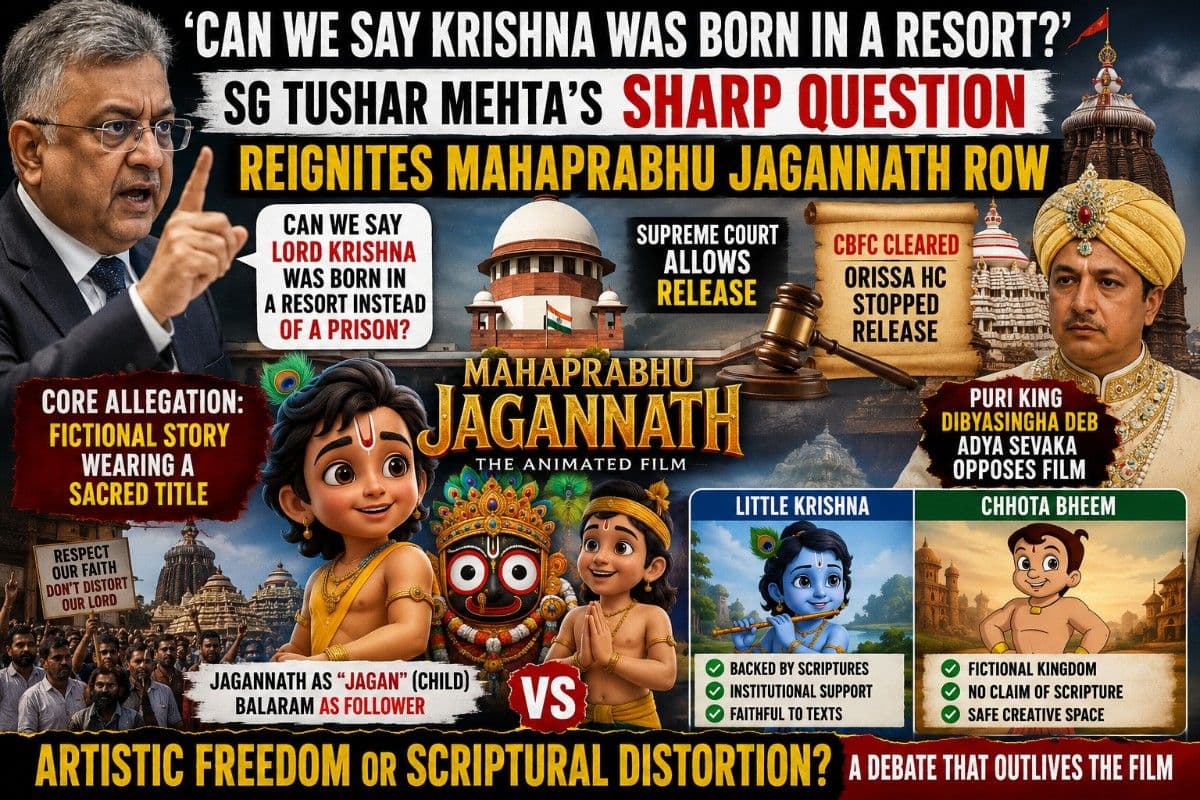
Bhubaneswar: "Can we say Lord Krishna was born in a resort instead of a prison?"
With that pointed question before the Supreme Court, Solicitor General Tushar Mehta distilled the heart of one of the most sensitive cultural battles involving Lord Jagannath in recent years.
The controversy is no longer merely about an animated children's film. It has evolved into a larger debate over where artistic freedom ends and scriptural authenticity begins, particularly when the deity at the centre is Lord Jagannath of Puri, whose rituals, traditions and theology are living religious practices followed by millions.
The animated feature "Mahaprabhu Jagannath", produced by Ele Animations Pvt Ltd, has now become a legal, cultural and theological flashpoint after the Central Board of Film Certification (CBFC) cleared it, the Orissa High Court initially restrained its release, and the Supreme Court eventually permitted its release after hearing both sides.

📱 Get Argus News App
✨Why the Film Triggered Opposition
The strongest opposition has come from:
- Puri Gajapati Maharaja Dibyasingha Deb, regarded as Lord Jagannath's Adya Sevaka (First Servitor)
- Shri Jagannath Temple Administration (SJTA)
- Jagannath culture scholars
- Several servitor bodies
- Devotees and cultural organisations
Their objection is remarkably specific.
It is not to animation itself.
It is not to children's storytelling.
It is not even to fictional narratives inspired by mythology.
Instead, they argue the film crosses a line by using the sacred title "Mahaprabhu Jagannath" while fundamentally altering the canonical relationship between Jagannath and Balabhadra.
The Core Allegation: A Fictional Story Wearing a Sacred Title
According to the filmmakers, the movie is essentially an adaptation of their earlier YouTube and television series "Jay Jagannath."
But that is precisely what critics say is the problem.
The storyline of Jay Jagannath depicts:
- Lord Jagannath incarnating as a child named Jagan
- Balaram portrayed as his devoted companion and follower
- Adventures based largely on fictional episodes and folk narratives
Traditional Jagannath theology, however, recognises:
- Lord Jagannath as the Supreme Lord
- Lord Balabhadra as His elder brother
- Both as equal divine manifestations deserving independent worship
Critics argue that portraying Balaram as an ardent follower rather than elder divine brother fundamentally alters centuries of accepted scripture.
For Jagannath scholars, this is not creative liberty.
It is scriptural deviation.
Why Critics Say This Is Different From Chhota Bheem
This comparison has become central to the controversy.
Chhota Bheem Never Claimed to Be Mahabharata
The makers of Chhota Bheem deliberately insulated themselves from religious controversy.
Their safeguards included:
- fictional kingdom of Dholakpur
- fictional timelines
- no claim of representing Mahabharata
- protagonist merely inspired by Bhima's strength
Even when Krishna or Ganesha appear, they are treated as magical guest characters rather than canonical scriptural figures.
This clear separation protects the franchise from allegations of rewriting sacred history.
Little Krishna Followed the Opposite Route
Unlike Chhota Bheem, Little Krishna directly portrayed Lord Krishna.
But its creators reportedly spent years studying:
- Srimad Bhagavatam
- Vaishnava scriptures
- traditional commentaries
- ISKCON theological guidance
Major episodes faithfully followed canonical texts.
Additional fictional conversations were inserted only between scripturally established events.
Equally important, the project enjoyed institutional religious backing, significantly reducing allegations of distortion.
Why Mahaprabhu Jagannath Fell Between Both Models
According to petitioners, Ele Animations adopted neither safeguard.
Instead it combined:
- sacred title
- real Jagannath identity
- fictional child adventures
- altered family relationships
- commercial storytelling
That hybrid model became the centre of litigation.
Traditionalists argue that if the film intended to tell a fictional children's story, it should have followed the Chhota Bheem model by creating an independent fictional universe.
Instead, by naming the film Mahaprabhu Jagannath, they contend the makers invited audiences to treat fictional episodes as authentic Jagannath tradition.
Why the Orissa High Court Initially Stopped the Release
The Orissa High Court accepted that the petition raised serious concerns regarding religious sensitivities.
The court was particularly persuaded by arguments that:
- Lord Jagannath is not merely a mythological figure but a living deity with active temple traditions.
- Children's films have long-term educational impact.
- Fiction presented under the sacred identity of Mahaprabhu Jagannath could create confusion regarding accepted Jagannath theology.
Accordingly, the High Court initially restrained the film's release pending further examination.
The interim order effectively halted its theatrical release despite CBFC certification.
What Happened in the Supreme Court
The filmmakers challenged the High Court order before the Supreme Court.
Representing the temple side, Solicitor General Tushar Mehta questioned whether creative liberty permits rewriting universally accepted religious narratives.
His illustration resonated widely:
"Can we say Lord Krishna was born in a resort instead of a prison?"
His argument was simple:
Creative freedom cannot legitimise factual distortion of sacred narratives deeply embedded in public faith.
The filmmakers, represented by Senior Advocate Devdatt Kamat, argued otherwise.
They maintained:
- devotion takes multiple artistic forms
- Indian tradition has long embraced God as child, friend and companion
- the film was intended for children
- it promotes morality and devotion rather than irreverence
The Supreme Court ultimately allowed the film's release.
The Bench observed that devotion is an internal matter and suggested that a children's animation does not automatically erode genuine faith merely because it adopts an imaginative storytelling style.
How Could CBFC Clear Such a Controversial Film?
That question has puzzled many devotees.
The answer lies partly in how the CBFC evaluates animation differently from live-action cinema.
Animation Gets Wider Creative Latitude
Under the Cinematograph Act and CBFC Guidelines, content cannot insult religious groups.
However, animation is often viewed differently because:
- cartoons are treated as artistic abstraction rather than literal representation
- they are generally aimed at children
- they are categorised as mythological entertainment
- they lack real actors whose personal identities may intensify controversy
Consequently, the Board often permits greater creative simplification of mythology.
Live Action Faces Far Tougher Scrutiny
Live-action depictions invite greater examination because:
- audiences perceive them as realistic
- visual details carry theological significance
- deviations are more easily challenged under laws relating to religious sentiments
- actors portraying deities often trigger additional controversies
Ironically, what may receive certification in animation could face substantially greater objections in live-action.
Why the Debate Extends Beyond One Film
Industry observers say the controversy arrives precisely when Indian studios are attempting to build a commercial "Sanatan Universe" similar to global cinematic franchises.
Following repeated controversies involving mythology-based productions, animation studios are reportedly changing their production practices by:
- appointing scripture advisory boards
- involving historians and temple scholars before scripting
- distinguishing folklore from canonical scripture
- using stronger legal disclaimers
- clearly identifying fictional adaptations rather than presenting them as authoritative narratives
The Mahaprabhu Jagannath controversy is now being viewed as a case study in religious risk management for India's emerging mythological animation industry.
Ele Animations' Defence
After the High Court proceedings, Ele Animations maintained that:
- the film represents devotional expression ("bhav"), not theological replacement;
- it extends the already popular Jay Jagannath television and YouTube series;
- it is intended for children and families;
- it forms the opening chapter of an ambitious Sanatan Universe showcasing Indian culture globally;
- the audience should ultimately judge the film after watching it.
The producers also highlighted the substantial commercial stakes, noting nationwide theatrical bookings before the release was stalled.
Why This Case May Become a Landmark
The legal battle surrounding Mahaprabhu Jagannath has exposed a regulatory grey zone.
Unlike Little Krishna, which remained firmly rooted in scripture, or Chhota Bheem, which clearly declared itself fictional, Mahaprabhu Jagannath occupies a difficult middle ground – borrowing the sacred identity of a living deity while weaving an imaginative narrative that many devotees believe departs from established Jagannath tradition.
The Supreme Court has allowed the film to be released. But the larger debate remains unresolved.
For devotees of Lord Jagannath, the question is no longer whether animation is acceptable.
The question is whether creative imagination can alter the accepted theological identity of a living deity while retaining His sacred name.
That
constitutional, cultural and civilisational debate is likely to outlive this
film itself.
Also Read: Rath Yatra 2026: President Droupadi Murmu Invokes Lord Jagannath’s ‘Unblinking Eyes’ to Give India a Moral Message on Equality, Service and Leadership | Special
Related Topics
Explore more stories