



A Devotee's Complete Guide to Reach Lord Jagannath Safely During Rath Yatra 2026 | Security, Traffic & Parking Explained

Key Points
Technology-Driven Navigation: Police have integrated traffic restrictions with Google Maps and launched a new Bulk SMS alert system to provide real-time congestion updates.
Strategic Parking Expansion: With 30 designated parking hubs and an increased capacity of 2,100 vehicles, officials have streamlined the "Park-and-Walk" system for 17 lakh expected devotees.
Enhanced Pilgrim Safety: A massive security deployment of 12,000 personnel is supported by 26 newly created Safe Zones, acting as vital medical and evacuation hubs along the 3-km Grand Road.
Bhubaneswar/Puri: Barely 16 hours left for the teeming million eyes fixed at the three majestic chariots and the Singhadwara (Lion Gate) when the Lord of the Universe, Shri Jagannath, along with his siblings – elder brother Lord Balabhadra and sister Devi Subhadra – will emerge out of the hoary Sri Mandir to immerse in the ocean of humanity.
The teeming million eyes will be waiting to catch a glimpse of the Holy Trinity and experience that indescribable moment of bliss when their gaze finally meets the divine siblings rolling majestically on the Grand Road.
Behind every such sacred moment, however, lies an equally gigantic administrative effort. To ensure that the strenuous journey undertaken by nearly 17 lakh devotees culminates in a peaceful darshan rather than chaos, the Odisha Government and Odisha Police have rolled out perhaps the most technology-driven and elaborate security and traffic management plan ever seen for the annual Rath Yatra.
Multi-Layered Security Shield Around the Lord's Journey

📱 Get Argus News App
✨For Rath Yatra 2026, security has been elevated to an unprecedented level with a multi-dimensional surveillance and crowd management system.
More than 12,000 police personnel, assisted by 19 senior IPS officers, CAPF units, CRPF, BSF, RAF, NSG, RPF and other specialised forces, have been deployed across Puri.
The administration has established an Integrated Command and Control Centre at Jagannath Ballabh Pilgrim Centre (JBPC), enabling authorities to monitor the movement of lakhs of devotees in real time through 244 CCTV cameras, AI-assisted surveillance and drone feeds.
Security is no longer confined to roads alone.
Drone and anti-drone systems will monitor the skies while the Odisha Police, Indian Coast Guard and Indian Navy maintain vigil along Puri's coastline.
To handle emergencies amid massive crowds, 26 Safe Zones have been created along the three-kilometre Grand Road.
These zones function as evacuation points, medical aid stations and resting areas for exhausted pilgrims.
Eight temporary hospitals, hundreds of ambulances and medical teams, extensive sanitation infrastructure, emergency pumping arrangements against waterlogging and dedicated disaster response teams will remain on standby throughout the festival.
The focus this year is clear – allow every devotee to pray peacefully while the security apparatus works silently in the background.
Traffic Management: The Real Backbone of a Hassle-Free Rath Yatra
If security protects devotees, traffic management determines whether they can actually reach Lord Jagannath comfortably.
Recognising this, Odisha Police's Traffic Control Centre has transformed traffic regulation into a technology-driven operation.
Thirty designated parking locations have been created across Puri – six more than last year – raising parking capacity by around 2,100 additional vehicles.
The parking distribution includes:
- 22 parking locations for four-wheelers with capacity for 7,730 vehicles
- 4 parking areas for two-wheelers accommodating nearly 15,000 motorcycles
- 4 bus parking hubs capable of parking around 750 buses
The police have declared a 24-hour No-Vehicle Zone from 12 midnight on July 16 until 12 midnight on July 17, covering the entire Grand Road and all major connecting roads. No private vehicle will be allowed anywhere near the chariot route.
Traffic monitoring has also entered the digital era. Authorities will combine AI-based traffic analytics, manual vehicle counting, drone surveillance and 244 CCTV cameras to regulate traffic flow.
To help motorists before they even reach Puri, Google Maps has been integrated with police traffic restrictions, enabling navigation apps to automatically avoid closed roads.
Two mobile LED display vehicles will continuously provide congestion updates along the Bhubaneswar-Puri corridor, while Bulk SMS alerts, introduced for the first time, will inform travellers about diversions and congestion on the Malatipatpur and Batgaon routes.
Across the district, 1,645 traffic signboards, including 1,050 temporary signs, have been installed to guide pilgrims.
For elderly devotees and persons with disabilities, Model Traffic Aid Posts at Talabania and Malatipatpur provide drinking water, seating arrangements and assistance, supported by 73 traffic aid posts spread across Puri district.
A Pilgrim's Journey to Puri: How to Reach Without Getting Stuck
Almost every pilgrim travelling from Bhubaneswar and most parts of Odisha enters Puri through the Bhubaneswar-Puri National Highway (NH-316). Once approaching Puri, the most important principle is simple:
Do not attempt to drive towards the Jagannath Temple.
Private
vehicles will be diverted to designated peripheral parking zones from where
shuttle services and pedestrian routes take over.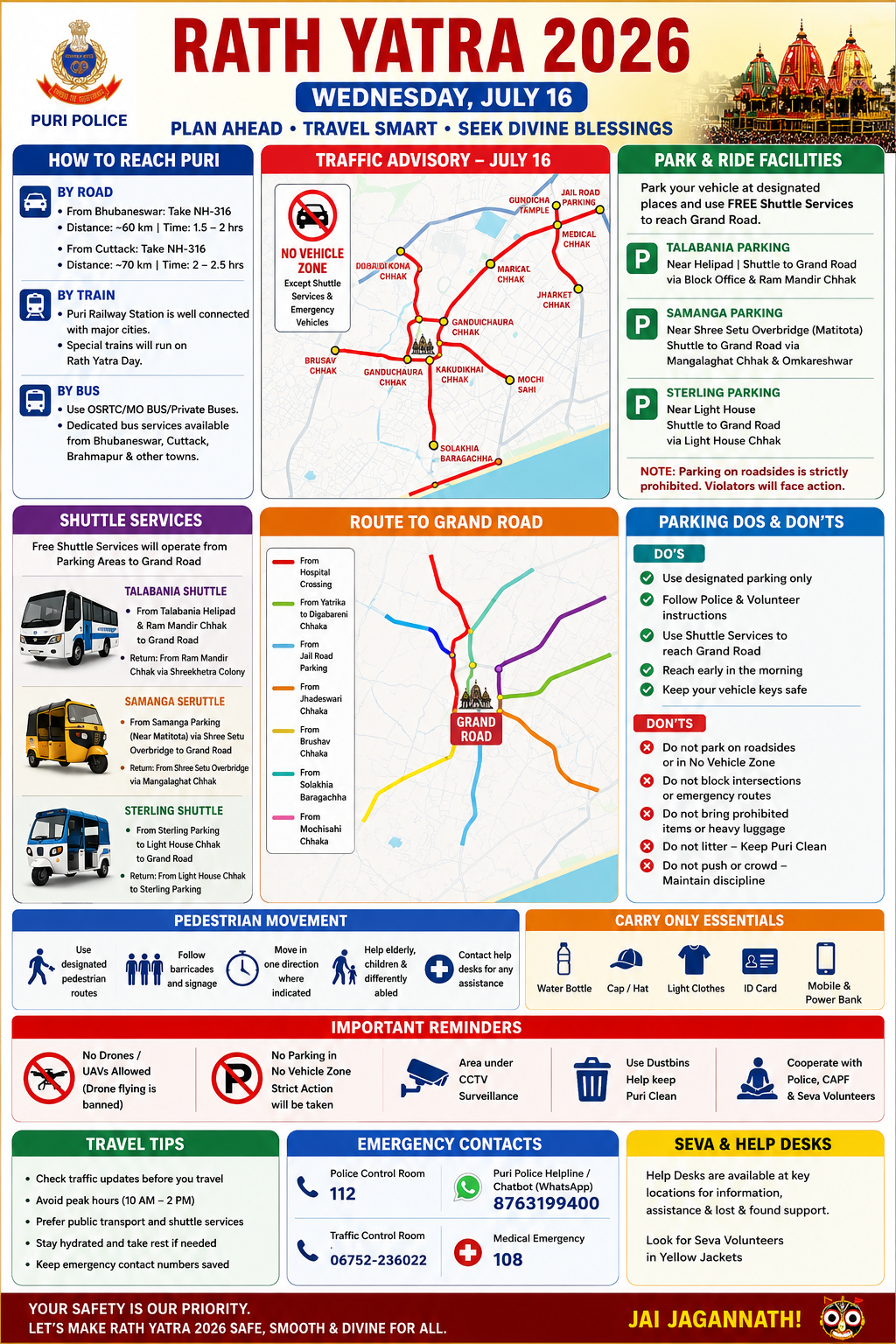
Four-Wheeler Pilgrims
Pilgrims travelling by car or SUV should follow police signages immediately after entering Puri district.
Cars will be diverted to designated parking hubs depending on traffic load.
Vehicles without passes will be accommodated in the earmarked public parking areas, while pass holders will be directed towards dedicated parking at JBPC, Yatrika, Loknath or Nail Field. Contingency parking has also been created along Jail Road.
After parking, private vehicles cannot proceed further.
Devotees should board the free shuttle buses or proceed on foot through designated pedestrian corridors leading towards the Grand Road.
Attempting to drive closer to the temple will only result in diversions, delays and inconvenience because the entire core city remains under No-Vehicle restrictions.
Two-Wheeler Pilgrims
Motorcycles entering from the Bhubaneswar side will be directed towards dedicated two-wheeler parking facilities created by Puri Police.
Parking facilities include designated locations around:
- Matitota
- Old Jagannath Ballabh area
- Blue Flag Beach
- Nilachal Ashok sector
These parking facilities together can accommodate nearly 15,000 motorcycles.
Once parked, riders must continue either through shuttle connectivity wherever available or walk along designated pedestrian routes.
Bus Travellers
Pilgrims arriving in government, private or tourist buses will have perhaps the simplest journey.
All buses will terminate at designated bus parking hubs including:
- Malatipatpur
- Talabania
- Samanga
- Swami Narayan Temple area
From these parking locations, pilgrims will use dedicated shuttle services towards the city before walking to the Grand Road.
Interstate and tourist buses are not permitted beyond Malatipatpur.
From Parking to the Grand Road: Your Final Pilgrimage
The last stretch of the journey is entirely pedestrian.
Once devotees leave their vehicles, Odisha Police has created a carefully designed "Park-and-Walk" and "Park-and-Ride" system to minimise congestion.
Talabania Parking
Pilgrims parking at Talabania should board the free shuttle service operating via Helipad Chhak, Block Office and Ram Mandir Chhak, from where they can comfortably walk towards the Grand Road.
Samanga Parking
Those parking at Samanga will travel through Shree Setu Overbridge before reaching Mangalaghat Chhak and Omkareshwar Temple, the designated pedestrian access towards Bada Danda.
Sterling Parking
Pilgrims using Sterling Parking will take shuttle services through Light House Chhak, another important pedestrian entry corridor leading towards the chariot route.
Once inside the city, devotees should strictly follow the designated pedestrian corridors marked by over 1,645 traffic signboards. Police have created one-way walking routes at several stretches to reduce crowd pressure.
Movement towards the Grand Road is organised through important junctions including Brusav Chhak, Ganduchaura Chhak, Kakudikhai Chhak, Market Chhak, Medical Chhak, Jail Road Parking, Dolabedi Kona, Mochi Sahi, Solakhia Baragachha and Jharkhet Chhak, depending upon the parking location assigned by the traffic police.
The administration has appealed to devotees not to gather at Singhadwara alone. While the Lion Gate remains the most spiritually significant point where the deities emerge from the temple, it is also expected to witness the highest crowd density. Pilgrims willing to wait slightly further along the Grand Road towards Gundicha Temple may find relatively better movement while still enjoying the divine procession.
Throughout the route, volunteers, police personnel, CCTV surveillance, public announcement systems, LED displays, emergency medical teams and 26 Safe Zones remain available. Devotees who feel fatigued, lose contact with family members or require medical assistance should immediately approach the nearest Safe Zone or Traffic Aid Post.
The Odisha Police has also urged devotees to cooperate with security personnel, avoid carrying prohibited items, refrain from roadside parking, use only designated shuttle services, follow Google Maps and Bulk SMS alerts for real-time diversions, and keep emergency numbers—112, 108, 06752-236022 and the Puri Police WhatsApp helpline 8763199400—readily available.
As lakhs
prepare for that once-in-a-lifetime moment when the towering Nandighosha,
Taladhwaja and Darpadalana begin their journey down the sacred
Bada Danda, the message from the administration is clear: park early, walk
patiently, follow the advisory and allow devotion – not congestion – to define
your Rath Yatra.
Also Read: Will Rain Play Spoilsport on Lord Jagannath's Rath Yatra? Low Pressure Area Likely to Keep Puri Weather Unstable on July 16| Exclusive Details Inside
Related Topics
Explore more stories