



With 42-Year Golabandha Jinx Broken, How CM Majhi's Gopalpur Tour Signals BJP’s Political Consolidation Strategy in Ganjam| Special Story
Key Points
Bhubaneswar: Chief Minister Mohan Charan Majhi’s Gopalpur (Ganjam district) tour on Wednesday was more than a rehabilitation package announcement. The story carries a political message too.
By declaring how his government had broken a 42-year-old jinx surrounding the rehabilitation of displaced Nolia families of Golabandha, Majhi sought to establish the BJP government as the one that finally delivered where previous governments had failed.
But his sharper political message has been zoomed on by the comparison he drew.
Ganjam, he reminded the audience, had produced five Chief Ministers. Yet, a problem affecting the Nolia community remained unresolved for decades.

📱 Get Argus News App
✨The reference was not merely historical.
The political arrow was unmistakably aimed at the BJD era –and, more specifically, at the legacy of former Chief Minister Naveen Patnaik, who ruled Odisha for 24 years and represented Hinjili in Ganjam.
The BJP is attempting to tell Ganjam voters that while the district may have been the political nerve centre of Odisha for decades, political prominence did not necessarily translate into the resolution of every long-pending local grievance.
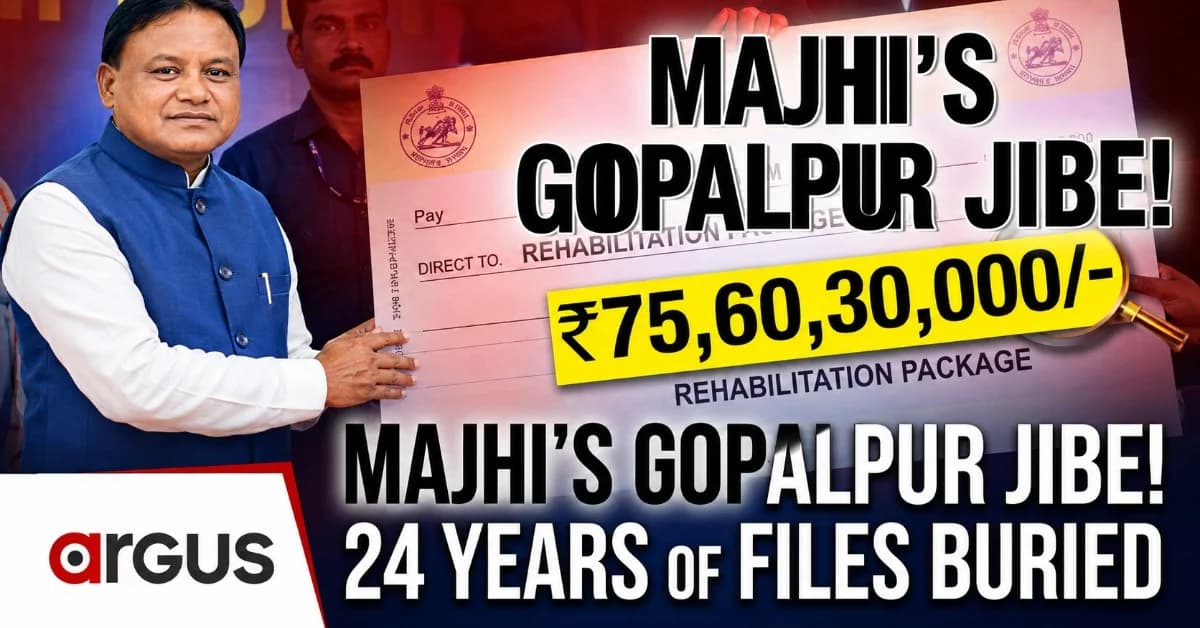
His direct jibe at former CM Naveen Patnaik is evident from the statement - “24 years of files being buried."
And Majhi’s Ganjam visit appeared designed to reinforce this argument through a combination of solved grievances, project execution, rehabilitation payouts, employment promises, industrial investments and maritime infrastructure.
In other words, the Majhi government is trying to convert delivery into political consolidation.
The ₹75.60-Crore Political Message
At Golabandha, Majhi announced a Rs75.603-crore Rehabilitation and Resettlement package for 1,371 displaced Nolia families.
This 42-year Golabandha deadlock itself offers the BJP its strongest political exhibit.
Land was acquired in 1984 for the Army Air Defence College, but rehabilitation of the displaced Nolia community remained unresolved.
The numbers themselves show why the announcement carries electoral weight.
The political significance lies in the contrast with the earlier rehabilitation framework. The old approach had largely become a housing-centric solution to what was essentially a livelihood problem.
Golabandha: The Numbers That Explain the Breakthrough
|
Key takeaway |
Important number |
Political significance |
|---|---|---|
|
Age of the deadlock |
42 years |
Allows BJP to claim it resolved a grievance older than the BJD government |
|
Eligible displaced families |
1,371 |
A direct beneficiary bloc receiving a major settlement |
|
Total R&R package |
₹75.603 crore |
High-visibility government intervention |
|
Direct cash support |
₹5 lakh per family |
Immediate and politically tangible benefit |
|
Total direct compensation |
₹68.55 crore |
Bulk of package goes directly to affected families |
|
Unfinished houses to be completed |
998 |
Converts an old incomplete rehabilitation promise into visible delivery |
|
New houses |
10 |
Completes the remaining housing requirement |
|
Housing allocation |
₹4.251 crore |
Targets unfinished rehabilitation infrastructure |
|
Community infrastructure |
₹2.80+ crore |
Addresses civic and livelihood gaps |
The Direct Jibe: Why Majhi Invoked Five Chief Ministers
"Majhi’s political attack was built around a simple question: If Ganjam produced five Chief Ministers, why did the Nolia rehabilitation and developmental projects continue to hang fire?"
This argument is politically potent because Ganjam has long been associated with Odisha’s highest political offices.
But among those Chief Ministers, Naveen Patnaik carries the greatest contemporary political relevance. He represented Hinjili and ruled Odisha for 24 years. Thus, Majhi’s reference to “ 24 years of files remaining buried” under the previous government was, politically, a direct challenge to the BJD’s governance record in its strongest political territory.
The BJP’s argument is therefore not that Ganjam lacked political power.
It is the opposite.
The BJP is trying to argue that despite having political power, some of Ganjam’s unresolved issues were left behind – and that the new government is now clearing that backlog.
That is why the Golabandha announcement is politically bigger than the rehabilitation of 1,371 families.
It creates a larger narrative:
Ganjam produced Chief Ministers, but BJP claims it is producing solutions.
The BJP Ganjam Consolidation Signal
The signal can be gauged from the wider package of announcements and projects highlighted during the visit.
The BJP is not trying to politically consolidate Ganjam through one beneficiary group alone. Its strategy appears to operate across multiple social and economic layers:
1. Resolve Old Grievances
The first layer is the Golabandha rehabilitation package.
The BJP is converting a four-decade-old dispute into a direct-delivery success story. The political value lies in the last-mile outcome: cash transferred, houses completed and facilities delivered.
2. Solve Another Displacement Problem
At the same event, Majhi handed over land pattas to 96 out of 112 families displaced by the Chheligada Medium Irrigation Project.
Each eligible family is to receive 10 decimals of homestead land and 2 acres of cultivable land at Santarapur in Digapahandi.
This is politically important because it reinforces the same governance template: old project, old displacement problem, new government claims final resolution.
3. Turn Ganjam into an Employment Story
Majhi also highlighted the investment pipeline at the Gopalpur Industrial Park.
According to the figures highlighted during the visit, 14 projects involving more than Rs40,000 crore are expected to create around 18,000 jobs.
The political target here is clearly Ganjam’s youth.
The BJP is trying to shift the political conversation from merely welfare and grievance redressal towards jobs, skills and industrial growth.
4. Build a Blue Economy Constituency
The fourth layer is the coast.
Ganjam has a substantial fishing and coastal population. By linking the Golabandha settlement with modernisation of the Arjipalli fishing harbour and the proposed network of 28 fish landing centres, the BJP is attempting to expand the political relevance of the announcement beyond the Nolia families.
The idea is clear: the Golabandha package may solve one community’s grievance, but the maritime investment story can appeal to a much larger coastal constituency.
5. Connect Ports, Industry and Jobs
The government is also building a larger economic narrative around Ganjam through:
Rs21,500 crore proposed investment in the Bahuda mega port;
Expansion of Gopalpur Port;
Rs40,000 crore investment pipeline at Gopalpur Industrial Park;
14 projects;
Around 18,000 jobs;
Modernisation of Arjipalli fishing harbour;
28 fish landing centres.
These announcements allow the BJP to tell Ganjam voters that the district is central to Odisha’s future economic map.
Ganjam: From BJD Bastion to BJP Consolidation Target
The BJP’s strategy becomes clearer when viewed against the 2024 election numbers.
Ganjam was once the undisputed political heartland of the BJD. But the 2024 simultaneous elections fundamentally altered the equation.
Out of the district’s 13 Assembly constituencies, the BJP won 11, the BJD retained only 1 and the Congress won 1. Naveen Patnaik won Hinjili, but by a relatively narrow margin of 4,636 votes. The BJP also won both Lok Sabha seats – Berhampur and Aska.
Ganjam’s New Electoral Arithmetic
|
Political indicator |
Number |
What it means for BJP |
|---|---|---|
|
Total Assembly seats in Ganjam |
13 |
One of Odisha’s most important political districts |
|
BJP seats in 2024 |
11 |
BJP already has a dominant Assembly footprint |
|
BJD seats |
1 |
Sharp erosion of BJD’s district-wide dominance |
|
Congress seats |
1 |
Opposition space remains fragmented |
|
BJP Lok Sabha seats |
2 out of 2 |
Complete parliamentary sweep in the district |
|
Naveen Patnaik’s Hinjili victory margin |
4,636 votes |
Symbolically important erosion of BJD’s once-formidable advantage |
These figures explain why Majhi’s visit cannot be seen as a routine government programme.
BJP has already won Ganjam electorally. It is now trying to consolidate Ganjam politically.
Winning an election is one thing. Building a durable political base is another.
The Majhi government appears to be attempting the second phase.
The Consolidation Formula: Solve + Build + Employ
The BJP’s emerging Ganjam strategy can be decoded as a three-part formula.
|
Political objective |
Government action |
Target constituency |
|---|---|---|
|
Resolve historical grievances |
Golabandha R&R package |
Nolia and displaced families |
|
Close project-linked disputes |
Chheligada pattas and rehabilitation |
Rural and project-affected families |
|
Create future expectations |
Gopalpur Industrial Park investments |
Youth and job seekers |
|
Expand coastal outreach |
Harbour modernisation and fish landing centres |
Fishing communities |
|
Build development narrative |
Ports and industrial projects |
Wider Ganjam electorate |
|
Attack BJD legacy |
“24 years of File Buried” |
Voters reassessing old political loyalties |
This is why the Gopalpur visit had the character of both a political programme and a project-delivery event.
The two are intrinsically linked.
The BJP needs solved grievances to establish credibility. It needs industrial projects to establish future expectations. It needs employment promises to attract youth. And it needs all three to politically challenge the BJD’s historical emotional and organisational hold over Ganjam.
The ‘Finisher’ Advantage
There is also a significant political lesson in Majhi’s strategy.
Not all the projects highlighted in Ganjam began under the BJP government. Some industrial, irrigation and maritime proposals have roots in earlier administrations.
But Indian electoral politics often gives greater political credit to the government that delivers the visible last mile.
That is where Majhi is attempting to build his advantage.
For the BJP, the argument is not necessarily about who first conceived every project.
It is increasingly about who cleared the bottleneck, who completed the rehabilitation, who transferred the money, who handed over the patta and who created the conditions for the project to move forward.
That is the “finisher” narrative the Majhi government is trying to construct.
And the double-engine government argument strengthens it further, particularly in matters involving central clearances, defence-linked land, ports and large industrial infrastructure.
Why This Tour Matters Politically
Majhi’s Gopalpur tour may therefore mark an important stage in BJP’s post-2024 strategy in Odisha.
The 2024 election broke the BJD’s electoral dominance in Ganjam.
The next challenge for the BJP is to ensure that the 2024 verdict does not remain a one-election wave.
For that, it needs to replace the BJD’s organisational and political legacy with its own development constituency.
The Golabandha settlement offers the BJP a powerful starting point because it is concrete, measurable and emotionally resonant.
Alongside it, Chheligada brings into glare the delivery narrative. And alongside grievance resolution comes the promise of ports, green industry, maritime infrastructure and jobs.
The broader political proposition: The BJD once made Ganjam its political fortress. The BJP is now trying to make Ganjam the showcase of its governance model.
And Majhi’s political message to the district is becoming increasingly clear:
The
2024 election gave BJP control over Ganjam’s electoral map. The
next phase is to capture its development narrative, and convert that
narrative into a durable political consolidation.
Also Read: Chheligada: The River-Linking Crown Odisha Lost to a 24-Year Delay| Exclusive
Related Topics
Explore more stories