



Chheligada: The River-Linking Crown Odisha Lost to a 24-Year Delay| Exclusive
Key Points
Bhubaneswar: It was conceived in an era when the Atal Bihari Vajpayee government had put river interlinking on India’s long-term water-management agenda.
In Odisha, the Chheligada Irrigation Project too began to acquire that larger ambition when the BJD-BJP coalition government reworked the original proposal into an inter-basin water-transfer project.
Had the project moved as originally envisaged and been completed around its early 2019 target, Chheligada could have emerged as India’s second modern river-linking project and the country’s first major post-Independence gravity-fed inter-basin river link.
Instead, a project that was meant to become a national engineering milestone became a textbook case of delay, cost escalation, rehabilitation deadlock and administrative inertia.

📱 Get Argus News App
✨Now, more than a quarter-century after its conception, the Mohan Charan Majhi government is attempting to restore momentum. But the historical irony is stark: from a potential second place, Chheligada now finds itself effectively chasing a place among the fourth major modern river-linking projects in the country.
The Project at a Glance
Located near Chheligada village in R. Udayagiri block of Gajapati district, the multipurpose project is built around the Badajore River, a tributary of the Vansadhara system.
Its central engineering idea is to store water and then divert it through a hill tunnel into the Ghodahada system, thereby transferring water from the Vansadhara basin to the Rushikulya basin.
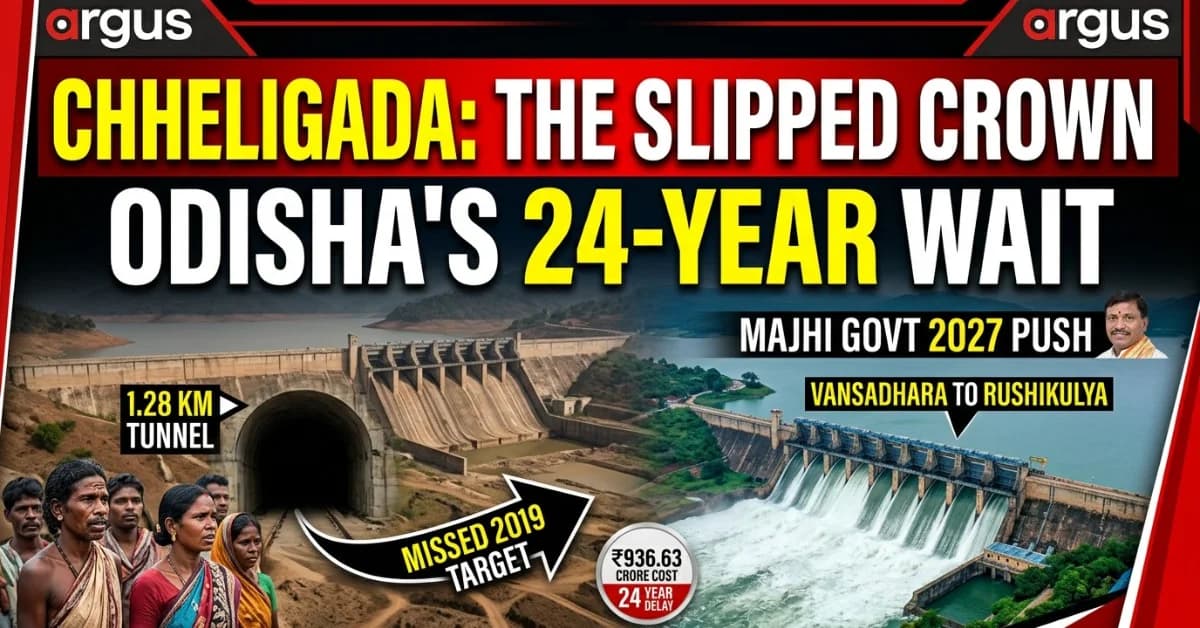
The project has a 266-metre-long, 30-metre-high concrete dam with seven radial gates. Its most distinctive engineering feature is the 1.28-km diversion tunnel.
The completed project is designed to create irrigation potential over 6,260 hectares, generate 36 MW of hydroelectricity and supply 31.54 million cubic metres of water annually to Berhampur.
|
Parameter |
|---|
Chheligada Project Profile
Location
R. Udayagiri block, Gajapati district
River
Badajore, tributary of Vansadhara
Dam
266 metres long, 30 metres high
Spillway
7 radial gates
Diversion tunnel
1.28 km
River basins linked
Vansadhara to Rushikulya
Irrigation potential
6,260 hectares
Ganjam irrigation
5,760 hectares
Gajapati irrigation
500 hectares
Hydropower
36 MW
Drinking water
31.54 million cubic metres annually to Berhampur
Latest estimated cost
₹936.63 crore
Initial 1999 estimate
₹52.96 crore
From a Local Dam to a River-Linking Vision
Chheligada was originally conceived in 1999 as a relatively conventional reservoir project. Its early objective was to harness water over the Badajore River for local agricultural needs.
The project, however, underwent a major transformation after the BJD-BJP government came to power.
By the time the foundation stone was laid in 2005, the engineering design had been expanded. A diversion tunnel was incorporated to carry water out of the Vansadhara basin and into the Rushikulya basin. The revised plan also added mini-hydel units and a major drinking-water component for Berhampur.
In effect, Chheligada stopped being merely an irrigation dam. It became a multipurpose water-transfer project that sought to move surplus water from one basin to another.
How the Project Changed
|
Feature |
Original 1999 Vision (Giridhar Gomango Govt) |
Reworked 2005 Vision (BJD-BJP Govt) |
|---|---|---|
|
Hydrological concept |
Local reservoir |
Inter-basin water transfer |
|
River basin |
Vansadhara |
Vansadhara to Rushikulya |
|
Water diversion |
No major inter-basin transfer |
1.13 km, later 1.28 km tunnel |
|
Power generation |
Not part of original concept |
36 MW through three mini-hydel units |
|
Major beneficiaries |
Local farmers |
Farmers in Gajapati and Ganjam, Berhampur city |
|
Cost base |
₹52.96 crore |
Escalated with greater design complexity |
|
Historical significance |
Conventional irrigation |
Odisha's pioneering intra-state river-linking project |
The Crown That Slipped Away
This is where Chheligada's story turns from ambition to missed opportunity.
Had the project been completed by its early target of 2019, Odisha could have claimed a remarkable national milestone. By then, Chheligada would have been in a position to follow Madhya Pradesh's Narmada-Kshipra project as one of India's earliest major modern river-linking systems.
Its engineering distinction would have been even sharper because Chheligada was designed as a gravity-fed system. Unlike projects dependent heavily on pumping, the natural gradient was intended to carry water through the diversion tunnel while also enabling downstream power generation.
But the project did not meet the 2019 deadline.
The years of delay allowed other projects to move ahead. Chheligada's national historical position slipped, leaving Odisha with a completed diversion tunnel but without the dam and full operational system required to make the river link functional.
The National Race Chheligada Lost
|
Rank / Project Sequence |
Project |
State |
Commissioning / Status |
|---|---|---|---|
|
1 |
Narmada-Kshipra Link |
Madhya Pradesh |
Operational from 2013 |
|
2 |
Pattiseema Lift Irrigation Scheme |
Andhra Pradesh |
Operational from 2015 |
|
3 |
Kosi-Mechi Link |
Bihar |
Operational phase from 2021 |
|
4 |
Chheligada Multipurpose Project |
Odisha |
Tunnel completed in 2023; full project targeted for 2027 |
|
Future major link |
Ken-Betwa |
Madhya Pradesh-Uttar Pradesh |
Under construction (by 2030) |
Had Chheligada met its 2019 target: It could have occupied the second modern river-linking position in this chronology, according to the project's completion sequence outlined in the source material.
The 24-Year Wait
The project's chronology tells the story of a dream repeatedly pushed forward and then pushed back.
|
Year / Period |
Development |
|---|---|
|
1999 |
Project originally conceived over Badajore River |
|
2001 |
Initial techno-economic approval |
|
2005 |
Foundation stone laid; project reworked with larger inter-basin ambition |
|
Early target |
Full project aimed around 2019 |
|
2015-17 |
Tendering and development difficulties; land and clearance issues intensified |
|
September 2022 |
Stage-I forest/environment-related clearance process renewed |
|
May 2023 |
Major push to accelerate project |
|
September 2023 |
1.28-km diversion tunnel completed |
|
October 2023 |
Stage-II Central environmental clearance received |
|
June 2025 |
Cabinet approved ₹151.78-crore contract for final dam and spillway works |
|
Late 2026 / Early 2027 |
Latest physical completion target |
The most striking part of this timeline is that Chheligada's signature tunnel was completed in September 2023. Yet, the tunnel remains dry because the main dam has not been completed to impound water and feed it into the inter-basin passage.
The state, therefore, has a completed river-linking conduit but not yet a fully operational river link.
The Tunnel Was Ready, the Project Was Not
The 1.28-km tunnel is Chheligada's engineering heart.
Designed to transfer water from the reservoir into the Ghodahada river system, the tunnel is structurally complete. But a tunnel by itself cannot create a river link. The main dam has to impound water, the reservoir has to be operational and the intake and downstream distribution network have to be completed.
That is why the project has found itself in an unusual position: its most historically significant engineering structure was ready, while the larger project around it remained incomplete.
The Real 'Dam' Was Rehabilitation
For decades, the concrete structure was not the only obstacle. In many ways, the greater challenge was human displacement.
The project requires the submergence of five core villages and affects 596 core displaced families. More than 4,000 tribal people across 15 villages are directly affected.
The project could not simply close the reservoir gates and fill the dam while hundreds of families remained in the submergence zone. Rehabilitation, resettlement and land rights became the real bottleneck.
The incomplete rehabilitation colonies, disputes over compensation, recognition of forest rights and demands for land-based rehabilitation repeatedly slowed the project.
Old R&R vs New R&R: The Fresh Hope
The Majhi government's major intervention has been to revise and strengthen the rehabilitation framework and move away from the old compensation architecture that had failed to resolve local resistance.
The new rates under the 10th Biennial Revision have increased compensation and assistance across key categories.
Old vs New R&R Package
|
Provision |
Old Rate |
New Rate |
|---|---|---|
|
Self-rehabilitation assistance |
₹1,13,128 |
₹1,16,550 |
|
House construction aid |
₹3,39,383 |
₹3,49,650 |
|
Irrigated land grant |
₹2,26,255 per acre |
₹2,33,100 per acre |
|
Non-irrigated land grant |
₹1,13,128 per acre |
₹1,16,550 per acre |
|
Monthly maintenance allowance |
₹4,525 |
₹4,662 |
|
Temporary shed assistance |
₹22,626 |
₹23,310 |
|
Transportation allowance |
₹4,525 |
₹4,662 |
But the bigger change has not been merely the increase in monetary rates.
The new framework, CM Majhi outlined on Thursday, provides displaced families at the Santrapur rehabilitation colony with 10 decimals of homestead land and two acres of agricultural land. An additional ₹8.48 crore has been sanctioned to cover 78 extended families who were not adequately covered under older survey frameworks.
This has raised hopes that the long-standing rehabilitation deadlock may finally be broken.
Why the New Package is Seen as a Break from the Past
|
Earlier Problem |
New Intervention |
|---|---|
|
Compensation rates failed to reflect rising costs |
Revised rates under updated R&R framework |
|
Displaced families demanded livelihood security |
Two acres of agricultural land provided under rehabilitation package |
|
Housing displacement concerns |
10 decimals of homestead land plus house construction assistance |
|
Extended families left outside older surveys |
78 extended families included under ₹8.48-crore package |
|
Concerns over fund delivery |
Greater use of DBT |
|
Forest-rights complications |
Floor-price approach for FRA lands |
|
Lack of a strict construction deadline |
₹151.78-crore contract with an 18-month execution window |
Majhi Government's 2027 Push
The Majhi government has now sought to impose a deadline-driven structure on a project that drifted for years.
In June 2025, the Odisha Cabinet approved a Rs151.78-crore tender for the final dam body and spillway. The contract carries an 18-month execution window, placing the target around late 2026 or early 2027.
The government's strategy rests on three pillars: completing the dam, accelerating rehabilitation and removing legal and compensation bottlenecks that had frozen land acquisition.
The administration has also moved to recognise and address FRA-linked land issues and has linked the civil engineering push with a more direct rehabilitation drive.
Majhi Government's Completion Roadmap
|
Action |
Purpose |
|---|---|
|
₹151.78-crore dam and spillway contract |
Complete final structural works |
|
18-month execution mandate |
Prevent open-ended construction delays |
|
Revised R&R rates |
Address compensation concerns |
|
Land pattas |
Give displaced families legally secure rehabilitation land |
|
10 decimals homestead land |
Provide permanent residential rehabilitation |
|
2 acres agricultural land |
Protect livelihood after displacement |
|
₹8.48 crore for 78 extended families |
Address exclusions under earlier surveys |
|
FRA land pricing mechanism |
Resolve tribal land-compensation hurdles |
|
DBT payments |
Speed up and streamline rehabilitation assistance |
A Symbolic Breakthrough, Not Yet a Full Settlement
The recent land-patta distribution has undoubtedly given the project a fresh political push. But the numbers also show that the rehabilitation challenge is not completely over.
Of the 596 core displaced families, the government has made progress with a limited first tranche of families at Santrapur. The source material records pattas being distributed to 96 families at one event, against a targeted 112-family subset, while a much larger number of affected families remain outside full rehabilitation.
The Majhi government's intervention, therefore, marks a breakthrough, but not yet the final resolution of the entire displacement issue.
Current Rehabilitation Picture
|
Progress Made |
Work Still Pending |
|---|---|
|
Pattas distributed to an initial group of displaced families |
Large number of core families yet to complete relocation |
|
Homestead and agricultural land package offered |
Rehabilitation of all affected families remains incomplete |
|
78 extended families brought under special financial coverage |
Livelihood concerns and compensation disputes persist |
|
Revised R&R rates notified |
Some displaced groups continue to seek further assurances |
|
Dam work accelerated |
Canal and distribution networks also need completion |
|
Rehabilitation process restarted |
Reservoir filling depends on complete evacuation of submergence zones |
From ₹52.96 Crore to ₹936.63 Crore
Perhaps no number captures the cost of delay better than Chheligada's price tag.
The project began with an estimated cost of Rs52.96 crore. Today, the estimated cost stands at Rs936.63 crore.
That is an escalation of more than 1,600 per cent.
The project was not merely delayed. Every year of delay made it more expensive, while inflation, design changes, land acquisition complications and revised rehabilitation obligations increased the final financial burden on the state.
What could have been completed as a relatively modest pioneering project became a nearly Rs1,000-crore example of how delay itself can become the most expensive component of infrastructure development.
The Bigger Significance for Odisha
Chheligada matters far beyond its dam wall.
The project is a prototype for Odisha's future approach to water redistribution. The state has already been pushing a broader intra-state river-linking strategy, and Chheligada's tunnel offers a practical example of how water from a relatively surplus basin can be transferred to a region facing greater water stress.
It also combines three objectives in one project: irrigation, hydropower and urban drinking-water supply.
The irrigation benefits are intended to extend across Gajapati and Ganjam. The hydel component is designed to generate 36 MW. Berhampur is expected to receive a major drinking-water supply from the project.
That makes Chheligada more than a delayed irrigation scheme. It is a regional water-management model whose success or failure could influence future intra-state river-linking projects in Odisha.
The Bottom Line
Chheligada is a story of what Odisha could have achieved, and what it lost to delay.
Conceived at the turn of the century, reimagined by the BJD-BJP government into an inter-basin project and positioned to become one of India's earliest modern river links, Chheligada had a chance to wear a national engineering crown.
Had it been completed around 2019, Odisha could have celebrated a project with a claim to being the second major modern river-linking project in the country and a pioneering gravity-fed inter-basin transfer system.
Instead, bureaucratic inertia, clearance delays, unfinished rehabilitation colonies, land disputes and the absence of sustained political urgency pushed the project through a 24-year struggle.
Now, the Majhi government is trying to ensure that Chheligada's final chapter is different from its first two decades. The revised R&R package, land pattas, recognition of extended families, FRA-related compensation measures and the 18-month construction mandate have together created the strongest possibility yet of closure.
The
crown of being second may be gone. But if Chheligada finally begins
carrying Vansadhara water into the Rushikulya basin by early 2027,
Odisha will still gain something historically significant: its first
major operational intra-state river-linking project – and a hard
lesson in how a 20-year delay can turn a national pioneer into a late
entrant.
Also Read: CWC Technical Committee Begins Assessment in Mahanadi Water Dispute; The Shift Signals What? | Explainer
Related Topics
Explore more stories