



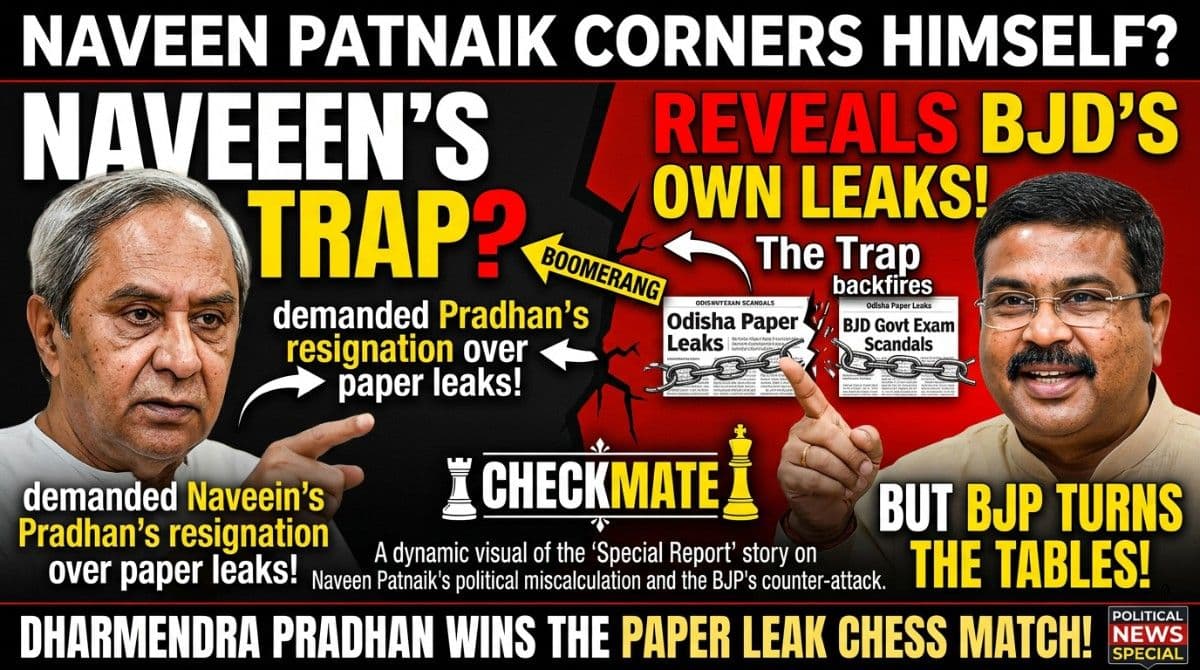
Why Naveen Patnaik's Bid to Corner Dharmendra Pradhan Ended Up Cornering Himself; How the Political Chess Went Wrong | Special Report
Key Points
Bhubaneswar: Politics often rewards restraint as much as rhetoric.
For over two decades, Naveen Patnaik cultivated precisely that image – a leader measured in speech, sparing in confrontation and almost clinical in choosing his political battles. It is this reputation for nuance that made his swift demand for Union Education Minister Dharmendra Pradhan's resignation over the examination paper leak controversy appear strikingly uncharacteristic.
Before the dust had settled and before any direct culpability was established, and, more so, when strictest actions had been taken, 13 culprits hauled up, a biggest ever change in NEET 2027 exam format announced, NEET retest ended successfully with applicants feeling satisfied, Odisha's former chief minister had joined the Opposition chorus seeking ministerial accountability.
Patnaik latching on to the Dipke’s demand, a dubious self-proclaimed leader who was very eloquently silent, enjoying pelf and power in Kejriwal govt when a litany of scams were unravelling, stuns political observers here.

📱 Get Argus News App
✨Moreover, the contrast was equally conspicuous. While several Opposition parties naturally mounted a political offensive, Naveen's intervention carried a different weight.
Unlike leaders whose politics thrives on perpetual confrontation, the BJD supremo has historically projected himself as a statesman above day-to-day political slugfests.
His unusually early entry into the debate therefore raised an obvious question: what prompted one of India's most understated politicians to abandon his trademark restraint?
In politics, as on a chessboard, every move has a hidden objective. Seen through that prism, Patnaik's intervention appeared less about Delhi's examination controversy and more about Odisha's political theatre. The target was not merely Dharmendra Pradhan the Union Minister, but Dharmendra Pradhan the strategist – the man widely credited with scripting the BJP's historic overthrow of the BJD government in 2024.
Firing at His Bête Noire
Few political rivals have shaped Naveen Patnaik's fortunes as profoundly as Dharmendra Pradhan.
When Narendra Modi assumed office in 2014, Odisha remained a BJD fortress, with the BJP relegated to the margins. Over the next decade, Pradhan painstakingly rebuilt the party from the booth level upward. He expanded organisational networks across nearly every polling booth, leveraged flagship Central welfare schemes to create direct voter connect, and relentlessly highlighted governance failures that punctured the BJD's carefully cultivated image.
The breakthrough came in the 2017 Panchayat elections, where the BJP's Zilla Parishad tally surged dramatically, signalling that the BJD's rural dominance could indeed be challenged. The momentum continued in the 2019 Lok Sabha elections, when the BJP nearly doubled its vote share and emerged as Odisha's principal Opposition.
By 2024, Pradhan had refined the political narrative even further. Rather than attacking Naveen Patnaik personally, he shifted public discourse towards "Odia Asmita", questioned bureaucratic influence in governance, highlighted issues such as the Ratna Bhandar controversy, and helped craft welfare promises like Subhadra Yojana and enhanced MSP for paddy.
The result was historic.
The BJP secured 78 Assembly seats and 20 of Odisha's 21 Lok Sabha constituencies, ending the BJD's uninterrupted 24-year rule.
For Patnaik, therefore, Dharmendra Pradhan is not merely a Union Minister. He is the architect of the political strategy that dismantled the BJD's seemingly impregnable citadel.
Against that backdrop, demanding Pradhan's resignation carried unmistakable political symbolism.
When the Fire Turns Around
Yet political offensives often invite historical scrutiny.
If the yardstick for accountability is examination paper leaks, Odisha's own record during the BJD years inevitably re-entered public discussion.
The chronology is difficult to ignore.
In 2019, the Odisha Teacher Eligibility Test (OTET) had to be cancelled after handwritten copies of question papers surfaced on social media barely hours before the examination. The Crime Branch investigation eventually led to the arrest of the then Vice-President of the Board of Secondary Education along with teachers and data operators.
Three years later, during the 2022 matriculation examination, the Odia Language paper went viral moments before candidates entered examination halls. Police investigations resulted in the arrest of school teachers accused of photographing and circulating question papers.
The following year witnessed perhaps the most sophisticated breach. The Odisha Staff Selection Commission cancelled its Junior Engineer (Civil) Main Examination after investigators traced the leak to a commercial printing press in neighbouring West Bengal. The probe uncovered an inter-state racket involving printing press employees and professional brokers, culminating in multiple arrests.
In 2024, allegations again surfaced after photographs of Class X English and regional language papers circulated through WhatsApp groups in several districts. Though the Board rejected claims of a systemic leak, it suspended officials for administrative lapses and subsequently introduced barcoding and customised watermarks on question papers.
These repeated episodes eventually tell a very sordid record when he was at the helm.
Politics Behind the Timing
The immediate political question, therefore, was obvious.
Why would Naveen Patnaik choose resignation as the first demand when the national controversy itself had yet to establish direct ministerial culpability?
Within political circles, one interpretation quickly gathered traction.
The move was seen as an attempt to shift the political debate from administrative accountability to ministerial responsibility while simultaneously putting Odisha BJP leaders in an uncomfortable position by targeting the state's tallest BJP face.
But the anticipated divisions never materialised.
Instead, the BJP closed ranks.
Leading the counter-offensive was veteran parliamentarian Bhartruhari Mahtab, himself a former BJD stalwart who now represents the BJP.
His response was unusually direct.
"Patnaik should not consider the people of Odisha as so weak. Several incidents of glaring failures occurred in conducting various competitive exams in the State during his tenure. The way he came forward to support the Opposition speaks volumes."
The political message was unmistakable.
Rather than defending Dharmendra Pradhan alone, the BJP sought to shift the spotlight back onto the BJD's own administrative record.
The Bottom Line
Politics frequently rewards aggressive timing.
It also punishes selective memory.
Naveen Patnaik's intervention was almost certainly aimed at placing his principal political adversary under pressure while attempting to regain the initiative in Odisha's evolving political landscape.
Yet the strategy produced an unintended consequence.
Instead of confining the debate to Delhi, it reopened uncomfortable questions about Odisha's own examination leak history under BJD administrations helmed by him. A controversy intended to corner the BJP ended up inviting comparisons with the BJD's own administrative legacy.
Equally significant was the BJP's swift consolidation. Rather than exposing divisions within the ruling party, Patnaik's remarks prompted senior leaders, including Bhartruhari Mahtab, to mount a coordinated political counterattack rooted in Odisha's own record.
Political narratives are rarely won by the first move alone.
As the old
chess maxim goes, every attack exposes the attacker too. And in
politics, perhaps more than anywhere else, history is often the most
unforgiving opponent.
Also Read: Look Who's Calling Kettle Black! Why Congress Stalls NEET Debate, Only to Face Mirror of Its Own Sordid Record| Special Report
Related Topics
Explore more stories