



Look Who's Calling Kettle Black! Why Congress Stalls NEET Debate, Only to Face Mirror of Its Own Sordid Record| Special Report
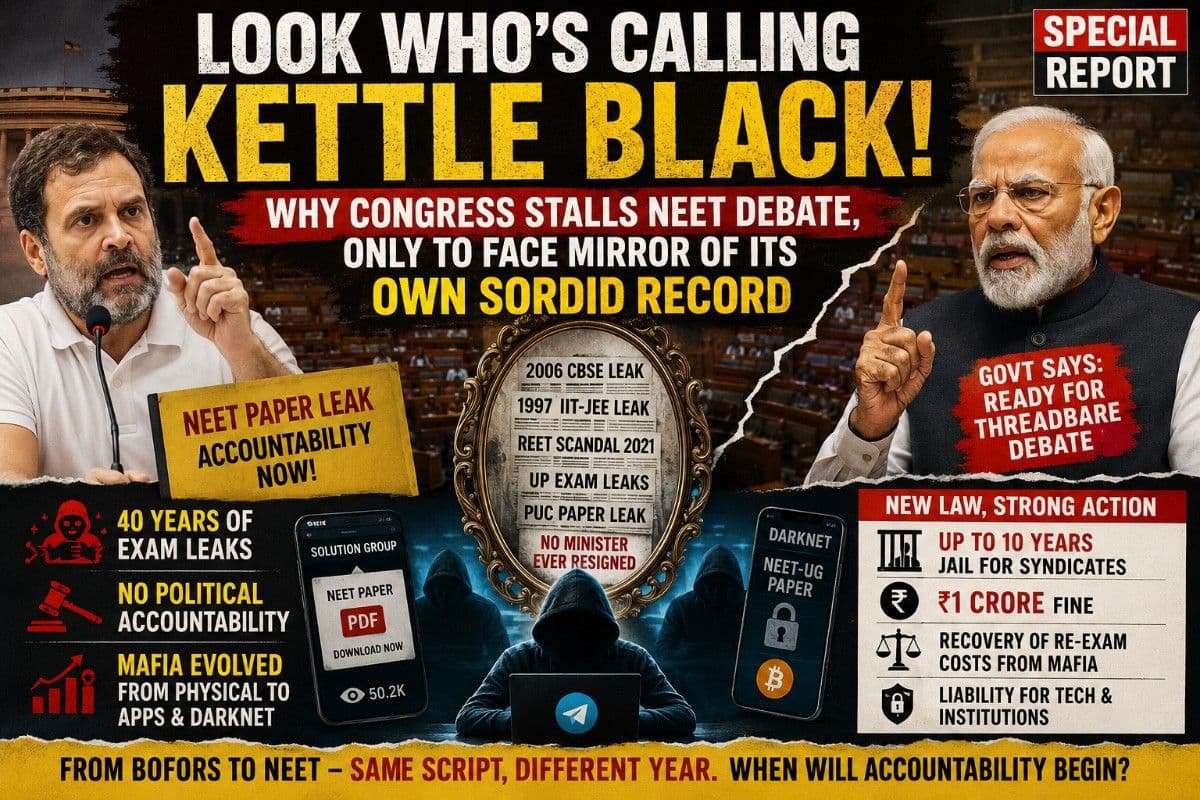
Key Points
Bhubaneswar: For the second consecutive day, Parliament remained paralysed as the Lok Sabha and Rajya Sabha witnessed repeated disruptions over the NEET paper leak issue, with the Congress led Opposition demanding political accountability, when the government saying ready to have threadbare debate on the issue.
From Rafale to NEET, it seems Rahul Gandhi led Congress had refused to learn any hard lesson. Rahul baba’s Congress has always weaponised its political arsenal – Hit and Run. The party never stays in the ring to own the accountability. Because, Indian political history is evident, how from Bofors to 2006 IIT Paper leak, the Party sung a different tune. Only to get exposed of its own sordid tale of records, the Rahul led Congress has weaponised the hit and run political strategy.
The fact is India has rarely fixed political accountability for examination leaks. Instead, Congress and INDI alliance party led governments have largely responded to the exam leak with bureaucratic suspensions, police investigations. More worse is the country saw stricter laws against the paper leak mafia only in 2024 envisaging up to 10 years rigorous jail term and Rs 1 cr fine.
Ironically, the debate unfolding in Parliament today reflects a pattern that has persisted for nearly four decades. Every major exam leak has generated outrage, but very few have triggered structural legal reforms before the next leak surfaced.

📱 Get Argus News App
✨By treating each scandal as an isolated administrative lapse rather than recognising the emergence of organised examination crime, governments inadvertently allowed local cheating rackets to evolve into sophisticated, technology-driven criminal syndicates.
Political Heat, But a Familiar Script
When the Congress is creating deadlock over NEET on accountability, its history shows that ministerial resignations following paper leaks have been virtually absent.
From the Congress-led UPA to Samajwadi Party governments in Uttar Pradesh, from Rajasthan to Karnataka and Telangana, the political response has followed a remarkably similar template:
Paper Leak → Suspension of Officials → Police/CBI Probe → New Safeguards → No Ministerial Exit
Whether it was the 1997 IIT-JEE leak, the 2006 CBSE paper leak, the 2021 REET scandal in Rajasthan accountability has then largely stopped at examination boards, bureaucrats and lower-level officials.
Sand Beneath High Moral Ground
A review of major examination scandals reveals the big trend.
Congress Governments
Rajasthan alone witnessed around ten major paper leaks after 2015, including the politically explosive REET teacher recruitment examination, police constable recruitment, junior engineer recruitment and High Court LDC examination.
Despite massive protests, no cabinet minister resigned. Instead, board chairpersons were removed, officials arrested and anti-cheating legislation introduced.
Similarly, Karnataka's repeated PUC Chemistry paper leaks resulted in suspension of officials – not ministerial exits.
Samajwadi Party Era in Uttar Pradesh
Between 2012 and early 2017, Uttar Pradesh experienced at least eight major documented examination leaks involving PCS, police recruitment, lower subordinate services and revenue inspector examinations.
The period saw the emergence of "solver gangs" operating through corrupt printing presses, strongrooms and local intermediaries.
Despite widespread cancellations and judicial intervention, political accountability remained absent.
Instead, pressure culminated in the removal of the UPPSC chairman – not ministers.
UPA Years at the Centre (2004-2014)
The UPA period witnessed several national-level examination compromises. Here are the details.
The Crises: Major central entry-point compromises occurred during this decade, including the 2004 CBSE AIPMT leak, the 2006 CBSE Class 12 Accountancy leak, the 2006 CAT leak, and the 2011 AIEEE leak.
Accountability: No political resignations.
· During the 2004 and 2006 leaks, HRD Minister Arjun Singh did not step down.
· During the 2011 AIEEE engineering entry leak, HRD Minister Kapil Sibal did not step down.
· Accountability was managed operationally by cancelling examinations or individual sets, introducing the independent double-witness protocol for opening security packets, and assigning local police crime branches to make arrests.
Coalition Governments Before 2000
Even the landmark 1997 IIT-JEE paper leak, one of India's earliest national examination scandals, resulted in cancellation of the examination and CBI investigations. Veteran political leader late SR Bommai was the HRD (Education) Minister. Congress was supporting the Third Front led govt.
Political accountability never travelled beyond institutional boundaries.
The Biggest Policy Mistake: Treating Every Leak as an Isolated Crime
Perhaps India's greatest failure was not merely the occurrence of paper leaks – it was the manner in which governments interpreted them.
For decades, paper leaks were viewed as:
- administrative failures;
- isolated insider thefts;
- local corruption.
They were rarely recognised as organised crime.
As a result, investigations typically ended with:
- arrest of printing press workers,
- suspension of centre superintendents,
- blacklisting of contractors.
The masterminds often escaped.
The Congress party never bothered to bring out a dedicated anti-paper leak legislation. The result criminal syndicates continued adapting.
How the Mafia Evolved Faster Than the Law
The transformation of examination crime mirrors India's digital revolution.
Earlier
The mafia stole physical papers.
Bundles were removed from printing presses.
Question papers were photocopied.
Selected candidates were secretly assembled.
Distribution remained limited to one city or district.
Today
Technology has rewritten the crime.
One smartphone image.
One encrypted PDF.
One Telegram channel.
Within minutes, lakhs of aspirants across multiple states can access the paper simultaneously.
Darknet platforms, encrypted messaging applications, cryptocurrency payments and anonymous cloud storage have replaced physical courier networks.
Ironically, many of these technologies were adopted precisely because they are harder for investigators to trace than traditional paper-based operations.
The exam mafia did not merely modernise –it professionalised.
Weak Laws Became the Mafia's Biggest Protection
Before 2024, India had no dedicated central legislation specifically targeting organised examination fraud.
Police depended largely on IPC provisions relating to cheating, criminal breach of trust and conspiracy.
Those provisions were designed for conventional crimes – not nationwide cyber-enabled examination rackets.
Consequently:
- bail was often easily obtained;
- syndicates regrouped quickly;
- financial assets remained untouched;
- organisers frequently returned to business.
The law remained several steps behind the criminals.
Every Major Leak Produced One New Reform
Ironically, every major scandal has also strengthened India's examination architecture.
1997 IIT-JEE
Triggered tighter security over commercial printing presses.
2006 CBSE Leak
Introduced the Independent Witness Protocol requiring multiple authorised officials while opening sealed question packets.
State-Level Recruitment Scandals
Led several states to enact dedicated anti-cheating laws, especially Rajasthan.
Successive crises have forced governments to modernise systems that perhaps should have evolved proactively.
The Modi Government's Biggest Legal Shift
Following repeated national controversies, the Centre enacted the Public Examinations (Prevention of Unfair Means) Act, 2024, fundamentally altering India's legal response.
The law marks a departure from earlier IPC-based prosecutions by specifically targeting organised examination fraud.
Its provisions include:
- non-bailable offences for organised leak syndicates;
- imprisonment extending up to ten years for organised crime;
- fines running into ₹1 crore for institutions or service providers involved;
- recovery of the entire re-examination cost from convicted entities;
- criminal liability extending to technology providers that fail to report security breaches.
The focus has shifted from punishing individuals to dismantling criminal ecosystems.
From Human Trust to Digital Trust
The examination ecosystem itself is undergoing a structural transition.
Traditional security relied upon:
- locks,
- sealed packets,
- human supervision.
Modern systems increasingly rely upon:
- encrypted cloud servers;
- biometric authentication;
- 256-bit encryption;
- AI-powered monitoring;
- computer-based testing.
The objective is straightforward:
Remove the opportunity for human manipulation before it occurs.
NEET 2026 May Become the Turning Point
While the Congress Party is running away from the debate on the floor to avoid facing the above uncomfortable questions, and only targeting the NEET leak, when post the leak, the Union education Minister Dharmendra Pradhan has introduced a series of gamechanging steps that would become the turning point.
This latest NEET leak appears likely to produce India's most significant examination reform yet.
Following the disruption caused by the 2026 leak, Union Education Ministry announced that NEET-UG from 2027 will migrate to a Computer-Based Testing (CBT) model, replacing the traditional pen-and-paper format.
The move aims to eliminate vulnerabilities associated with transporting, storing and distributing physical question papers.
Parliament's Debate Should Go Beyond Politics
The second day of parliamentary disruption over NEET raises an important constitutional question.
Should accountability stop at bureaucratic suspensions?
Or should India develop an accountability framework where examination failures trigger independent institutional audits, statutory timelines for investigations, financial recovery from organised syndicates and transparent public reporting?
History suggests political blame has changed hands many times.
The exam mafia, meanwhile, has only become smarter.
The real lesson from nearly forty years of paper leaks shows Congress govts then treated it as a petty crime, when the mafia evolution has been on.
Until reforms became preventive rather than reactive, criminal networks consistently stayed one step ahead of the system.
The tragedy
of contemporary Indian political system is it is now high on political one-upmanship
than real soul searching, at least not to expect from Rahul led Congress party.
Also Read: Political Propaganda / Gen Z Unmasked: Why the Cockroach Janta Party’s Overhyped 'Roar' Turned Into an AC Whimper| Analysis
Related Topics
Explore more stories