



Subhadra Show, Mission Nayagarh: CM Majhi Sugar Mill Revival Plan to Sweeten BJP's 2027, 2029 Clean Sweep| Political Analysis
Key Points
* After winning Ranpur and Khandapada in 2024, BJP sees the Sugar Mill and Brutang Project as its roadmap to target all four Nayagarh Assembly seats in 2029.
* The 439-vote margin in Nayagarh has made the BJD stronghold a key BJP battleground from the 2027 rural polls to the 2029 Assembly election.
Bhubaneswar: The sugar mill may have been shut for more than a decade, but for Odisha Chief Minister Mohan Charan Majhi, its revival is increasingly looking like more than an industrial project.
The politcal atmospherics at the Nayagarh event on Friday crystal-clearly suggest it becoming a political project – one aimed at turning the BJP’s historic 2024 breakthrough in the BJD citadel of Nayagarh into a complete saffron sweep by 2029.
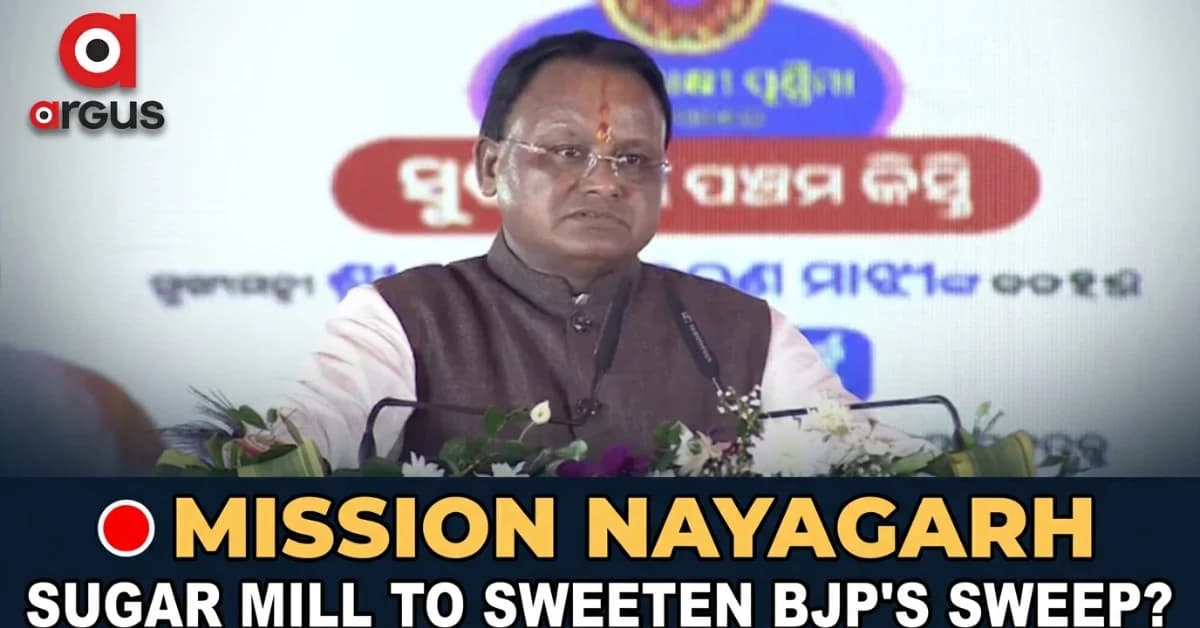
Addressing the Subhadra Yojana fund-transfer programme, the CM harped on the revival of the long-defunct Nayagarh Sugar Mill, making it the centre of his development narrative.
By showcasing the revival of a mill that had become a symbol of political promises, farmer distress and administrative failure, the Chief Minister appeared to be drawing a clear political line: compare the past with the present, and judge governments by delivery.

📱 Get Argus News App
✨For the BJP, Nayagarh is no longer merely a district. It is a mission.
And if 2024 was the saffron party's breakthrough year, the road from the 2027 rural polls to the 2029 Assembly elections may well be paved through two major projects – the Nayagarh Sugar Mill revival and the Brutang Irrigation Project.
From BJD Citadel To A 2-2 Political Battlefield
For years, Nayagarh was firmly in the BJD's political grip. Even when the BJP and BJD fought the 2000s elections as allies, the saffron party had a presence in the district, with Ranpur emerging as one of its important pockets.
Surama Padhy won Ranpur in 2000 and 2004 when the BJP-BJD alliance was in place. But after the alliance broke, Nayagarh largely turned into BJD territory. For years, the regional party dominated all four Assembly segments – Nayagarh, Daspalla, Khandapada and Ranpur.
The 2024 election changed the equation.
The BJP independently won Ranpur and Khandapada, while the BJD retained Nayagarh and Daspalla. More significantly, the BJP came within striking distance of one of the BJD's strongest leaders, Arun Kumar Sahoo, in Nayagarh. The margin was a mere 439 votes.
That narrow defeat is now politically significant.
The 2024 mandate did not merely give the BJP two seats. It gave the party a 2-2 launchpad in a district once considered a BJD fortress.
And the message emerging from Majhi's Nayagarh visit and project announcements is that the BJP is not looking at Nayagarh as a divided district in 2029.
The target appears to be 4 out of 4.
The Sugar Mill: From Political Liability To BJP’s Political Opportunity
Few projects carry the emotional and political weight of the Nayagarh Sugar Mill.
Established in 1988, the mill was once central to Nayagarh's agricultural economy. The district was known for its sugarcane cultivation, and the factory created an economic chain involving cultivators, workers, transporters and ancillary businesses.
But the decline of the mill eventually became a textbook example of how an economic asset can turn into a political liability.
Privatised in 2004 after being sold for a paltry Rs5.22 crore, the mill subsequently went through financial, administrative and legal difficulties. Production stopped and the unit became completely defunct by 2015.
The consequences were visible across the sugarcane belt.
Farmers who had grown cane for the mill lost their assured market. Cultivation declined. The old factory infrastructure deteriorated. The issue triggered agitations, protests and repeated political promises.
For more than a decade, the closed gates of the mill stood as a reminder of what had gone wrong.
For the Majhi government, therefore, the project offers a ready-made political opportunity.
The BJP does not have to search for a development symbol in Nayagarh.
The sugar mill itself is the symbol.
If the BJD years are portrayed as the period of closure, stagnation and promises, the BJP wants the revival phase to become the evidence of a different model of governance.
That was precisely the political subtext of Majhi's renewed focus on the mill during the Subhadra event.
The BJP Formula: From Ganjam to Nayagarh
From Gopalpur on Thursady to Nayagarh on Friday, the BJP govt's political messaging increasingly follows a pattern.
First, identify a long-pending project or public grievance.
Second, highlight the period during which the issue remained unresolved.
Third, announce or begin implementation.
And finally, turn the project into a referendum on governance.
In Nayagarh, the sugar mill provides all three elements – a historical grievance, a development promise and a political contrast.
The BJP can argue that a project which remained trapped in closure, legal disputes and political assurances for years is now being moved through a new institutional mechanism involving Modi PSU Indian Potash Limited (IPL).
The political message is simple:
What was discussed earlier is now being delivered.
That gives BJP govt an opportunity to take a sharp political potshot at its archrival BJD's style of governance without making every speech purely political.
The project does the talking.
A new sugar mill, if executed on the ground, will be more effective politically than a thousand accusations.
The Sugar Mill’s Political Geography: Four Seats At The Core
The immediate political impact of the revival will be felt across all four Assembly constituencies of Nayagarh district.
|
Assembly Constituency |
2024 Winner |
Political Significance of Sugar Mill Revival |
|---|---|---|
|
Nayagarh |
BJD |
Mill located in the core Nayagarh belt; BJP lost by just 439 votes |
|
Daspalla |
BJD |
Potential synergy with Brutang Irrigation and rural agriculture |
|
Khandapada |
BJP |
Important historical sugarcane cultivation belt |
|
Ranpur |
BJP |
Agricultural and cane-growing pockets stand to benefit from procurement revival |
The most politically important seat is Nayagarh itself.
A margin of just 439 votes has effectively placed the constituency at the top of the BJP's target list.
For the BJP, the logic is obvious: if the party has already reduced the BJD's advantage to a few hundred votes, a successful project-delivery narrative could provide the additional political swing needed to flip the seat.
Daspalla, meanwhile, could become the next major target.
Here, the political calculation is more closely linked with the larger development combination being attempted by the Majhi government.
Sugar + Water: The BJP’s Nayagarh Development Equation
The revival of the Nayagarh Sugar Mill cannot be separated from the Brutang Irrigation Project.
The political value of the two projects lies in their possible interconnection.
A sugar mill needs sugarcane.
Sugarcane needs assured cultivation.
And assured cultivation in a region affected by seasonal water stress requires irrigation support.
This is where the BJP can create what may become its central Nayagarh development narrative:
Water for the farm, market for the crop and industry for the district.
The Brutang project can address the first part of the chain.
The sugar mill can address the second.
Together, they can create a political argument that the government is not merely inaugurating isolated projects but building an economic ecosystem.
That is why the development significance goes beyond one factory.
Historically, the Nayagarh mill required around 1.70 lakh metric tonnes of sugarcane annually. A revived procurement chain could potentially benefit farmers, labourers, transporters and ancillary workers across the broader sugarcane belt.
The political impact could therefore extend beyond the factory's immediate location.
Beyond Nayagarh: A Six-Seat Political Ripple?
The direct impact is concentrated in Nayagarh's four Assembly seats.
But the sugarcane economy historically had a wider geographical footprint.
Agricultural areas along the borders of Nayagarh with Ganjam and Khurda could also see indirect benefits if procurement, transport and cane cultivation expand.
That gives the project a potential political ripple effect beyond the district.
|
Electoral Reach |
Constituencies/Regions |
Potential Political Impact |
|---|---|---|
|
Direct |
Nayagarh, Daspalla, Khandapada, Ranpur |
Farmers, workers, transporters, irrigation and local employment |
|
Indirect |
Sugarcane-growing border belts towards Ganjam and Khurda |
Cane procurement, price support and reduced distress sales |
This is what makes the project strategically important for the BJP.
A development project located in one constituency can potentially generate political capital across multiple constituencies.
In electoral terms, the mill is not just a Nayagarh project.
It could become a regional rural economy project.
From 2027 Rural Polls To 2029 Assembly Polls
The BJP's Nayagarh strategy is unlikely to wait until the 2029 Assembly election.
The 2027 rural elections could become the first major political test of whether the project narrative is translating into support at the grassroots.
If the BJP can convert development announcements into visible construction, employment activity and farmer confidence before the panchayat polls, it could strengthen its local organisational base.
That, in turn, could create a two-stage political campaign.
Stage One: 2027 rural elections – convert development delivery into grassroots expansion.
Stage Two: 2029 Assembly elections – convert grassroots expansion into a four-seat sweep.
For the BJP, winning local bodies would be especially important in a district where the BJD had historically built a strong rural organisational network.
Projects can create political goodwill.
But panchayat-level control can help convert goodwill into an election machine.
This makes Majhi's Nayagarh mission a long campaign rather than a one-day announcement.
A New Battlefield In An Old BJD Fortress
Nayagarh today presents a fascinating political contrast.
For the BJD, it remains a district where it still holds two Assembly seats and retains strong local networks.
For the BJP, it is a district where the 2024 election cracked open a political fortress.
The 2-2 split has transformed the district into a battlefield.
And CM Mohan Charan Majhi appears to be using development projects to shape the next phase of that battle.
The sugar mill gives him the political symbolism.
The Brutang project gives him the development infrastructure.
The 2027 rural election offers the organisational test.
And 2029 offers the final electoral target.
The Nayagarh mission has begun.
And
for the BJP, the route to a 2029 clean sweep may now run through two
symbols – water
from Brutang and sugar from Nayagarh.
Also Read: Brutang Project Shows How PM Modi–CM Majhi ‘Double-Engine’ Odisha’s Development Bullet Train, Not Naveen’s 5T Software | Political Analysis
Related Topics
Explore more stories