



Brutang Project Shows How PM Modi–CM Majhi ‘Double-Engine’ Odisha’s Development Bullet Train, Not Naveen’s 5T Software | Political Analysis
Key Points
Bhubaneswar: Nayagarh's air was brimming with politics on Friday. CM Mohan Majhi was there to transfer the 5th installment of BJP's election winning scheme – the Subhadra Yojana.
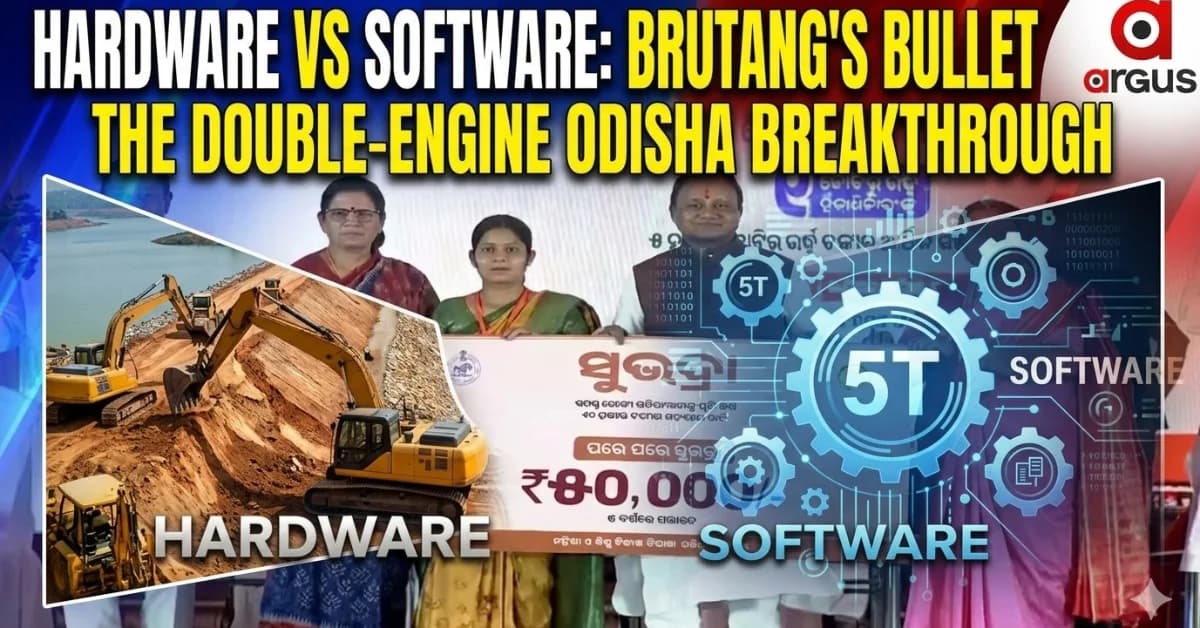
With all MPs, MLAs, including Speaker Surama Padhy, who all share deep political connections with the voters there, on the dias, Mohan Majhi went full guns blazing against his political opponents. Simultaneously, using the Nayagarh soil as his stage, he showcashed to the Odisha voters the BJP double engine model versus the BJD era's governance software – the 5T system.
By centering his narrative on the swift resoultion of a three-decade-old irrigation deadlock within weeks of taking office, the CM secured a powerful political case to present to Odisha voters: while the previous government spoke of 5T, the BJP’s double-engine model delivers the physical infrastructure
For Majhi, therefore, Brutang is no longer merely an irrigation project.
It is fast emerging as a political exhibit.
And the message the BJP is likely to carry to Odisha voters is simple: if Naveen Patnaik’s 5T was the software of governance, Majhi’s double-engine government wants to present itself as the hardware – and the bullet train – that actually moves development on the ground.
From 5T Software to Double-Engine Delivery

📱 Get Argus News App
✨The contrast is politically sharp.
The Naveen Patnaik government built its governance identity around the 5T framework – Teamwork, Technology, Transparency, Transformation and Time. It was a governance software designed to improve administration, accelerate decision-making and create a technology-driven state machinery.
But the BJP can now ask a politically uncomfortable question: What happens when the software does not produce physical output?
For the Brutang project, the answer is visible in the timeline.
The project received its Stage-I, or in-principle, forest approval in August 2010. But it remained caught in environmental compliance requirements, forest-land diversion, wildlife safeguards, compensatory afforestation, land issues and inter-departmental coordination for nearly 14 years before the final Stage-II clearance was issued in July 2024.
The project’s broader history stretched even further, with the irrigation proposal remaining stalled for decades.
CM’s political argument can therefore be built around a straightforward contrast: if governance was being technologically transformed, why did a strategically important irrigation project remain trapped in administrative paperwork for so long?
The BJP’s answer is its double-engine formula.
Majhi’s Delhi Express
The Brutang breakthrough gives a concrete political meaning to the phrase “double-engine government”.
Soon after taking oath, Majhi travelled to New Delhi and directly raised the stalled project with the Union Environment Ministry. The final Stage-II clearance was issued on July 8, 2024.
The speed of the breakthrough is what gives the BJP its political ammunition.
A project that had remained entangled in a long compliance cycle suddenly moved after the change of government.
The Majhi administration then moved beyond clearance.
A dedicated push was mounted to address the pending environmental compliance issues, including compensatory afforestation requirements over 1,524.17 hectares and wildlife mitigation provisions.
The government also cleared a Rs194.07-crore tender for spillway and gate construction and put the project under a 30-month completion timeline.
That sequence – from political intervention to regulatory clearance, financial approval and a construction deadline – is precisely the governance chain Majhi can showcase.
Clearance. Fund. Build. Deliver.
For a BJP government looking to establish a distinct development identity after ending the BJD’s long rule, that chain may be more politically valuable than another governance slogan.
Why Did Brutang Remain Stuck?
The previous BJD government’s handling of Brutang was not a simple story of a project being ignored.
The project faced genuine ecological, financial and logistical obstacles.
The proposed project required diversion of 1,524.17 hectares of forest land near the Baisipalli Wildlife Sanctuary and intersected a crucial elephant movement corridor. This required a complex redesign of infrastructure and the incorporation of wildlife mitigation measures.
The state also had to arrange an equivalent 1,524.17-hectare non-forest land parcel for compensatory afforestation – an enormous land-management challenge involving revenue and forest departments.
The project’s estimated cost also rose to Rs1,658.72 crore, while the need for wildlife protection structures and other safeguards increased the financial burden.
There were also concerns related to displacement and rehabilitation, with the revised project structure affecting more than 680 rural families, according to the project inputs.
But this is where the political debate begins.
Every difficult project has technical hurdles. The political test is whether a government has the capacity – and the will – to remove them.
The Majhi government’s central claim is that the same hurdles that remained unresolved for years were tackled through concentrated political intervention and faster inter-departmental coordination.
The Bullet Train Analogy
In the political language that the BJP can build around Brutang, the comparison may be striking:
5T was the software. Double-engine is the bullet train.
Software can process information, monitor files and improve systems.
But a bullet train moves people and goods from one destination to another at speed.
For Odisha voters, Majhi may seek to argue that development must ultimately be judged not by the sophistication of the governance framework but by how quickly a project moves from file to field.
Brutang gives him a ready-made example.
A
30-year-old aspiration.
A 14-year clearance deadlock.
A new
government.
A clearance within weeks.
Funds unlocked.
A
construction deadline fixed.
That is the story Majhi apparently tried to carry to the electorate.
And it has an additional political advantage: the benefits are not confined to a government office or an urban constituency.
The project is designed to create assured irrigation potential over 23,300 hectares of cultivable command area and cover 309 villages across Nayagarh district. The project inputs estimate that 7.42 lakh people stand to benefit.
Brutang Is Not Just a Dam, It Is a Political Irrigation Network
The physical geography of the project can also become its political geography.
The Brutang project is located in the drought-prone Nayagarh region and is intended to address water scarcity and provide more dependable irrigation to farmers.
The
dam near Manjari village in Dasapalla block is designed as a major
water infrastructure project, with a 552-metre-long earth dam and an
estimated total project cost of Rs1,658.72 crore.
The irrigation
network is expected to touch:
95 villages in Nuagaon
95 villages in Khandapada
98 villages in Nayagarh
15 villages in Odagaon
6 villages in Dasapalla
The project is also intended to strengthen drinking-water supply to Nayagarh town.
This means CM is not merely inaugurating or reviving an irrigation project.
He is building a potential political network across hundreds of villages.
If the project progresses on schedule and irrigation actually reaches the fields, Brutang could become a demonstration project for the BJP’s larger governance argument: the double-engine advantage is not an abstract Delhi slogan; it can change the speed at which Odisha’s long-stalled projects are completed.
The Real Political Battle: Promise Versus Delivery
The BJP’s strongest opportunity lies in converting Brutang from a project story into a story of governance credibility.
For decades, large projects often became election-time promises.
The project timeline note that the rapid clearance and funding decisions can help the government challenge the perception that infrastructure projects remain confined to political announcements and administrative files.
For BJP, the Brutang narrative can therefore travel beyond Nayagarh.
A farmer in another drought-prone district may not receive water from Brutang.
But politically, the government can make that voter ask a different question: if a project that remained stuck for decades can move after the double-engine government came to power, can my district’s stalled project be next?
That is where infrastructure delivery can produce what may be called a development contagion effect.
The physical benefits remain local, but the political message travels regionally.
BJP Govt’s New Odisha Development Model
The Brutang project also offers the Majhi-led BJP government a template for defining its own governance model.
The model has three visible components:
First, direct political intervention: Chief Ministerial ownership of a stalled project.
Second, double-engine coordination: Faster engagement between the Odisha government and the Union government.
Third, execution pressure: Financial approvals, deadlines and direct monitoring.
This is fundamentally different from merely creating a governance architecture.
It is an attempt to create an execution architecture.
The BJP government’s political message, therefore, could be: 5T told the government how to work; double-engine governance is designed to make the government move faster.
And
Brutang is being positioned as one of the early test cases, which has
been crystal clear from the dynamics of the Nayagarh Subhadra money
transfer event.
Also Read: With 42-Year Golabandha Jinx Broken, How CM Majhi's Gopalpur Tour Signals BJP’s Political Consolidation Strategy in Ganjam| Special Story
Related Topics
Explore more stories