



Special Report| ₹ 5,000 Budget, Zero AI, and a 10-Day Sprint: Why Odisha’s 2026 Campus Polls Are a High-Stakes Chess Match
Key Points
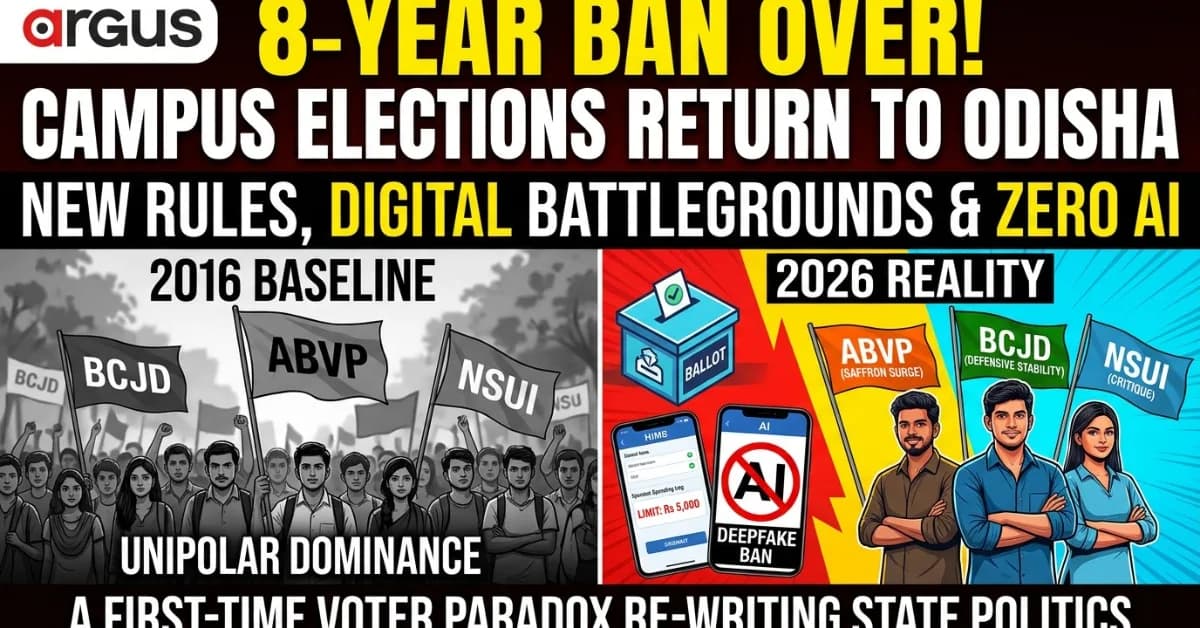
Strict Fiscal Caps: Candidates face immediate disqualification for exceeding a strict Rs 5,000 budget logged via the centralized HIMS portal.
Complete AI & Poster Ban: Synthetic media, deepfakes, and traditional physical wall posters are strictly outlawed to ensure campaign authenticity.
High-Stakes Regional Shifts: Unprecedented political re-alignments transform traditional strongholds across Western, Coastal, and Southern Odisha campuses.
Bhubaneswar: This Autumn brought cheer back to college campuses. The dust of democracy, which had settled thick and hard across institutions for over eight years – initially due to the devastation of Cyclone Titli and later under the pretext of campus violence – was finally stirred on October 5, 2026, when the Higher Education Department of the Government of Odisha issued a historic notification. After an eight-year forced hibernation dating back to 2017, student union elections were officially revived.
Across the length and breadth of the state, from the coastal breeze of Cuttack to the mineral-rich hills of Sambalpur, campus walls instantly transformed into digital battlefields. The democratic right of Odisha’s youth, long locked away by the previous administration under a mountain of security excuses, was unlocked in a single stroke by the newly formed Bharatiya Janata Party (BJP) dispensation under Chief Minister Mohan Charan Majhi.
The announcement sent shockwaves through the state’s academic ecosystem.
The calendar was ruthlessly efficient, compressed into a relentless 10-day sprint: official notifications on October 7, nomination filings and scrutiny packed into a frantic weekend, the iconic "Why I Stand For" meetings on October 14, and the final tryst with the ballot boxes on October 15.

📱 Get Argus News App
✨For the newly minted Gen Z electorate, it was an exhilarating plunge into autonomous democracy. For the veteran political strategists of the Akhil Bharatiya Vidyarthi Parishad (ABVP), the Biju Chhatra Janata Dal (BCJD), and the National Students' Union of India (NSUI), it was a high-stakes chess match played at breakneck speed. Campus democracy was back, but the old playbook was completely dead.
The New Rules: A Digital Sandbox and Legal Handcuffs
The revival of the elections was not a mere copy-paste of the chaotic past.
The BJP government, keen on showcasing a model of clean governance while subtly altering the campaign landscape to its structural advantage, introduced an uncompromising framework of regulations. Chief among these was the hyper-strict enforcement of the Lyngdoh Committee guidelines, coupled with a revolutionary digital surveillance mechanism.
For the first time, every single rupee spent by a candidate had to be logged, itemized, and uploaded onto the state’s centralized Higher Education Management Information System (HIMS) portal.
The spending cap was anchored at a punishing Rs5,000 per candidate. In an era where campus elections historically bled lakhs of rupees in printed banners, hired muscle, and off-campus feasts, this fiscal constraint acted as a legal straitjacket. Any candidate found exceeding this micro-budget faced instant, non-negotiable nullification of their valid nomination.
Furthermore, the state introduced a pioneering, 'draconian' ban on AI-generated fake content, deepfakes, and synthetic media.
In previous national and state elections, political parties had weaponized AI to generate hyper-personalized audio broadcasts, localized deepfake videos of rival candidates, and automated smear campaigns. By strictly outlawing these practices on campus, the government placed a massive premium on absolute authenticity.
The rules also banned defacing campus walls with physical posters, shifting the entire weight of literature distribution onto digital channels.
This inverted the logistics of student politics.
It meant that a candidate could no longer win a campus simply by out-spending their rival or flooding WhatsApp groups with sophisticated, AI-driven digital propaganda.
The game shifted to real-time, organic peer networks. The ruling state dispensation created an environment where the student wing with the most disciplined, naturally active grassroots cadre would thrive, while those reliant on top-down corporate political machinery would stagger under the bureaucratic weight of the HIMS audit.
The New Pitch: The Battle for a Blank Slate
The electoral pitch of 2026 stands out completely from any campaign that preceded it.
The most defining characteristic of this election is the "First-Time Voter" paradox. Because the last state-wide campus elections were held in 2017, not a single undergraduate or postgraduate student sitting in a lecture hall today has ever witnessed or participated in a college election. The collective institutional memory of student unions has been thoroughly wiped clean. There are no senior batches to hand down traditional loyalties; there are no lingering campus syndicates to enforce block voting.
Consequently, the pitch has transformed from historical baggage into an aggressive war for a blank slate.
The ABVP’s narrative is built on the intoxicating theme of "Campus Liberation." Their campaigns frame the previous BJD-led decade as an era of democratic suppression, presenting themselves as the vanguard that fought in the trenches, filed PILs in the Orissa High Court, and ultimately forced the gates open.
Backed by the ideological currents of the ruling state government, the ABVP is pitching a vision of nationalist integration, placement cell overhauls, and direct access to state administrative corridors.
Conversely, the BCJD’s pitch is entirely defensive yet deeply structural. They are appealing to an institutional sense of stability, warning students against the sudden "saffronization" of peaceful academic spaces. Their digital brochures highlight the massive infrastructure upgrades, digital labs, and scholarships instituted during the Naveen Patnaik era.
Meanwhile, the NSUI finds itself pitching an anti-establishment, dual-critique narrative, positioning itself as the only democratic alternative standing against both the faded regional monopoly of the BJD and the aggressive state-backed machinery of the BJP. It is an unscripted, high-velocity experiment in pure political marketing.
Blast from the Past: The 2016 Baseline
To comprehend the sheer magnitude of the geopolitical shift taking place across Odisha’s campuses in 2026, one must look back exactly one decade to the baseline of 2016.
In 2016, student politics in Odisha was a unipolar empire. The Biju Chhatra Janata Dal (BCJD) was an unstoppable juggernaut, protected by the absolute state patronage of the BJD government. In the 2016 elections, BCJD captured over 85% to 90% of all student union panels across the state.
In the coastal belts, it was common practice for BCJD candidates to win executive seats entirely uncontested. Rival nominations from the ABVP or NSUI were routinely scrutinized out of existence or withdrawn under immense political and administrative pressure. At major state universities like Sambalpur and Berhampur, the BCJD panels operated like official extensions of the state secretariat.
Where the BCJD did face resistance in 2016, it came not from the traditional opposition, but from spontaneous Independent Student Fronts.
For instance, in historic upsets that shook the ruling party in 2016, independent candidates managed to snatch the coveted Presidential chairs at Ravenshaw University in Cuttack and Ramadevi Women's University in Bhubaneswar.
The ABVP in 2016 was a growing but highly localized force, restricted to specific pockets of Western Odisha and select evening colleges, while the NSUI was already beginning its long, slow retreat into rural strongholds. The campus of 2016 was a space where power flowed from the top down. The campus of 2026, by contrast, is an unpredictable arena of fractured authorities.
The Regional Mapping: Who Holds the Edge in 2026?
As the state approaches the October 15 ballot, a highly polarized, region-wise breakdown reveals how the political landscape has twisted over the last ten years:
Western Odisha: The Saffron Bastion
In the western belt – encompassing Sambalpur, Rourkela, Balangir, and Sundargarh – the ABVP holds a definitive, overwhelming edge.
Even during the height of BJD rule in 2016, Western Odisha’s campuses were highly volatile zones where ABVP consistently gave BCJD a bloody nose.
In 2026, with the BJP firmly in power at the state level, this region is primed for a comprehensive saffron sweep. Institutions like Sambalpur University and Gangadhar Meher (GM) University are seeing intense ABVP mobilization. The local student body here is highly responsive to the nationalist pitch, and the NSUI has been completely relegated to a marginal, nominal presence.
Coastal Odisha: The Bitter Slugfest
The coastal nerve center – including the political hubs of Bhubaneswar, Cuttack, Puri, and Balasore – is a complete toss-up.
In 2016, this region was the crown jewel of the BCJD empire. Ten years later, it has devolved into a brutal, multi-cornered battleground.
At Utkal University, the traditional dominance of the BCJD is facing a ferocious assault from an energized ABVP cadre that enjoys the psychological backing of the state administration.
At Ravenshaw University in Cuttack, the ghost of the 2016 independent student wave still lingers, making it highly unpredictable. While the ABVP is surging, the BCJD’s urban student networks remain deeply entrenched, turning the coastal belt into a razor-thin margin game where the NSUI is expected to finish a distant third.
Northern Odisha: The Tribal Inversion
Across Mayurbhanj and Keonjhar, the ground has shifted drastically beneath the BCJD's feet. Historically a region of intense binary contests, the ABVP holds the clear upper hand in 2026. Leveraging deep-rooted grassroots organizational networks and the fact that Chief Minister Mohan Charan Majhi hails from Keonjhar, the ABVP has successfully converted campus sentiment into a pro-government wave. The BCJD is fighting a rearguard action to maintain its relevance in tribal degree colleges, while the NSUI has been structurally squeezed out of the primary contest.
Southern Odisha: The Berhampur Paradigm Shift
Nowhere is the mutation of Odisha's student politics more spectacular than in Berhampur and the Ganjam district. In 2016, Ganjam was the home turf of the BJD leadership; campus elections here were a foregone conclusion. Berhampur University routinely saw the entire BCJD panel elected completely unopposed as ABVP and NSUI struggled to even find candidates willing to file nominations.
In 2026, the Berhampur paradigm has inverted entirely, creating a fascinating triangular contest where the ABVP holds a surprising operational edge. This sudden swing is driven by a massive local political variable: Dr. Pradeep Panigrahi, the newly elected BJP Member of Parliament for Berhampur. Panigrahi is a legendary former student leader and an alumnus of Berhampur University. Ironically, during the 2016 baseline era, he was the BJD’s chief strategist who personally engineered the total annihilation of the ABVP on these very campuses.
When Panigrahi switched allegiances to the BJP, he did not just change his party color – he brought his vast, highly loyal, and deeply entrenched personal network of student organizers, local youth leaders, and campus commanders with him into the saffron fold.
As a result, the ABVP in Berhampur has been instantly injected with a seasoned, battle-hardened political machinery. Backed by both the sitting MP and local BJP MLAs, the ABVP is mounting an unprecedented assault on historic bastions like Khallikote Unitary University and Berhampur University. The BCJD is facing its toughest survival challenge in two decades, forced to defend its collapsing southern fortress, while the NSUI is fighting desperately to hold onto its traditional rural pockets in neighboring Koraput and Rayagada.
The Bottomline: The Dawn of a New Era
When the final votes are counted on the evening of October 15, 2026, the results will map far more than just the names of college union presidents. They will outline the future contours of mainstream state politics in Odisha. By bringing campus democracy out of its eight-year coma under a strict regime of digital accountability and anti-AI regulations, the BJP government has ensured that the 2026 elections will stand out as a historic turning point.
The old world of unchecked money, administrative strong-arming, and unipolar regional dominance that defined the baseline of 2016 is officially gone.
In
its place stands a raw, highly digitized, and deeply polarized campus
landscape – one where a new generation of youth is writing the
first lines of Odisha's next political chapter on a completely clean
slate.
Also Read: Special Story| Odisha Student Union Elections 2026: Why Campus Polls Are Unlikely Before Durga Puja Holidays
Related Topics
Explore more stories