



Special Story| Odisha Student Union Elections 2026: Why Campus Polls Are Unlikely Before Durga Puja Holidays
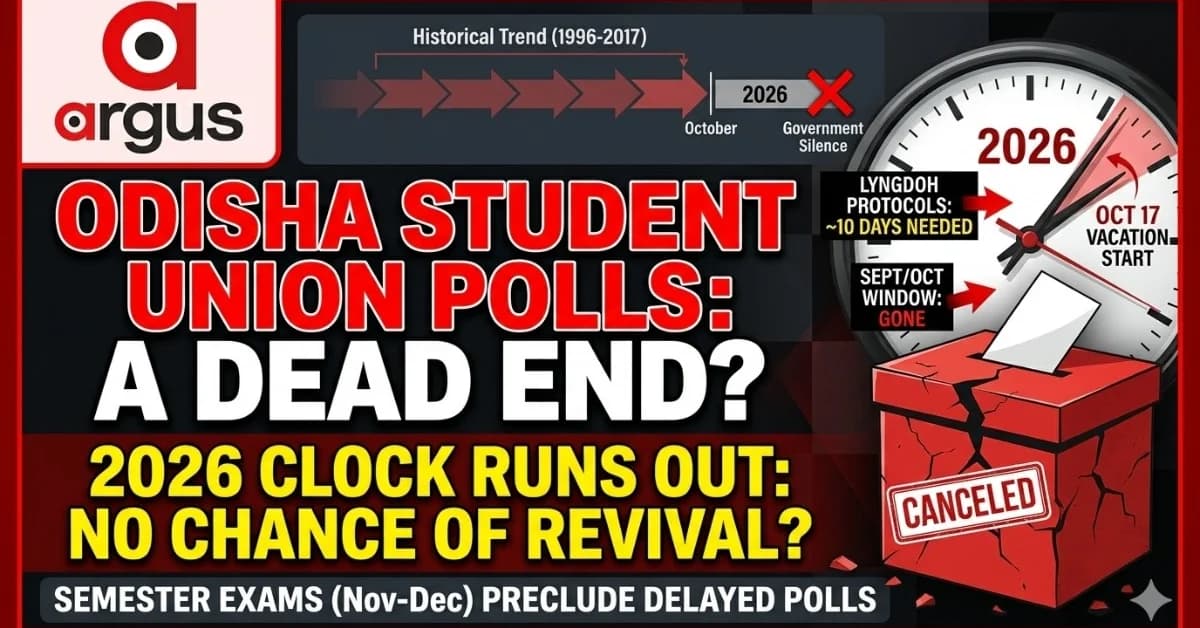
Key Points
Suspended Tradition: Student union elections (Chhatra Sansad Nirbachan) in Odisha have remained in limbo since the last formal polls were conducted in September 2017.
The Pre-Puja Deadline Rule: Historical data shows that elections must conclude at least 48 hours before the autumn vacation—scheduled for October 17, 2026—leaving no remaining runway.
Semester System Barriers: Modern Choice-Based Credit Systems and rigid end-semester exam schedules in November and December legally lock out any possibility of rescheduling polls for later in the year.
Bhubaneswar: For nearly a decade, the corridors of higher education institutions across Odisha have echoed with everything except the vibrant roar of democratic campus politics.
Ever since the last formal ballots were cast in September 2017, the tradition of Chhatra Sansad Nirbachan – the student union elections – has been suspended in a state of calculated limbo.
While the recent statement by Higher Education Minister Suryabanshi Suraj that "deliberations are continuing" and that "no final decision has been taken at the government level" is keeping the hopes alive for the 2026 election cycle, the clock seems ticking out fast.
A deep dive into the historical data compiled by the Odisha Higher Education Department from 1996 through 2017 confirms an absolute trend.

📱 Get Argus News App
✨If the election process did not reach its natural conclusion at least forty-eight hours before the commencement of the autumn vacation, the state simply scrapped or suspended the polls for the entire session. The administration has never entertained the idea of shifting the dates into November or December, preferring a total cancellation over a late-year disruption.
During the pre-Lyngdoh Committee era, spanning from 1996 to 2005, student union elections were largely driven by institutional custom rather than uniform statutory mandates.
Yet, even in those unregulated days, colleges and universities strictly adhered to a tight late-September or early-October voting window.
The Department of Higher Education routinely issued a standardized common academic calendar at the very start of the session, dispatching election circulars to premier institutions like Utkal University, Sambalpur University, and Berhampur University by early September.
Polling was systematically conducted between September 20 and October 5, carefully synchronized with the lunar placement of the festive holidays. If campus violence or factional infighting flared up during the nomination phase in September, individual college principals simply invoked the infamous "Why Poll" declaration, permanently canceling elections for their specific campus rather than adjusting the timeline.
This fast-paced schedule became even more rigid after 2006, following the Supreme Court-mandated implementation of the Lyngdoh Committee Guidelines.
The new framework transformed the election timeline into a highly regulated, high-speed sprint lasting exactly nine to eleven days from the formal notification to the declaration of results.
The final three successful election cycles held in the state perfectly illustrate this clockwork precision.
In 2015, the official notification was dropped on October 3, and voting wrapped up on October 14, precisely forty-eight hours before campuses emptied for the festive break.
In 2016, the notification arrived on September 23, culminating in a successful poll on October 5.
The final cycle of 2017 followed a identical path, with the notification issued on September 13 and polling concluding peacefully on September 23.
The historical precedents established after 2017 further solidify the rule that Odisha's campus polls cannot survive outside this pre-Puja window. I
n 2018, the state government had the schedule of polling date for October 11. However, the unexpected landfall of Cyclone Titli, coupled with a sudden surge in campus unrest, threw the preparations into disarray.
Instead of choosing the seemingly logical path of postponing the dates by a few weeks into November or December, the Higher Education Department permanently canceled the polls for the remainder of the session.
From 2019 onward, the department completely omitted student union election dates from the Common Academic Calendar, using administrative excuses like preserving peaceful academic environments to indefinitely freeze campus politics.
This absolute refusal to push elections into the final months of the year is rooted in a massive institutional roadblock: the modern semester system.
Prior to 2015, under the legacy annual examination model, November and December were relatively quiet months on campus, theoretically allowing for political flexibility.
However, under the modern Choice Based Credit System, late November and December are legally and logistically locked down.
This period is strictly reserved for internal assessments, mid-semester evaluations, practical examinations, and university-wide End-Semester exams. University vice-chancellors and college principals have traditionally maintained an unyielding stance against any political disruptions during this crucial winter window.
Delaying examinations by even a single week risks fracturing the entire state-wide academic calendar, triggering a domino effect that delays graduation degrees and harms students' future employment opportunities.
Furthermore, there is absolutely no historical protocol or mechanism in Odisha where a canceled or delayed autumn campus poll has ever been revived later in the same academic year.
When these historical trends and statutory constraints are mapped onto the current 2026 calendar, the mathematical impossibility of holding the elections becomes undeniably clear.
2026 Clock
According to the official Common Holiday List issued by the Higher Education Department, the Durga Puja vacation for all degree colleges across Odisha is legally mandated to begin on October 17, 2026. Working backward from this date, and adhering to the strict Lyngdoh Committee protocols, the absolute final day to conduct polling and count ballots would be October 15.
However, holding a state-wide campus election requires a mandatory two-tier notification process.
First, the state secretariat must issue an administrative directive to all university vice-chancellors and principals, allowing them a necessary buffer of three to five days to establish internal election committees, appoint chief return officers, and coordinate with local police for campus security.
Only after this groundwork is complete can the individual colleges publish their formal institutional notifications, which instantly triggers the mandatory ten-day Lyngdoh window. This window requires a distinct set of days for filing nominations, scrutinizing papers, addressing appeals, executing withdrawals, and conducting a short, regulated campaign.
For this high-speed sequence to have successfully culminated by October 15, the state government was required to issue its initial notification to university heads by the first forty-eight hours of October.
As
that deadline passes in absolute silence from the Secretariat, the
runway has officially vanished. The calendar math demonstrates that
there are simply not enough remaining days to legally fulfill the
statutory requirements of the Lyngdoh Committee before the October 17
holidays begin.
Also Read: Exclusive| Monsoon May Withdraw From Odisha By October 10; No Cyclone in Bay Of Bengal Till October 15
Related Topics
Explore more stories