



Special Analysis|58 Years of the Kotia Conflict: Inside the Political Opportunism of BJD and Congress
Key Points
Silent Bureaucratic Shift: Andhra Pradesh replaced broad political announcements with targeted poll notifications for three core panchayats covering disputed Kotia villages.
Fresh Legal Battle: Odisha's Revenue Department and Koraput Sub-Collector are approaching the Supreme Court with a contempt petition over status quo violations.
Constitutional Limitations: Article 131 prevents the Supreme Court from permanently drawing state boundaries, leaving the ultimate resolution in the hands of Parliament.
Bhubaneswar: Jan 25, Year 2021: Andhra Pradesh (AP) Government declared to conduct the Panchayat polls in the Kotia gram panchayat of 28 villages in Odisha.
YSR government then in Andhra Pradesh took a heavy-handed, highly publicized approach to shock Odisha's administrative machinery, force the local populace to pick a side through physical ballot boxes, and challenge Odisha’s geographic dominance openly.
A peeved State government had then decided to move to the Apex Court to seek a restraining order to maintain status quo.
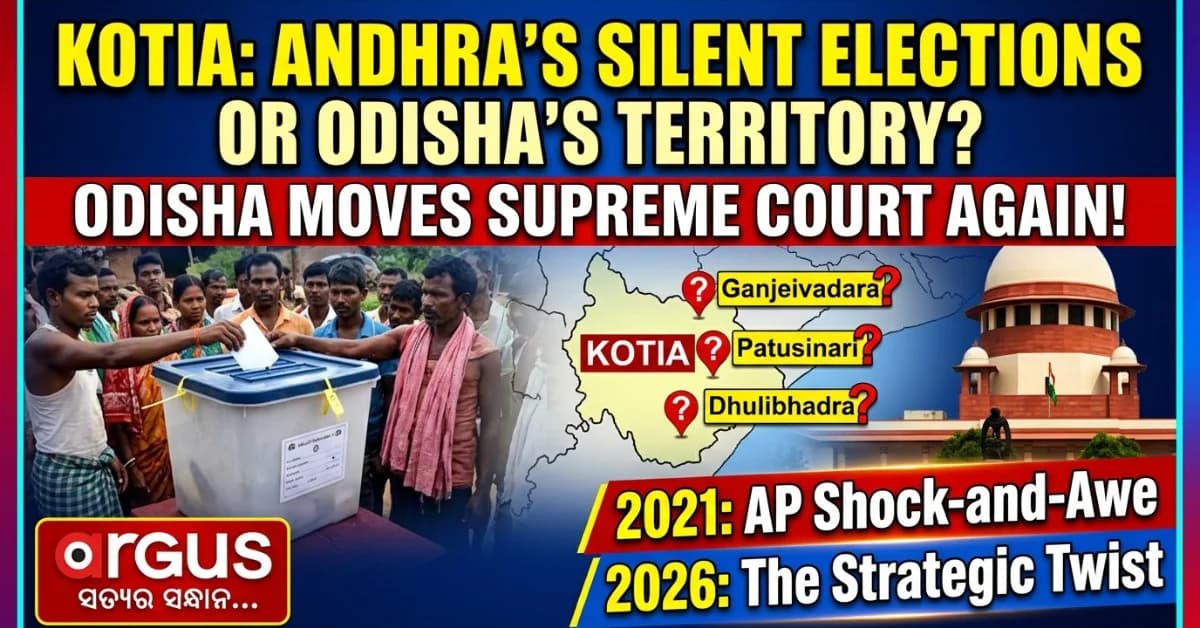
October 14, Year 2026: In 2026, the strategy has shifted from loud political posturing to silent, precise bureaucratic execution. Instead of announcing elections for "Kotia," Andhra Pradesh's State Election Commission issued notifications for three highly specific, alternative panchayats: Ganjeivadara, Patusinari, and Dhulibhadra.

📱 Get Argus News App
✨The Twist this time: These three specific panchayats encompass the core, most heavily populated hubs of the 21 disputed villages. By targeting these three nerve centers, Andhra Pradesh is effectively holding elections for the entire functional populace of Kotia without having to use the controversial word "Kotia" in the official headline.
And this time too, a peeved State Government has decided to approach the Apex Court of India. It will go to the Supreme Court over the contempt of court order, informed Koraput Sub-Collector Fabi Rashid.
Odisha Speaks of What Status Quo Violation, Why Moves SC?
November 14, 1968: Odisha government officially moved the Supreme Court under Article 131 of the Constitution of India. This article gives the Supreme Court exclusive jurisdiction over legal disputes between different state governments.
December 2, 1968, the Supreme Court passed an interim order directing both Odisha and Andhra Pradesh to maintain a strict status quo while the judicial trial proceeded.
30 March 2006: SC passed a permanent injunction on the disputed area. And the Court citing its limitation under Article 131 of the Constitution had ordered that the Court couldn’t decide on the disputes of State boundaries. It said, “The matter will be resolved by the legislature only.
While the Supreme Court dismissed the suit, it recorded an agreement between both states and ordered them to continue maintaining the status quo.
Odisha’s filing of Contempt petition in 2021 has been in response to the March 30, 2006 Judgement on maintaining status quo.
What Happened To 2021 Naveen Govt’s SC Appeal?
The Supreme Court Issued Notices: On February 12, 2021, a division bench headed by Justice A.M. Khanwilkar formally issued a notice to the Andhra Pradesh government, demanding an explanation for why contempt proceedings shouldn't be initiated.
No Concrete Restraining Order: Critically, the Supreme Court refused to pass an immediate stay or restraining order to halt the physical voting process. The court noted that because the technical names used by Andhra Pradesh in its poll notification differed from Odisha's revenue records, it required a detailed response from Andhra Pradesh before halting an ongoing democratic exercise.
The Consequences on the Ground in 2021
Because the Supreme Court issued a notice but didn't explicitly halt the process, Andhra Pradesh went right ahead and successfully conducted the panchayat polls in Kotia in mid-February 2021.
Local tribal villagers – trapped in a dual-identity crisis – marched to the booths and cast their votes, electing Sarpanches and ward members under Andhra Pradesh's administrative framework.
The Lingering Legal Deadlock (2021–2022)
Seeing that a simple contempt petition was yielding no territorial protection, Odisha moved a fresh application in January 2022, urging the Supreme Court to hear its core structural territorial suit.
March 2022: the Supreme Court agreed to hear Odisha’s original arguments but ultimately adjourned the matter pending final judgment, granting both states the liberty to return to court only if "circumstances changed".
The 2021 Script Andhra Familial WIth
This exact 2021 script is why the current October 2026 notification has triggered such deep anxiety in Odisha.
Andhra knows that a "status quo" order functions as a weak shield; by the time the Supreme Court processes a contempt petition, the ballot boxes have already been filled.
2021 Vs 2026: Andhra Pradesh Script
The AP govt then and now has very smartly scripted their Kotia story very cleverly. Take a Glance at the script then and now:
|
Feature / Metric |
2021 Local Body Elections |
2026 Local Body Elections |
|
Notification Date |
Jan 25, 2021 |
Oct 14, 2026 |
|
Polling Timeline |
4 phases (Feb 2021) |
3 phases: Nov 26, Nov 29 & Dec 2, 2026 |
|
AP Ruling Party |
YSRCP (Y.S. Jagan Mohan Reddy) |
TDP-led NDA Coalition (N. Chandrababu Naidu) |
|
Targeted Area |
Broad territorial inclusion under Vizianagaram district. |
Explicit focus on 3 villages in the newly bifurcated Parvathipuram Manyam district. |
|
Panchayat Setup |
General border administrative units (Salur Mandal). |
Operates via 3 specific overlapping panchayats: Ganjeivadara, Patusinari, & Dhulibhadra. |
|
Odisha's Legal Step |
Filed emergency contempt in SC (notice issued, polls not halted). |
Revenue Department & Sub-Collector initiating a fresh contempt petition. |
Can the Supreme Court Adjudicate? (The Article 131 Hurdle)
The biggest legal reason this issue lingers is a jurisdictional constraint under the Indian Constitution.
While Article 131 grants the Supreme Court exclusive original jurisdiction to resolve disputes between two or more states, it contains a critical proviso. The court cannot adjudicate disputes that originate from pre-constitutional treaties, sanads, or agreements.
· The 2006 Landmark Ruling: When Odisha filed an original suit in 1968, the Supreme Court ultimately dismissed it in March 2006. The court ruled that because the boundary confusion stems from vague British-era mappings (such as the 1936 reorganization and the 1942 Gilby demarcation report), the Supreme Court cannot permanently redraw the state boundary.
· Who has the power? The apex court explicitly stated that under the Constitution, only the Union Parliament has the definitive authority to alter, redefine, or settle interstate boundaries. Therefore, the Supreme Court can enforce a temporary "status quo" to prevent flare-ups, but it cannot deliver a final, binding territorial adjudication.
Why Kotia Issue Keeps Lingering?
For decades, Odisha treated Kotia as a legal and political event, whereas Andhra Pradesh treated it as an administrative mission.
|
Factor |
Odisha's Approach |
Andhra Pradesh's Approach |
|
Strategy |
Reactive & Judicial: Rushes to court or sends high-level committees only when Andhra triggers an intrusion. |
Proactive & Bureaucratic: Maintains a steady, aggressive rollout of grassroots machinery year-round. |
|
Ground Presence |
Historically plagued by structural neglect, though recently attempting to catch up with infrastructure pushes like establishing a degree college. |
Deeply embedded. Smoothly issues ration cards, executes targeted welfare schemes, and conducts consistent data collection. |
|
The "Dual Identity" Trap |
Provides standard state benefits, but struggles with the demographic preference of Telugu-speaking pockets. |
Capitalizes on geographical proximity to issue dual Aadhaar and Voter IDs, effectively making residents dual citizens of both states. |
Kotia Evolution: BJD Era vs. BJP Era (2024–2026)
Here is
how Kotia became an Issue
1. Administrative Framework
- Prior to 2024 (BJD Era): Reactive Interventions – formed special monitoring committees in only 2018) and a Rs100-crore development package only after intense border flare-ups or election pushes from Andhra.
- After 2024 to 2026 (BJP Era): Institutional Restructuring – created a dedicated 16-member High-Power Kotia Committee to institutionalize governance (though critics note infrequent meetings).
2. Ground Reach & Outreach
- Prior to 2024 (BJD Era): Infrastructure Deficit – suffered historical neglect that allowed Andhra to build a massive welfare foothold. Late-stage BJD efforts tried bridging the gap with roads and health centers.
- After 2024 to 2026 (BJP Era): Aggressive Welfare Rollout – direct, high-profile administrative presence featuring intensive distribution of land titles, ration cards, pensions, and localized tourism funding.
3. Educational & Social Strategy
- Prior to 2024 (BJD Era): Focused on standard rural tribal development schemes with minimal higher-education connectivity to mainstream Odisha.
- After 2024 to 2026 (BJP Era): Groundwork for a Degree College – Revenue Minister Suresh Pujari announced completed preliminary groundwork to establish a formal degree college directly inside the Kotia cluster. It was considered a strategic move to disrupt the educational dependency of Kotia students on Andhra Pradesh institutions.
4. The Legal Battle
- Prior to 2024 (BJD Era): Filed a fresh status quo violation suit in the Supreme Court in January 2022 after Andhra successfully held panchayat polls in 2021.
- After 2024 to 2026 (BJP Era): Contempt Action—following Andhra's October 2026 election notification, the administration immediately directed local authorities (Koraput Sub-Collector) to approach the Supreme Court with a contempt petition.
5. Political Alignment Trap
- Prior to 2024 (BJD Era): Inter-State Rivalry – fought Andhra Pradesh (under YSRCP) strictly as an external political and legal adversary.
- After 2024 to 2026 (BJP Era): The Alliance Conundrum – the BJP governs Odisha and the Centre, but is allied with the TDP (the ruling party in Andhra Pradesh), leading to intense political scrutiny.
Kotia Issue: 2026 Political Drama
· Political posturing gained momentum on Kotia and a political drama has unfolded in the State.
Former Chief Minister Naveen Patnaik and Congress leaders have aggressively seized upon this. They accuse the state BJP government of a "studied silence" and surrendering Odisha's sovereign territory to maintain political stability in New Delhi.
The main reason for the drama is being clearly discernible as the Opposition latched on the word “Political Stability.”
Kotia: The Political Irony
The Kotia issue lingers because Odisha is fighting a structural and administrative battle using purely defensive legal tools. A status quo order from the Supreme Court acts as a temporary painkiller. Until the political executive convinces the Union Parliament to intervene and officially execute a modern, clear boundary survey, Kotia will remain trapped in this endless loop of competitive federalism and dual governance.
Interestingly, when the Kotia issue has been lingering from year 1968, and as Supreme Court has said, the issue cane be resolved by Union Govt, the then ruling party – Indian National Congress – whose govts ruled in Andhra Pradesh, Odisha and Delhi, had then proactively dealt the matter or even in 2006, the Kotia Cinema would have seen The End.Also Read: Political Analysis| Odisha SIR Row: How CM Mohan Majhi Deployed Riker’s Doctrine against Former CM Naveen Patnaik
Related Topics
Explore more stories