



Political Analysis| Odisha SIR Row: How CM Mohan Majhi Deployed Riker’s Doctrine against Former CM Naveen Patnaik
Key Points
Political Heresthetics in Play: CM Mohan Charan Majhi applied Riker’s doctrine by changing the SIR debate from alleged electoral conspiracy to purging fraudulent and dead voters.
The SIR Data Baseline: Odisha's final voter roll settled at 3.16 crore electors following a net deletion of 17.66 lakh entries—including 8.32 lakh deceased and 8.08 lakh relocated voters.
Neutralizing Opposition Narrative: By prioritizing voter roll cleanup and constitutional sanctity, the Chief Minister effectively disarmed BJD and Congress attacks ahead of upcoming polls.
Bhubaneswar: Political Scientist William
H. Riker had once proposed a doctrine. He said, “If you can choose the
alternative that people vote on, you can control the outcome... The art of
heresthetics is structuring the political world so you win."
In political science, Riker’s phrase "If you can choose the alternative that people vote on" refers to the strategy of controlling the options available in a debate rather than trying to change people's minds.
Instead of arguing over an existing question, a clever strategist completely replaces the question being asked. Whoever successfully defines what the choice is about wins the battle.
Riker’s Doctrine

📱 Get Argus News App
✨In a standard political debate, politicians usually try to persuade people to change their opinions on an issue. Riker argued that this is incredibly difficult. Instead, top strategists use a technique called heresthetics (the art of setting up a political situation to win).
They do this by introducing a new dimension or a different "alternative" to the table, forcing their opponents onto unfavorable ground.
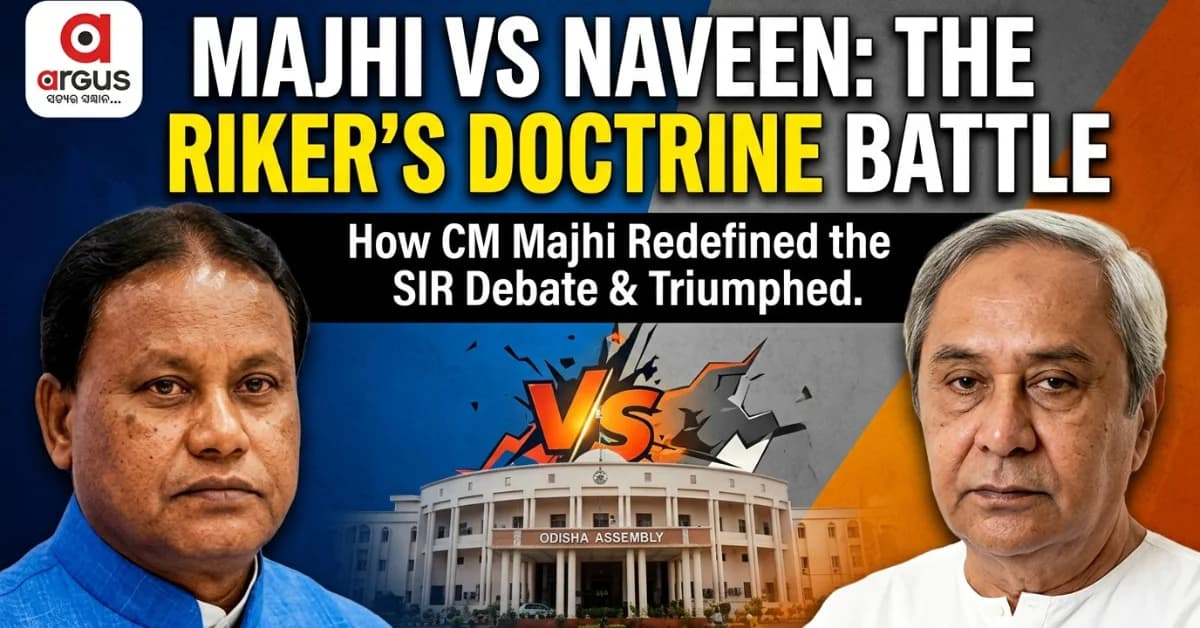
On Monday, Odisha CM Mohan Majhi joins issue with Opposition, especially, former CM Naveen Patnaik on the political hot potato – the SIR.
The CM’s joining issue with former CM Naveen Patnaik reminds the classic playing of Riker’s doctrine. Here is how
· The BJD's Choice: Former CM Naveen Patnaik tried to make the public vote/decide on a specific alternative: Is the government committing an electoral conspiracy, or are they protecting voters?
- CM Majhi's Strategic Shift: Chief Minister Majhi did not engage with that choice. He ignored it and introduced his own alternative. By highlighting "duplicate entries, outdated records, and deceased persons," he changed the alternative to: Do you want an honest, clean democracy, or do you want an error-ridden voter list?
By successfully choosing the alternative that the public focuses on, the Chief Minister effectively controlled the outcome of the debate. He structurally forced the opposition into a corner where continuing to attack the SIR made them look like they were defending fraudulent or dead voters.
Interestingly, CM’s X post when seen in a proper perspective tells a tale.
Odisha has not witnessed SIR in 2026. The State has recorded an SIR in 2002 too, when BJD was on the hot seat along with BJP. No murmurs were heard then, though that SIR too had purged many voters from the voter roll.
Odisha Chief Minister Mohan Charan Majhi’s Monday X post therefore, for
political observers, seems a highly calculated public statement on social media.
In doing so, CM Majhi directly joined issue with former Chief Minister and Biju Janata Dal (BJD) President Naveen Patnaik, effectively shifting the battle from an asymmetric multi-party attack by the regional opposition and Congress into a direct executive-to-opposition showdown.
The Political Timing: Countering a Month-Long Narrative
To fully appreciate the weight of the Chief Minister's intervention, one must examine the meticulous political timing of his statement. This was not a proactive announcement, but rather a deliberate counter-offensive to a narrative that the opposition had been aggressively constructing for several weeks.
Former CM Naveen Patnaik had been leading a highly vocal campaign against the SIR process on social media since late September 2026.
The regional opposition's offensive reached a crescendo on Friday, September 25, 2026, when Patnaik publicly demanded the immediate resignation of the Chief Election Commissioner (CEC), Gyanesh Kumar. Citing media reports of internal policy disagreements among Election Commissioners regarding voter roll exclusions, changes to registration forms, and data access, Patnaik and his allies – including elements of the Congress-led INDI alliance – charged that the SIR was being deliberately overcomplicated to selectively alienate legitimate voters.
For weeks, the BJD and its political partners weaponized the initial high volumes of deletions, alleging a massive electoral conspiracy designed to hollow out the opposition's core support base ahead of future local and assembly polls.
By allowing the opposition's rhetoric to peak and run its course through late September and early October, CM Majhi’s subsequent public intervention functioned as a calculated, stabilizing executive response that sought to systematically deflate the opposition's momentum just as final verification figures crystallised.
Deconstructing Chief Minister’s Political Messaging
CM Majhi’s public statement bypasses partisan rhetorical mudslinging, choosing instead to counter the alliance’s claims using institutional definitions of democratic governance. His message targeted both the general public and the opposition through a multi-layered framework:
1. Redefining Deletions as "Democratic Hygiene"
Where Patnaik highlighted the missing names as a symptom of administrative manipulation, the Chief Minister reframed the core definition of the issue.
Majhi asserted that "duplicate entries, outdated records, and the names of deceased persons remaining on voter lists can compromise their accuracy."
By explicitly identifying these categories, his messaging signaled to the public that a high number of deletions is not evidence of a political purge, but rather the natural byproduct of purging dead weight and administrative errors from a registry that had not seen a full door-to-door survey in nearly a quarter of a century.
2. Depoliticizing the Bureaucracy
In response to the opposition's heavy-handed demands for institutional resignations, Majhi elevated the SIR above routine political squabbling.
He emphasized that "ensuring reliable electoral rolls is, therefore, not merely an administrative necessity, but essential to safeguarding electoral integrity."
This served as a direct rebuke to the BJD and Congress, implicitly characterizing their outcries as political posturing that undermines the foundational trust required for free and fair elections.
3. Neutralizing the Fear of Wrongful Exclusion
The most potent weapon in Patnaik’s arsenal had been his direct warnings to citizens, urging them to verify their records before being stripped of their constitutional rights.
CM Majhi directly co-opted and neutralized this line of attack by stating that the process must "equally, protect every legitimate voter from wrongful exclusion."
By validating the need for voter protection within his own statement, the Chief Minister stripped the opposition of its monopoly on voter advocacy, presenting his government as a balanced arbiter committed to both cleanliness and inclusion.
4. Asserting Constitutional Sanctity Over Minor Grievances
Concluding his messaging framework, Majhi declared that these updates are "not minor administrative details; they go to the heart of electoral fairness, equal representation and the sanctity of every vote."
This statement effectively flipped the moral high ground. It framed the intensive revision process as a grand democratic ideal rather than a clerical tool, positioning those who oppose or obstruct the cleanup as forces operating against the long-term transparency of the state's electoral system.
Data Reality Check: The Final SIR 2026 Footprint
While the political messaging from both camps relied on framing and narratives, the ultimate resolution of the issue rests upon the verified objective data released by the state's election authorities. Following extensive household surveys, periods for claims and objections, and targeted local restoration drives, the definitive empirical baseline for the Odisha Special Intensive Revision 2026 was finalized as of October 11, 2026:
- Total Final Registered Electorate: The total number of valid voters across Odisha settled at 3,16,32,754 electors. This final cohort comprises 1,61,30,319 male voters, 1,54,99,661 female voters, and 2,774 third-gender electors.
- Net Volume of Deletions: When contrasted with the pre-SIR baseline pool of approximately 3,33,99,591 electors, the thorough cleanup resulted in a total net reduction of 17,66,837 names from the final rolls – representing a localized contraction of roughly 5.29% of the previous unverified registry.
- The Breakdown of Removed Entries: The final dataset compiled by the Office of the Chief Electoral Officer (CEO) validated the exact administrative rationale outlined in the Chief Minister’s tweet:
- Deceased Voters: Approximately 8,32,000 deceased individuals whose names had languished on active registries were successfully removed.
- Shifted/Relocated Voters: Around 8,08,000 entries representing individuals who had permanently migrated or changed constituencies were cleaned up.
- Duplicate/Double Enrollments: Over 1,58,000 instances of duplicate voter records were identified and consolidated.
- Absent/Untraceable Entries: Roughly 2,000,000 unverified or permanently absent entries were flagged across successive verification phases.
- Mitigation and Structural Additions: To counteract instances of accidental omission and ensure maximum inclusion, the final roll factored in a net addition of 2,45,720 newly registered or restored electors processed during subsequent verification windows and a three-day emergency registration drive held in early October.
- Concurrently, to support this massive voter alignment, the total footprint of polling stations across Odisha was structurally rationalized and expanded to 45,250 polling booths, up significantly from the previous baseline of 38,123.
Bottomline: The Riker’s Touch
The dispute over the SIR in Odisha demonstrates how a routine electoral process can become a battleground for political control. By leveraging the data of the October 11 final registry, Chief Minister Mohan Charan Majhi successfully answered the long-running narrative constructed by former CM Naveen Patnaik.
By transforming a debate over
massive numbers into a transparent discussion about institutional integrity, the
CM took a leaf from Riker’s book to take on the Opposition narrative. Political
observers are keenly watching on WHAT NEXT?
Also Read: Analysis| Why Odisha’s 2026 Voter List Purge Triggered a Political War—But 2002 Stayed Silent
Related Topics
Explore more stories