



September Signal: Why Odisha BJP Is Calling Its State Executive Meet Now? | Political Analysis
Key Points
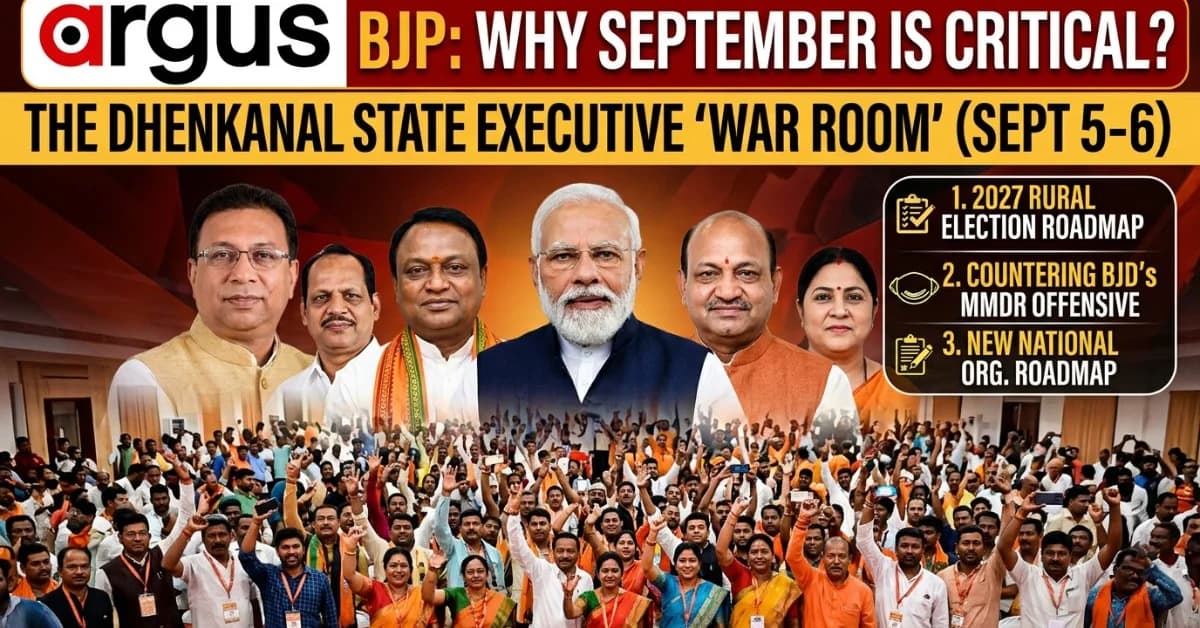
Bhubaneswar: The Odisha BJP’s proposed State Executive meeting in Dhenkanal on September 5–6 may appear, on the surface, to be another organisational exercise. Politically, however, its timing is anything but routine.
The BJP rarely chooses September for its full State Executive deliberations. A look at the party’s meeting calendar over the past decade shows September has emerged as an exception rather than the norm – with the party holding its State Executive in September 2017, again in September 2020, and now preparing for another September session in 2026.
Odisha BJP: State Executive Meetings & Regional Shifts (2016–2026)
|
Year |
Meeting Date(s) |
|---|

📱 Get Argus News App
✨Venue Location
Type / Operational Mode
2016
November 24–25, 2016
Baripada, Mayurbhanj
Physical Regional Meet
2017
April 15–16, 2017 (National)September 27, 2017 (State)
Bhubaneswar (Janata Maidan)
BJP National Executive hosted in Odisha; followed by Standard State Executive Session
2018
January 19–20, 2018
Balasore
Physical Regional Meet
2019
June 15–16, 2019
Bhubaneswar
Post-General Election Strategy Session
2020
September 5, 2020
Virtual / BJP State Headquarters
Peak Pandemic Virtual Session; addressed by JP Nadda via video link
2021
March 7, 2021
Bhubaneswar
Hybrid / Limited Physical Presence
2022
January 21–22, 2022
Bhubaneswar
Standard State Executive
2023
July 3–4, 2023
Bhubaneswar
Pre-Election Mobilization Drive
2024
July 19–20, 2024
Puri
First Post-Victory Meeting; maiden ruling-party governance framework
2026
September 5–6, 2026 (Upcoming)
Dhenkanal
Second Formal Post-Victory Meeting; expected to focus on grassroots consolidation and the 2027 rural polls
Political pattern: The table makes the September pattern particularly visible—2017, 2020 and 2026 – with each September meeting coinciding with a distinct political or organisational urgency.
While State BJP had organised Physical Regional Meets in districts like Baripada → Balasore since 2016, the data hows the BJP's top state political body had met first outside Bhubaneswar in 2024, soon after mega win, in Puri, and the second has been slated to be held in Dhenkanal.
Dhenkanal Is More Than a Venue
The choice of Dhenkanal also carries political symbolism.
The BJP has increasingly moved major organisational meetings beyond Bhubaneswar. The first State Executive after its 2024 victory was held in Puri; the proposed second meet is now slated for Dhenkanal. The shift takes the party’s top organisational deliberations away from the administrative capital and closer to the political field.
Dhenkanal occupies an interesting political geography. It connects the central Odisha belt with areas extending towards the coastal and western regions. For a BJP that is trying to convert its 2024 statewide breakthrough into a durable rural organisation, the location allows the leadership to place greater emphasis on districts and grassroots networks rather than only the capital-centric political ecosystem.
There is also an internal organisational dimension.
With panchayat tickets and local political influence likely to become increasingly important, bringing senior leaders, ministers, MLAs and the organisational machinery together outside Bhubaneswar can help the leadership assess local equations and enforce greater organisational alignment before the rural electoral battle begins.
The
September Signal
A
glance also showed there is a pattern to the September meetings:
urgency.
The 2017 meeting came months after the BJP’s highly successful national executive in Bhubaneswar, post the party’s impressive performance in the Odisha panchayat elections. With the next Assembly election less than two years away, the State Executive was effectively a follow-up organisational exercise to convert the momentum into a sustained political campaign.
Three years later, in September 2020, the circumstances were entirely different but the political imperative was again immediate.
The Covid-19 pandemic had severely restricted physical political mobilisation. At the same time, the BJP was facing an aggressive BJD campaign against the Centre’s farm laws. The September 2020 executive therefore became a platform to work out how the party could keep its grassroots outreach alive despite the pandemic and counter the opposition narrative around the agricultural reforms.
That makes the September 2026 meet politically significant. The question is: what is the urgency this time?
The answer appears to lie in the convergence of three political clocks – the BJP’s new central organisational roadmap, an increasingly aggressive opposition campaign and the 2027 rural elections.
Why September, Again?
The timing becomes more revealing when viewed against the party’s previous September precedents.
In 2017, the party was trying to build on a momentum after rural Odisha win. In 2020, it was trying to remain politically active despite an unprecedented public-health crisis while countering a BJD offensive over the farm laws.
In 2026, the BJP has another set of immediate organisational pressures.
First, the national BJP has undergone a leadership and organisational restructuring under Nitin Nabin. The newly constituted national office-bearers have been given a roadmap that places renewed emphasis on connecting with Gen-Z, first-time voters and digitally active young people. The August 22 organisational briefing at the BJP headquarters also laid emphasis on an immediate three-month operational blueprint.
That directive now has to be translated into an Odisha-specific political strategy.
The State Executive therefore comes at a point when the Odisha BJP has to answer a new question: how does a party that successfully mobilised traditional electoral constituencies build political connect with a generation whose political consumption is increasingly digital?
The state unit’s strategy for Gen-Z and first-time voters is consequently likely to become one of the important organisational themes emerging from Dhenkanal.
A State Executive in Election-Preparation Mode
The proposed Dhenkanal meeting will be only the second major State Executive session of the Odisha BJP since the party formed its first government in the State in June 2024. Its first post-victory executive, held in Puri on July 19–20, 2024, was essentially about the transition from opposition to governance.
The message then was clear: the BJP had won power after 24 years of BJD rule and its cadre had to move from an agitation mindset to a governing-party mindset. The meeting focused on the government’s 100-day agenda, implementation of electoral commitments and communicating the new government’s governance priorities.
The political requirement in September 2026 is different.
The BJP is no longer learning how to govern. It is preparing to translate its Assembly victory into grassroots organisational dominance.
The immediate target is the panchayat and rural local body elections due in early 2027. The proposed meeting is expected to work out a detailed roadmap for the rural polls, with the party looking to consolidate its Assembly gains at the village, block and panchayat levels.
That is a fundamentally different organisational challenge.
Winning an Assembly election can be driven by a powerful statewide narrative, leadership projection and constituency-level contests. Panchayat elections require a far denser political machine – booth workers, village-level networks, local influencers, candidate identification and sustained contact with voters.
Hence, the September meet could effectively become the BJP’s first major rural-election war room after coming to power.
From Assembly Victory to Panchayat Machine
There is another reason why the BJP cannot afford to push this exercise closer to the end of the year.
The rural elections are approaching, and an organisational strategy announced in November or December would leave the party with a much narrower preparation window.
September gives the BJP roughly a three-month operational runway.
That window can be used to identify weak organisational pockets, activate dormant workers, strengthen booth and village-level committees, map local political equations and assign accountability to senior leaders.
The party’s own organisational logic increasingly points towards an early, target-driven election mode, rather than waiting for the formal campaign season. The September meeting provides the political sanction for that transition.
In other words, the Dhenkanal meet may not be about launching the panchayat campaign in the conventional sense.
It could be about rebuilding the BJP machine before the campaign begins.
The BJD Factor: MMDR Narrative
The State BJP's apex politcal body meet will also focus on the BJD’s renewed offensive on the MMDR Amendment Act.
The opposition party has been aggressively raising the issue, creating a narrative that the BJP government at Centre is weakening Odisha's revenue generating capabillity, and trying to paint the State BJP govt and BJP MPs negelecting the State's interests.
The September meet will prove cruicial in shaping a counter narrative to BJD politcal strategey, especially when BJD traditionally steps up its grassroots political outreach around October through its annual Jan Sampark Padayatra.
The timing of the BJP’s September 5–6 meeting therefore gives the ruling party an opportunity to settle its political messaging before the opposition’s annual mobilisation gathers momentum.
The political calculation is straightforward: decide the narrative in September before the BJD takes the battle to the streets in October.
The State Executive can therefore become the platform where the BJP decides not merely what it will say about the MMDR issue, but how its MLAs, MPs, district leaders and grassroots workers will explain the government’s position at the local level, and call the opposition's bluff.
Biggest Question Before State Executive
The BJP’s 2024 Assembly victory ended the party’s 24-year wait for power in Odisha. But an Assembly victory does not automatically translate into control over the State’s rural political architecture.
Fortifying the Party's organisational architecture, therefore, will form the central theme of the State Executive.
In that endeavour, it has to institutionalise its electoral victory at the village level.
That means building a panchayat-level leadership pool, strengthening booth committees, identifying local candidates early, ensuring government schemes and welfare delivery become political touchpoints, and creating a communication structure capable of taking the BJP’s message beyond conventional party workers.
The September meet is likely to be where that transition is formally set in motion.
From Nitin Nabin’s Roadmap to Odisha’s Rural Battlefield
The significance of the Dhenkanal meeting ultimately lies in how quickly the Odisha BJP can localise the new national organisational priorities.
The central BJP’s new emphasis on youth and digital outreach now has to be translated into Odisha’s political geography. A state where rural elections will determine the next test of grassroots strength cannot depend only on traditional cadre mobilisation.
The party will need to combine its conventional booth network with a newer digital political architecture aimed at first-time voters and Gen-Z.
At the same time, the Odisha unit has to prepare for an opposition that is attempting to regain political space by aggressively raising issues such as the MMDR Amendment Act.
That is why the three-month window after September could become crucial.
The BJP may use the executive not merely to pass resolutions, but to assign political responsibilities, identify vulnerable zones, sharpen counter-narratives and put its entire organisational machinery into election-readiness.
The Message Behind Pattern Redux
There is an intriguing political symmetry here.
2017: Panchayat breakthrough → national executive in Odisha → September State Executive follow-up → preparation for the 2019 Assembly battle.
2020: Pandemic restrictions + BJD’s farm-law offensive → September State Executive → strategy to sustain grassroots outreach and counter the opposition narrative.
2026: New national organisational roadmap + Gen-Z outreach imperative + BJD’s MMDR campaign + 2027 panchayat elections → September State Executive in Dhenkanal.
The contexts are different.
But the organisational message is strikingly similar: when the Odisha BJP has chosen September for its apex state-level political meeting, it has usually been because the party has felt the need to act early rather than wait.
This time, the urgency is not about capturing power in Bhubaneswar.
It is about consolidating power in Odisha’s villages.
And that makes the September 5–6 Dhenkanal meeting potentially the BJP’s most important organisational checkpoint between its 2024 Assembly victory and the 2027 rural elections.
Related Topics
Explore more stories