



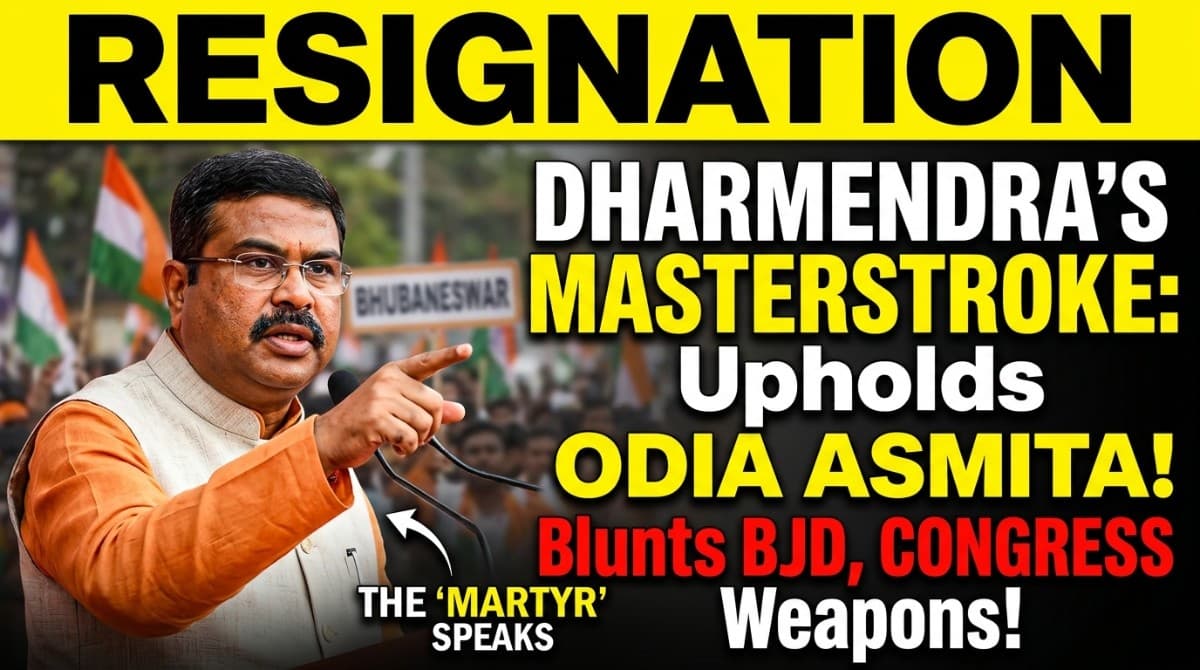
Resignation: Dharmendra Pradhan’s Masterstroke Upholds ‘Odia Asmita’, Blunting Opposition BJD, Congress Weapons| Political Analysis
Key Points
Strategic Resignation: Pradhan's voluntary exit neutralized a high-stakes national crisis and defused opposition-led unrest.
Policy Legacy: His tenure transformed India's education ecosystem through NEP 2020 grounding, digital scaling, and structural reforms.
Odia Swabhiman: The move grants Pradhan unmatched moral high ground, effectively blunting weapons of the BJD and Congress in Odisha.
Bhubaneswar: Politics, like chess, is never won by capturing the biggest piece. It is won by forcing the opponent into a position where every move thereafter only strengthens your game.
Politics resembles chess more than warfare. In war, battles are won by overpowering the opponent.
In chess, however, victory often comes by sacrificing a powerful piece to gain complete control over the board. The inexperienced player celebrates the captured queen; the grandmaster quietly prepares the checkmate.
Dharmendra Pradhan carries the low-decibel composure of a veteran Sangh Karyakarta, rarely seen losing his temper in public, choosing instead a slow, deliberate cadence in speech. In a high-stakes political manoeuvre – rejecting a quiet, back-door exit and instead controlling the narrative via a highly articulated public statement – he transformed a moment of severe administrative crisis into a display of high statesmanship.

📱 Get Argus News App
✨His resignation as Union Education Minister on July 25 should be viewed through that exact prism.
In politics, tactical retreats are frequently used to neutralize structural crises, absorb momentum, and force the opposing side into a strategic dead-end.
The Chessboard Was Never About NEET Alone
In his detailed 543-word, two-page post on X, talking directly to the youth and citizens of the country, the BJP’s strategist-general – known for avoiding high-decibel theatrics – conspicuously stated that his decision was "not about individual prestige," but a deliberate attempt to protect students from prolonged uncertainty. By stating so, he subtly flipped the script.
The Strategic Resignation: Blunting the Opposition's "Nepal-Sri Lanka Redux"
He successfully repositioned his exit as a selfless act of sacrifice to deny "anti-national forces" an opportunity to exploit Gen Z anxiety. The BJP top leader was hinting at the nefarious plans hatched to enact a Nepal- and Sri Lanka-style redux in Delhi. Intelligence Bureau (IB) reports had reportedly informed the government of plots to burn three to four students under the guise of self-immolation if the government rejected the resignation demand.
One can only imagine the quantum of violence the country would have been plunged into afterward.
Moreover, statements by opposition leaders warning that rejecting their resignation demand would trigger nationwide protests larger than those on July 20 exposed the sinister scale of the plot waiting to unfold.
By voluntarily stepping down on July 25, 2026, Pradhan executed a brilliant political stop-switch. This tactical retreat completely took the wind out of the opposition's sails.
Rather than defending a fortified cabinet post, his sacrificial strategy defused a systemic flashpoint, transforming a volatile national liability into a masterclass in political crisis management.
Defusing the Opposition Narrative
Crucially, through his letter, he reminded the public and the opposition of his broad, multi-decade political footprint, citing over four decades of work for students, teachers, and structural reforms. He deliberately reminded everyone that he was not a technocrat who panicked under fire, but an ideologically rooted organizational heavyweight. He highlighted the successful re-conduction of the exam on June 21, 2026, as a vindication of his administrative competence before bowing out on principle.
His primary defensive tactic has always been the aggressive deployment of figures, statistics, and historical timelines to blunt the rhetorical edge of the opposition's narrative.
This time, too, he played a masterstroke when, in his final statements, he attributed his "deep anguish" to "individuals holding responsible positions (Rahul Gandhi and his likes)" who actively misled the youth.
By pointing the finger at the opportunistic nature of the opposition, he zeroed in on how he was targeted by a coordinated systemic campaign.
The Policy Grandmaster: Dharmendra Pradhan's Legacy as Union Education Minister (2021–2026)
Stepping into office on July 7, 2021, as India's Union Education Minister just as the COVID-19 pandemic disrupted learning, Dharmendra Pradhan’s mandate was clear: convert the vision of the National Education Policy (NEP) 2020 into a functional, ground-level reality while seamlessly integrating education with India's booming digital economy. His five-year tenure transformed India's education ecosystem through structured overhauls and dense data integration:
- Hardwiring the National Education Policy (NEP) 2020: Oversaw the historic transition away from the colonial-era 10+2 system, formalizing the 5+3+3+4 architecture (Foundation, Preparatory, Middle, and Secondary stages) and rolling out the new National Curriculum Framework (NCF) that eliminated rigid barriers between Science, Arts, and Commerce streams.
- De-Colonisation and Regional Language Promotion: Pioneered the "education in mother tongue" agenda by translating and launching technical education textbooks (AICTE engineering and medical curriculums) in regional languages like Odia, Hindi, Tamil, and Marathi.
- Merging "Degrees" with "Skills": Bridged academic degrees and vocational trades by launching the National Credit Framework (NCrF) for seamless transitions from ITIs to universities, while integrating coding, AI, and data analytics into middle school.
- Digital Infrastructure & Mass Scaling: Scaled last-mile learning via PM e-VIDYA's 200+ dedicated satellite TV channels for remote tribal areas and introduced the Automated Permanent Academic Account Registry (APAAR)—the "One Nation, One Student ID" digital identity card.
- Institutional Frameworks: Secured record budget allocations (₹1,28,650 crore in Union Budget 2025–26) and proactively established the K. Radhakrishnan Committee to overhaul National Testing Agency (NTA) protocols.
Home Turf Resonance: Turning the Tables in Odisha
Nowhere is the impact of this move more profoundly felt than in Pradhan's home state of Odisha. The contrast in political accountability across eras is stark:
- Past Eras (BJD & Congress): Since 1997—when a young Dharmendra Pradhan fiercely protested against Class 12 paper leaks under the then-Congress regime with zero ministerial resignations—through the 24-year Naveen Patnaik era, which saw dozens of paper leaks, student protests, and demonstrations, not a single minister ever resigned, nor did Patnaik demand one.
- Present Day (Pradhan): Faced with national exam pressures, Pradhan immediately laid down his papers on moral grounds, replacing a shielded bureaucracy with an accountable statesman.
Days before his resignation, former Chief Minister Naveen Patnaik had broken a long-standing silence to explicitly demand Pradhan's exit over exam irregularities. By actually resigning, Pradhan over-delivered on the opposition's challenge, causing the BJD's attack to dramatically boomerang.
Upholding Odia Asmita
In Odia culture, humility, sacrifice, and moral uprightness are prized political virtues.
By walking away from a powerful Union Cabinet berth with his head held high, the "son of the soil" has fulfilled the Odia Swabhiman (Pride) archetype.
Freed from the exhausting daily management of a complex ministry, Pradhan returns to Odisha not as a defeated politician, but as a martyr for the student community.
He now holds absolute moral high ground, armed with an unanswerable rhetorical weapon against both the BJD and Congress: "I resigned on a matter of principle. What did your ministers do when Odisha's youth suffered?"
Having already engineered the historic defeat of Naveen Patnaik in the 2024 elections through the potent weapon of Odia Asmita, Pradhan's strategic resignation further cements that legacy.
It equips
him with unmatched moral capital to guide the Mohan Charan Majhi-led BJP state
government from the backend, systematically dismantle remaining opposition
networks, and seamlessly dominate Odisha's political landscape for the next
decade.
Also Read:Why Naveen Patnaik's Bid to Corner Dharmendra Pradhan Ended Up Cornering Himself; How the Political Chess Went Wrong | Special Report
Related Topics
Explore more stories