



Political Analysis| What’s Cooking in Odisha BJP: Two High-Profile Visits in 7 Days, 2017 Poll Wizard Saudan Singh in State Hints Something Big
Key Points
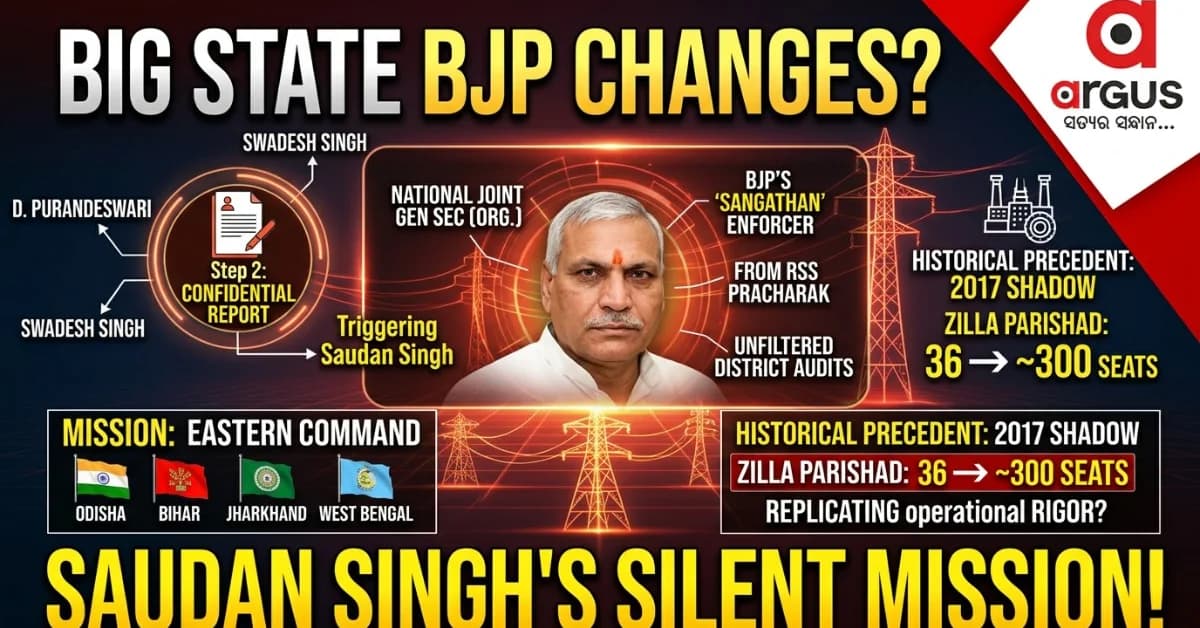
Confidential Report Catalyst: Saudan Singh’s rapid deployment follows a confidential assessment submitted by state in-charges to BJP National President Nitin Nabin.
Closed-Door Grassroots Audit: The premier RSS-loaned organizational strategist is bypassing state filters to directly evaluate district dynamics, booth committees, and cadre grievances.
Focus on Government-Cadre Synergy: The high-level review aims to streamline communication between the ruling state government and party workers ahead of upcoming elections.
Bhubaneswar: Big structural changes in the offing for the State BJP?
This is the defining question gripping the minds of political observers across Odisha.
Barely a week after the high-profile visit of State In-Charge D. Purandeswari and Co-In-Charge Swadesh Singh, the State BJP on Sunday welcomed another heavyweight central leader, signaling a major organizational shift.
Saudan Singh, the newly appointed BJP National Joint General Secretary (Organisation), arrived on a high-stakes, three-day official visit to the state.

📱 Get Argus News App
✨In the hyper-calculated world of BJP internal mechanics, such consecutive top-tier visits are never coincidental.
Political insiders suggest that this rapid deployment was triggered by a confidential report compiled by the state in-charges and submitted directly to BJP National President Nitin Nabin. The sudden presence of the party’s premier organisational auditor indicates that the central leadership has initiated a swift transition from diagnostic assessment to administrative execution.
The Anatomy of the Power
To understand the gravity of Saudan Singh’s visit, one must dissect the unique architecture of the position he occupies.
Unlike regular political general secretaries who manage public relations, address media panels, or contest elections, a National Joint General Secretary (Organisation) operates almost entirely away from the public eye.
As per the structural design of the saffron party, this specific office is traditionally staffed by a seasoned Rashtriya Swayamsevak Sangh (RSS) pracharak (full-time volunteer) loaned directly to the BJP. The mandate of an organisational secretary is not to capture headlines, but to enforce internal discipline, protect the core ideological compass, and build a resilient grassroots apparatus.
While state ministers and party presidents serve as the public faces of governance, the organisational general secretary holds the structural veto – frequently driving internal appointments, overseeing district-level re-allocations, and filtering ground-level truths for the central command in New Delhi.
Following the latest national reshuffle under Nitin Nabin, Saudan Singh was placed in charge of a highly sensitive geopolitical zone: the Eastern Command, encompassing Odisha, Bihar, Jharkhand, and West Bengal.
By designating Bhubaneswar as his strategic base of operations, the central leadership has made it clear that Odisha is a top priority in its eastern expansion strategy.
The Trigger Factor: Is It In-Charge's Report?
The unfolding situation in Bhubaneswar highlights the structured, multi-layered oversight mechanism that defines the BJP's organizational model:
Step 1: Ground Audit
State In-Charge & Co-In-Charge conduct localized tours, assessing administration and factional dynamics.
│
▼
Step 2: The Briefing
A detailed, confidential report is submitted directly to National President Nitin Nabin.
│
▼
Step 3: Triggering the 'Sangathan'
The Party President tips off the Organisational Wing to initiate structural corrections.
│
▼
Step 4: Silent Intervention
Saudan Singh arrives for a closed-door audit to streamline the state unit.
When D. Purandeswari and Dr
Swadesh Singh completed their initial rounds, their brief was to evaluate the
ground reality – specifically how effectively the state administration was
functioning and whether the grassroots cadre felt aligned with the leadership.
Political analysts conclude that their subsequent briefing to the party president acted as the catalyst for Saudan Singh's sudden travel plans.
When a political report signals internal friction points, communication gaps between the government and the cadre, or potential complacency at the district level, the central leadership deploys the Sangathan (the organisational wing) to step in.
Saudan Singh's visit represents the arrival of the party's top enforcer, equipped with the authority to implement necessary adjustments.
The Three-Day Masterclass in Organisational Engineering
True to his reputation as a disciplined strategist, Singh began his visit with a deliberate focus on spiritual and cultural foundations, offering prayers at the Shree Jagannath Temple in Puri on the opening day of his tour. Yet, as he returned to the capital city, the agenda shifted entirely to intense, closed-door internal audits.
Over the course of his three-day stay, his itinerary has been meticulously designed around three core strategic pillars:
1. Strategic Evaluation and Government-Cadre Alignment
Chaired alongside State President Manmohan Samal and State Organisation Secretary Manas Mohanty, these high-level sessions focused on structural alignment. The central objective is to ensure the ruling state government and the organizational wing operate in lockstep. Singh's focus remains on ensuring that government policies translate directly into sustainable political capital at the grassroots, while addressing any minor structural vulnerabilities early on.
2. Bypassing Filters: Unfiltered District-Level Audits
One of the defining features of a Saudan Singh audit is his practice of bypassing formal administrative channels to engage directly with local leadership. By holding targeted review sessions with regional observers, Mandal (block) presidents, and booth committee heads, Singh collects unvarnished feedback directly from the ground. This approach ensures the central leadership receives an authentic assessment of district-level dynamics, uninfluenced by state-level filters.
3. Administrative Equilibrium and Ideological Cohesion
As a RSS man within the party structure, a key part of Singh’s mission involves conducting private consultations with local Prant Pracharaks (regional RSS coordinators). These discussions aim to reinforce ideological alignment across both the legislative and organizational wings of the party, proactively resolving internal grievances and keeping the party's core support base fully unified.
|
Feature / Role |
State In-Charge (e.g., D. Purandeswari) |
Joint General Secretary (Organisation) (Saudan Singh) |
|
Primary Focus |
Public relations, electoral alliances, and general political oversight. |
Internal discipline, grassroots infrastructure, and ideological alignment. |
|
Operational Style |
High-visibility public tours, media engagements, and external messaging. |
Low-profile, closed-door strategy sessions and internal corporate-style audits. |
|
Core Mandate |
Acts as the primary political channel between the state unit and the Central Command. |
Serves as the direct bridge between the RSS framework and the BJP hierarchy. |
The Historical Precedent: The 2017 Shadow
The sense of urgency surrounding Singh's arrival is deeply tied to his track record in the region. Within the Odisha BJP cadre, his name carries significant weight due to his pivotal role ahead of the 2017 panchayat elections.
During that period, Singh was instrumental in reshaping the party's grassroots infrastructure. Under his guidance, a systematically managed booth-level campaign led to a remarkable turnaround: the BJP's Zilla Parishad tally rose from a modest 36 seats in 2012 to nearly 300 seats in 2017.
His return to Odisha, this time, when 2027 panchayat polls are around 6 months away, with an expanded mandate over four key eastern states, indicates that the central leadership is looking to replicate that same operational rigor.
For rival political parties in the state, his presence serves as a clear signal that the BJP is focused on consolidating its position and building long-term organizational momentum.
The Road Ahead
As Saudan Singh wraps up his three-day tour, the focus will then move to how his findings will shape the party's next steps. The insights gathered from his direct interactions with grassroots workers and regional coordinators will guide upcoming organizational decisions.
For the local cadre, the
message from the central command is clear: complacency is not an option. The
consecutive visits from the state in-charges and the national organizational
chief underscore that the central leadership is keeping a close watch on
Odisha's political landscape, ensuring the party machinery remains disciplined,
unified, and focused on the future.
Also Read: Political Analysis| BJP's Odisha Blueprint: Transforming Anganwadis into 'Shakti Kendras' for 2027 Rural Polls
Related Topics
Explore more stories