



Political Analysis| BJP's Odisha Blueprint: Transforming Anganwadis into 'Shakti Kendras' for 2027 Rural Polls
Key Points
Tactical Overhaul: The BJP has integrated its 2027 rural poll strategy directly into its organizational hardware, replacing broad rallies with micro-level election management.
Government-Party Synergy: Chief Minister Mohan Charan Majhi and his cabinet were directed to co-brand flagship initiatives like Subhadra Yojana with the party apparatus.
Anganwadi Integration: Rural Anganwadi centers are being transformed into functional Shakti Kendras to anchor political messaging in daily community life.
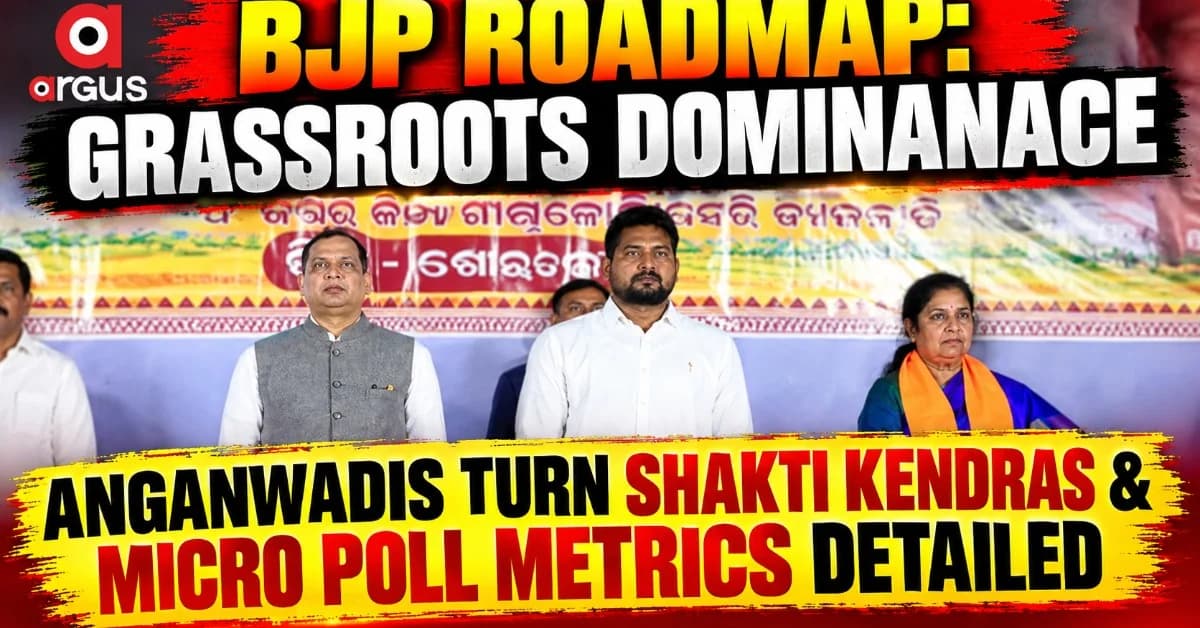
Bhubaneswar: The Bharatiya Janata Party (BJP) has prepared a roadmap to win the grassroot elections to be held early next year.
With its sights set firmly on consolidating power after forming the state government, the party has engineered a tactical organizational overhaul designed to ensure absolute dominance at the lowest tiers of governance.
The Odisha in-charge, D. Purandeswari, brings a formidable political USP blending seasoned administrative acumen as a former Union Minister, elite status as a National Vice-President, and a powerful rhetorical capability to command regional narratives.
Working in close coordination, co-in-charge Swadesh Singh provides his core political USP as an intellectual powerhouse, a former academic and ABVP stalwart skilled in micro-level booth management, youth outreach, and transforming policy metrics into relatable grassroots campaigns.

📱 Get Argus News App
✨Together, they have outlined a meticulously structured roadmap that penetrates deep into rural territory.The software for the 2027 Rural Poll has been booted seamlessly into the party's organizational hardware.
The in-charge and co-in-charge’s back-to-back strategy meetings and two monumental state visits tell the tale of a relentless campaign engine already running at peak capacity.
A core pillar of this grassroots blitz is the highly innovative hyper-local alignment of welfare delivery with political structure: Anganwadis will be turning into the BJP’s core Shakti Kendras.
This foundational blueprint marks a departure from traditional macro-campaigning, steering the party toward an environment where every micro-hub of community gathering becomes a fortress of support.
Booting the 2027 Rural Poll Software into the Party Hardware
The organizational shift inside the state unit demonstrates how the ideological "software" of the upcoming 2027 polls has been fully integrated into the physical "hardware" of the state's party infrastructure.
This means that the party is no longer just holding scattered public rallies or relying on broad media campaigns. Instead, it is systematically transforming its structural bodies – from state-level committees down to district, block, and village units – into functional nodes designed exclusively for election management.
The entire hierarchy is being synchronized with digital data suites, real-time voter metrics, and performance trackers for regional leaders. Every party worker is being assigned specific, quantifiable metrics to achieve within their respective zones, ensuring that the theoretical strategies devised in central rooms are seamlessly executed by the functional machinery on the field.
High-Octane Strategy Meetings and Monumental Visits
The pace of the campaign has been set by consecutive back-to-back strategy sessions and highly visible state visits by the newly appointed leadership team.
The roadmap began where all sustainable political victories are built – in the trenches of the party apparatus. Purandeswari and Singh started their tour at the state party office, sitting down exclusively with:
State and district functionaries
District presidents and block (mandal) in-charges
Frontline wing (Morcha) coordinators
This was a pure stock-taking audit. In a state where a party has recently swept to historic power, complacency is the immediate enemy.
The in-charges used this session to review the hard operational metrics of the party’s booth-level committees – specifically the Trideo and Panna Pramukh networks. They demanded performance tracking files on how well the ongoing Seva Sankalp Abhiyan was penetrating local blocks. The central leadership used this phase to identify local gaps, map out micro-level vulnerabilities, and test the immediate field readiness of the workers before handing out new top-down directives.
These visits served a dual purpose: first, to signal to rival political factions that the ruling party is moving with absolute unity and speed; and second, to directly interact with the rank-and-file workers to boost morale.
By holding consecutive review meetings with state office-bearers, district presidents, and front-line coordinators immediately upon arrival, the leadership has broken down regional bottlenecks and eliminated internal inertia. These extensive visits have acted as the primary catalyst, transforming abstract poll theories into localized action plans and creating an immediate wave of political momentum across the state's rural landscape.
Codifying "Government-Party Synergy"
Once
the structural audit of the organisation was complete, the in-charges
took their freshly gathered data straight to the executive branch.
They sat down with Chief Minister Mohan Charan Majhi and his
ministers in a closed-door coordination review.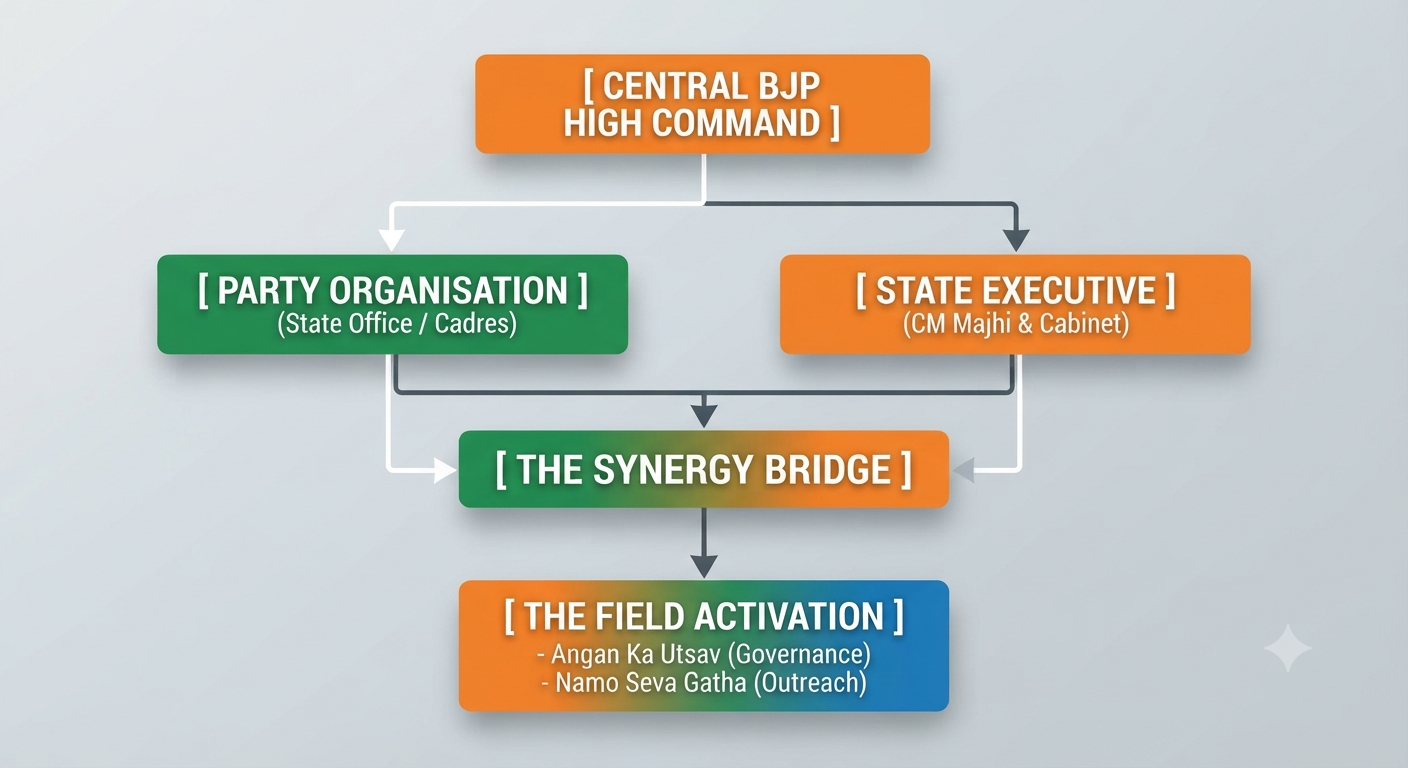 This
meeting was designed to establish a strict rulebook on
party-government coordination. The visiting in-charges made it clear
to the cabinet that the government must not operate inside an
administrative silo controlled by career bureaucrats. Along with
their roadmap, they asked the CM and ministers to aggressively
address communication gaps
and re-invigorate their public outreach.
This
meeting was designed to establish a strict rulebook on
party-government coordination. The visiting in-charges made it clear
to the cabinet that the government must not operate inside an
administrative silo controlled by career bureaucrats. Along with
their roadmap, they asked the CM and ministers to aggressively
address communication gaps
and re-invigorate their public outreach.
The primary directive given to the ministers was simple: every flagship initiative – from Subhadra Yojana to newly expanded local infrastructure layouts – must be physically co-branded and delivered alongside the party organisation. Ministers were tasked with backing the cadres on the ground, creating a unified machine where government welfare directly fuels party goodwill.
Two Field Visits, One Clear Signal
The true genius of the trip lay in the two field visits chosen by Purandeswari and Singh. They did not visit corporate tech hubs or high-end infrastructure sites. Instead, they went straight to the rural public squares.
Visit 1: The Anganwadi Courtyard (Capturing the Hearth)
By participating in the Angan Ka Utsav, the leadership visually anchored the party's new focus on everyday social infrastructure. With the Subhadra Yojana cash transfers already having broken the BJD’s grip on women, the BJP is now cementing that victory through the 1.48 lakh frontline Anganwadi workers and helpers. By showcasing state-sponsored maternal welfare and child health initiatives, the BJP is attempting to build a daily emotional relationship with the entire rural family unit.
Visit 2: "Namo Seva Gatha" at Jamukoli (The Propaganda Engine)
On October 4, the leaders traveled to Jamukoli near Jatani to sit among the public and watch the "Namo Seva Gatha – Pathprant Natak" (a street play celebrating 25 years of PM Modi’s public service).
This visit reveals the creative communication arm of the new roadmap. Purandeswari openly stated that roadside street theater is the single most effective way to take development stories directly to the people.
Politically, it signals a shift toward emotional, low-cost narrative storytelling. By embedding the theme of Viksit Bharat into traditional folk art formats, the BJP is bypassing digital echo chambers and delivering the message of central government success straight to the rural electorate.
Transforming Anganwadis into Strategic Shakti Kendras
The most innovative element of this grassroots roadmap is the structural integration of local spaces, specifically by focusing on transforming Anganwadis into the party's functional Shakti Kendras.
In rural ecosystems, Anganwadi centres serve as the vital core of daily social interaction, public health, and child development. By focusing political energy on these locations, the party aims to anchor its organization within the natural gathering points of rural communities.
The strategy involves turning these spaces into communication hubs where the benefits of central and state welfare initiatives are continuously explained to the public. This structural approach ensures that the party's political message is seamlessly woven into the daily socio-economic life of the village, making it a continuous presence rather than an occasional campaign visitor.
The entire two-day visit was a masterfully sequenced political activation.
Purandeswari
and Singh diagnosed the internal machinery, institutionalized the
relationship between the CM's office and the grassroots worker, and
physically demonstrated through field visits exactly how they expect
upcoming local body and Panchayat polls to be fought: through
relentless, everyday public contact and high-visibility community
service.
Also Read:EXCLUSIVE | Odisha’s October Political Showdown: BJD Revives Centre-versus-State Battle, BJP Deploys Seva Setu to Defend Its 2024 Victory
Related Topics
Explore more stories