



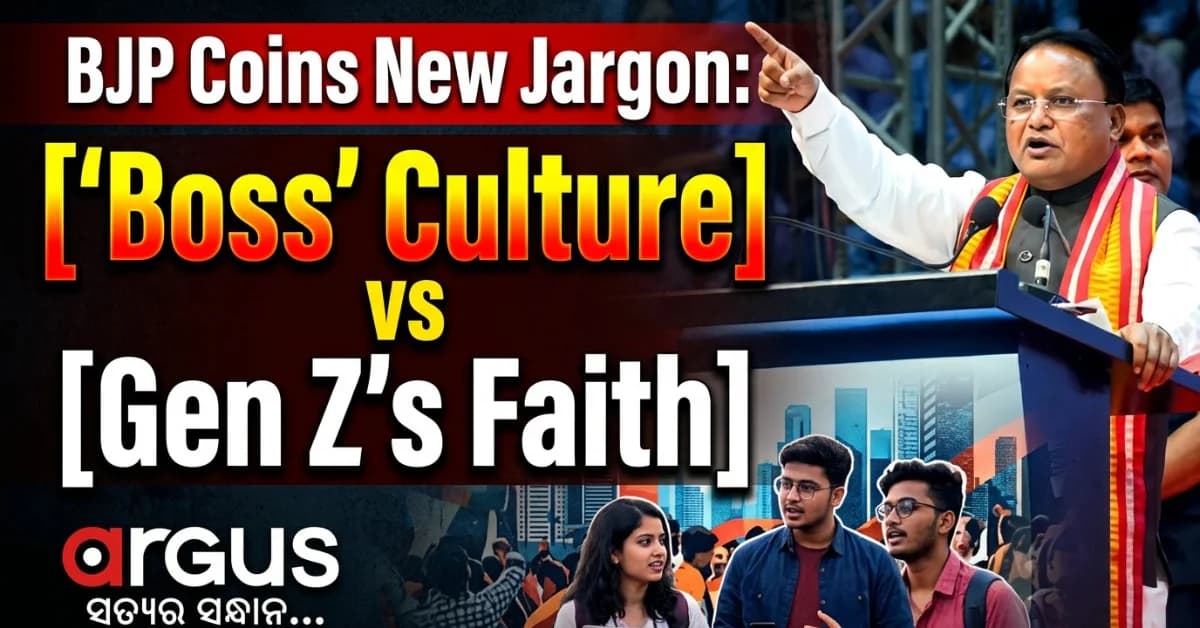
Political Analysis| Odisha College Results 2026: State BJP Draws New Battlelines — ‘Boss’ Culture vs ‘Faith in Gen Z’
Key Points
Political Gamble Pays Off: CM Mohan Charan Majhi lifted the 8-year campus poll ban, turning predicted Gen Z unrest into a major political and organizational win for the ABVP.
Dual Attack on BJD: Majhi slammed BJD’s past student poll ban, reframing former youth leaders in the opposition as compromised figures while proving Gen Z's civic maturity.
Building Long-Term Brand Loyalty: By restoring campus democracy, the BJP is securing grassroots leadership and establishing a reliable youth base ahead of the 2027 elections.
Bhubaneswar: Odisha’s BJP leadership seems deeply aligned with the foresight of noted American author Libba Bray, who famously observed, "There are no safe choices. Only other choices."
This stark political insight was recently broadcast loud and clear by none other than Chief Minister Mohan Charan Majhi himself at a massive youth conclave in Cuttack – an event widely seen as a triumphant toast to the sweet success of the party's student wing, the ABVP
While the Sunday air outside echoed with festive drumbeats and holiday vibes, the indoor stadium in Cuttack carried an entirely different kind of electricity. The arena was chock-a-block with saffron, white, and tricolour banners. Inside, the atmosphere was thick with the rhythmic thumping of local drums, intermittent bursts of slogans, and the high-decibel energy of thousands of undergraduate and postgraduate students. Gathered on and around the central stage was a formidable phalanx of the ruling Bharatiya Janata Party’s (BJP) state apparatus.

📱 Get Argus News App
✨From senior cabinet ministers and veteran organisational strategists to frontline legislators, the message delivered by the sheer density of this political heavyweight presence was unmistakable: this was not a routine university event. This was a formal victory lap, a coronation of a new political vanguard, and the unveiling of a highly aggressive, meticulously calculated blueprint for youth politics in Odisha.
Against this vibrant backdrop, Chief Minister Mohan Charan Majhi took the microphone. Flanked by senior leaders who all wore expressions of visible satisfaction, Majhi delivered a blockbuster political statement.
"While the previous regime callously banned student polls in 2017 while their leaders, who once boasted of student activism, remained cowardly silent under their boss's diktat, and voices urged us to delay under the pretext that 'Gen Z is upset,' we placed our absolute trust in the youth, and they responded by delivering an entirely peaceful, disciplined, and decisive mandate."
For political observers, the core of his message has two big political statements:
· A direct frontal assault on the structural legacy of the Biju Janata Dal (BJD) and its leader, Naveen Patnaik, which is a normal political statement in any electoral democracy. Since the former CM has suspended the campus polls on the ground of violence in campus, and the successful completion of the college elections with nominal violence incidents across, the CM’s attack on his predecessor is an expected political firework
· But the blockbuster statement of “voices urged us to delay under the pretext that “Gen Z is Upset” that reflected Libba Bray’ wise thought.
The Anatomy of a High-Stakes Political Gamble
To understand the gravity of the BJP’s celebration, one must understand the sheer scale of the gamble. When the Majhi administration fulfilled its manifesto promise to lift the eight-year suspension on campus democracy, mainstream political analysts and opposition strategists predicted a misstep.
The narrative, carefully cultivated in local media, was that the newly elected BJP government was walking into an electoral minefield. The prevailing wisdom suggested that Gen Z was deeply disgruntled – latent anxieties over local infrastructure gaps, shifting global trends, and the unpredictability of first-time voters would spark a massive anti-establishment backlash.
There were explicit warnings within administrative circles that reviving polls could lead to campus unrest, factional violence, and an embarrassing defeat for the ideological parent organization's student wing, the Akhil Bharatiya Vidyarthi Parishad (ABVP).
Had the campuses descended into chaos, the BJD’s historical justification for banning the polls in 2017 – maintaining academic sanctity – would have been vindicated.
Instead, the BJP-led state machinery executed a highly disciplined electoral window. The ABVP secured substantial breakthroughs across state universities and major colleges. By pulling off a largely peaceful, decisive election cycle across hundreds of campuses, the BJP did not just win student seats; it completely demolished the opposition’s foundational baseline regarding student safety and administrative control.
Tone and Tenor: Triumphant, Combative, and Unforgiving
The tone of the Cuttack conclave offered a vivid masterclass in how the State BJP handles electoral validation. Gung-ho over the success, the leadership ensured the tenor of the meet was overtly triumphant and deeply ideological.
Senior leaders who took the stage before the Chief Minister systematically framed the student election results not as a localized campus event, but as a macro-political alignment. The vocabulary utilized by the leadership line-up was deliberately nationalistic. The overarching framework presented by the party was clear: the youth of Odisha had decisively chosen the "Nation First" ideology.
On stage, local senior leaders mirrored this macro-positioning. They stood shoulder-to-shoulder with 19- and 20-year-old elected presidents and secretaries, treating them not as student dependents, but as frontline political peers. This visual orchestration was a deliberate exercise in style. By physically elevating these young winners in a massive public stadium, the BJP projected an image of a party that is dynamically continuous – openly transferring political capital to the next generation while the opposition remains anchored to an aging leadership structure.
Deconstructing the Rhetoric: The Strategy of the Dual Attack
Chief Minister Majhi simultaneously fires two distinct, high-velocity missiles at the opposition’s credibility.
1. Weaponizing the Hypocrisy of the Old Guard
By specifically targeting opposition leaders who "once boasted of student activism" but "remained cowardly silent under their boss's diktat," the CM is executing a sophisticated psychological operation. A vast majority of the senior leadership within the BJD today are products of the turbulent, highly democratic student movements of the late 1980s and 1990s. These are individuals whose entire political identities were forged on the anvil of campus free speech.
By pointing out that these very leaders stood quietly aside while campus democracy was choked out in 2017, Majhi strips away their historical romanticism. He successfully reframes them not as seasoned veterans of the soil, but as compromised bureaucrats who sacrificed their foundational values at the altar of high-command obedience.
2. Re-Profiling the "Gen Z" Demographic
The second, and perhaps more potent, aspect of the strategy is the systematic dismantling of the "Gen Z is Upset" myth. Modern electoral analysts frequently paint today’s youngest voters as hyper-individualistic, fundamentally anti-incumbent, and easily swayed by transient digital trends or local institutional grievances. The opposition heavily relied on this profile, hoping that the unpredictable nature of an untested demographic would trigger an organic rebellion against the state government.
CM’s speech turned this narrative completely on its head. By thanking the youth for an "entirely peaceful, disciplined, and decisive mandate," Majhi did something highly unusual in Indian political rhetoric: he publicly validated the civic maturity of Gen Z. He reframed Odisha's youngest citizens not as disgruntled, volatile agitators, but as responsible, clear-headed democratic stakeholders who actively chose stability, growth, and alignment with the national executive.
Cultivating Brand Loyalty from the Ground Up
Beyond the immediate media headlines and political posturing, the BJP’s aggressive embrace of the campus election results points to a deeper, long-term structural strategy.
For nearly a decade, the suspension of college polls created a profound leadership vacuum at the absolute grassroots of Odisha. By reviving this system and immediately securing a dominant footprint, the BJP has effectively monopolized the assembly line of future political talent in the state. The young boys and girls who won presidential chairs this week are the precise individuals who will manage local party machines, run municipal campaigns, and eventually contest legislative seats over the next two decades.
Furthermore, the style of the BJP’s outreach is deeply transactional in its emotional execution. By explicitly stating that the administration "placed our absolute trust in the youth," BJP is establishing an emotional contract with a generation that values institutional respect and agency above all else. It allows the party to build a powerful sub-national narrative: While the previous regime feared your voice, we trust your vote.
|
Metric |
Old Regime Paradigm (BJD) |
New Regime Paradigm (BJP) |
|
View of Youth |
Volatile, risky |
High-signal democratic asset |
|
Strategy |
Campus containment |
Grassroots mobilization & trust |
|
Justification |
Order over chaos |
Representation drives growth |
|
Result |
Generational vacuum |
Institutionalized brand loyalty |
The Bottomline
With 2027 holding a much bigger electoral test for the political players in the State, the Cuttack Indoor Stadium conclave was carefully orchestrated by the BJP to lock in a narrative of "Trust in Youth," while amplifying the campus results to claim that "Gen Z trusts the BJP."
True to the old adage of striking while the iron is hot, the BJP took the battle straight to the BJD camp. The ruling party effectively questioned how a political outfit defined by a rigid "boss culture"—where internal democracy is silenced—could ever expect to be trusted by the youth of Odisha.
By
assembling its entire senior leadership to celebrate a campus election, the BJP
has sent an unmistakable warning to its rivals: no election is minor, and no
demographic is up for grabs. The deconstruction of the "Gen Z" myth
is far more than a triumphant speech. It stands as a formal declaration that
the ruling establishment is aggressively cracking the code of Odisha's youngest
voter base, systematically converting a feared anti-incumbency liability into
an unassailable political fortress.
Also Read: Political Analysis| Campus to Panchayat: How BJP, BJD Spinning Student Polls into Ultimate 2027 War Machine
Related Topics
Explore more stories