



Political Analysis| Campus to Panchayat: How BJP, BJD Spinning Student Polls into Ultimate 2027 War Machine
Key Points
Strategic Pivot to Gen Z: The October 2026 campus polls served as a high-stakes testing ground, shifting political focus from hostel issues to capturing Odisha's first-time voter base.
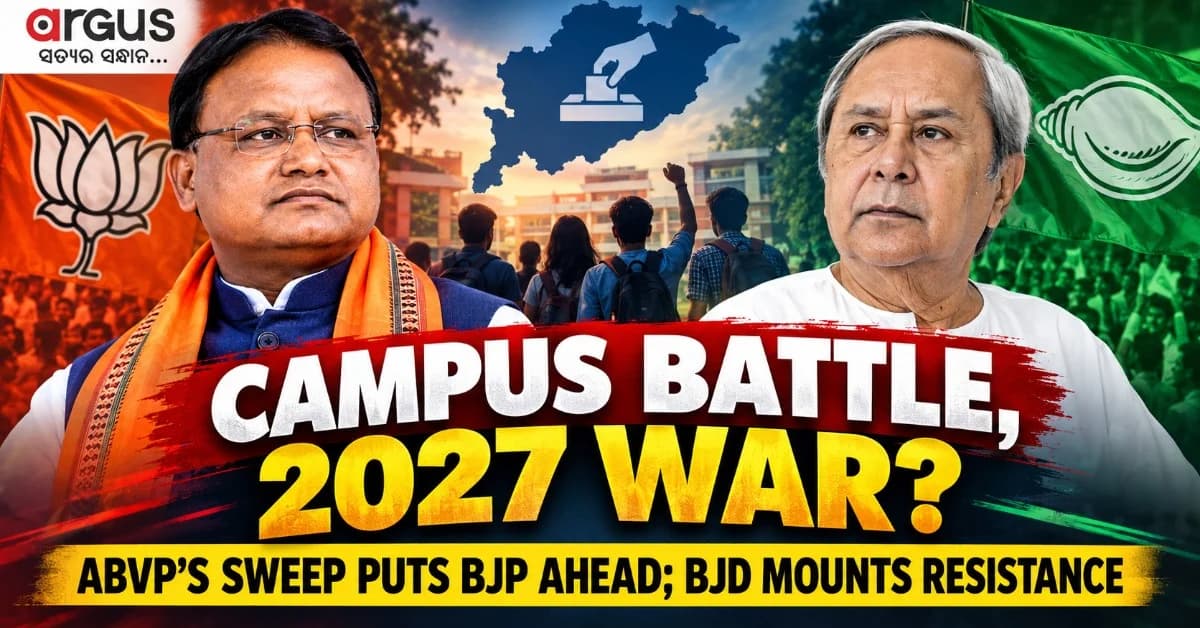
Clash of Narratives: CM Mohan Charan Majhi framed the election as a democratic liberation under "Viksit Odisha," while BJD's Naveen Patnaik used it to spark an emotional resistance against state power.
Panchayat Poll Prep: Both BJP and BJD are leveraging newly acquired campus cadres and digital networks to build their ground strategy for the crucial 2027 local body elections.
Bhubaneswar: The conclusion of the Odisha student union elections on October 15, 2026, marked a historic realignment of the state's political landscape.
Reopened after an eight-year forced suspension across 346 government colleges and 13 universities, the democratic exercise did far more than select campus presidents.
It functioned as a straightforward psychological and logistical testing ground for the state's premier political parties: BJP and BJD, which has become evident by the postures posted on X by Chief Minister Mohan Charan Majhi and former Chief Minister Naveen Patnaik. .
With the decisive 2027 local panchayat and civic polls less than a year away, both leaders have immediately bypassed the localized, campus-centric metrics of the election.

📱 Get Argus News App
✨Instead, they have deployed sophisticated political spin, calibrated rhetorical tones, and expansive narratives to paint their respective visions onto Odisha's electoral canvas.
This is no longer a debate over hostel infrastructure or college library funding; it is an elite, high-stakes battle for the loyalty of the state's massive Gen Z and first-time voter demographic.
By dissecting the specific spins of CM Majhi and former CM Patnaik, and auditing the concrete political assets their mainstream parties have just acquired, here is mapping out of the exact contours of the combat mode that will define the upcoming 2027 ballot.
Spin Anatomy: Majhi’s Institutional Triumph vs. Patnaik’s Defiant Resistance
The statements released by both leaders immediately following the declaration of results reveal a fascinating divergence in political communication strategy, carefully tailored to their current institutional positions.
ORCHESTRATING THE STATE NARRATIVE: THE POST-POLL RHETORIC
|
Feature |
🟠 Ruling BJP (CM Mohan Charan Majhi) |
🟢 Opposition BJD (Naveen Patnaik) |
|
Tone |
Triumphant & Statesmanlike |
Defiant & Combative |
|
Spin |
Democratic Liberation vs. Past Authoritarianism |
Heroic Defiance vs. State Conspiracy |
|
Strategic Goal |
Legitimize BJP governance & brand "Viksit Odisha" to Gen Z. |
Galvanize defeatist cadre into an emotional, anti-regime rebellion. |
Chief Minister Mohan Charan Majhi: Frame of Liberator
Chief Minister Mohan Charan Majhi’s post-election narrative is a masterclass in credit-claiming and structural reform. Rather than focusing on the raw numeric dominance of the Akhil Bharatiya Vidyarthi Parishad (ABVP), Majhi elevated the conversation to an institutional victory for the state itself.
· The Tone: Triumphant, institutional, forward-looking, and carefully balanced between partisan critique and statesman-like maturity.
· The Narrative: Majhi framed the very conduct of the elections as a fulfilled promise to the youth community, directly attacking the BJD’s twenty-four-year legacy. By asserting that the "previous government kept student union elections suspended to serve its political interests, suppressing the democratic voice of students," he transformed the election into a moral victory. He positioned his administration not merely as a ruling party, but as a democratic liberator that restored fundamental civic rights to the youth.
· The 2027 Spin: Majhi seamlessly linked the energy of the victorious campus candidates to his overarching governance tagline: "Viksit Odisha" (Developed Odisha). By demanding that the new student leaders focus on "discipline, academic environment, and unity," he is subtly telling Gen Z that under a BJP regime, political power is an instrument for systemic modernization and state pride, effectively seeking to build long-term, institutional loyalty among young voters.
Naveen Patnaik: The Rebel Commander
Conversely, the former five-term Chief Minister and BJD supremo Naveen Patnaik executed a defensive counter-spin designed to convert a numeric disadvantage into an emotional, anti-establishment rallying cry.
· The Tone: Defiant, fiercely protective, combative, and highly targeted.
· The Narrative: Patnaik completely bypassed the fact that the Biju Chhatra Janata Dal (BCJD) slipped to second place state-wide. Instead, he chose to focus intensely on the resilience of his student cadre. He introduced an aggressive vocabulary into the post-poll discourse, openly accusing the ruling BJP government of orchestrating a "conspiracy to win the Student Parliament election through injustice and unfair means."
· The 2027 Spin: Patnaik is deliberately attempting to foster a sense of collective grievance among the youth. By directly addressing "Odisha's GenZ," he is trying to reverse the traditional roles of power; despite being the dominant political force in Odisha for over two decades, the BJD is now trying to adopt the trendy, magnetic cloak of the anti-government outsider. Patnaik's spin aims to convince first-time voters that the BJP used state machinery, police manipulation, and administrative weight to suppress genuine student voices, thereby turning a campus defeat into a powerful, emotional narrative of resistance ahead of the rural polls.
Political Acquisitions: What Mainstream Parties Have Armed Themselves With
Beyond the rhetorical sparring, elections are fundamentally about acquiring tangible political assets. The conclusion of the campus polls has left the mainstream parties with distinct, battle-tested resources that they are already transitioning into combat mode for the 2027 local body and panchayat elections.
1. The BJP/ABVP Windfall: A Grassroots Human Infrastructure
By steering the ABVP to a dominant victory across 117 key educational institutions, including regional giants like Berhampur University and Gangadhar Meher University in Sambalpur, the BJP has secured an asset that money cannot buy: a freshly minted, highly motivated, and structurally organized youth cadre.
· The Rural Human Network: In rural district colleges, ABVP candidates won by establishing year-round micro-service models, such as their Student Academic Management System (SAMS) admission helpdesks. These student volunteers are not temporary mercenaries; they are deeply embedded local influencers. For the 2027 panchayat polls, the BJP now possesses thousands of recognizable campus leaders who can return to their respective native villages to lead door-to-door campaigns, leveraging their personal campus prestige to convert their families and village elders into BJP voters.
· The Legitimacy of Momentum: Winning the student polls allows the BJP to sustain the psychological narrative of an unstoppable saffron wave in Odisha. It disproves the opposition’s claim that the BJP's 2024 assembly victory was a fluke, giving their rural workers immense confidence to challenge long-standing BJD strongholds in the interior blocks.
2. The BJD/BCJD Retrenchment: A Battle-Hardened Core and Fortress Defense
While the BJD lost its state-wide campus monopoly, its 71 institutional victories – particularly across traditional coastal belts like Kendrapara and Jajpur – have provided the party with critical strategic clarity.
· Identification of Weak Links: The campus elections acted as a stress test for the BJD’s internal machinery. By losing ground in former bastions like Ganjam, the BJD leadership now has precise empirical data on which local MLAs and district coordinators failed to mobilize youth voters. This may make Patnaik to ruthlessly restructure district committees before the 2027 panchayat ticket distribution.
· The Cohesion of Victimhood: By centering their narrative on "fighting against state conspiracy," the BJD is trying to re-energized its base.
· 3. The Congress/NSUI Marginalization
The National Students' Union of India (NSUI) managed to win in just two colleges across the entire state. This dismal success ratio exposes a critical structural failure that the parent Congress party must urgently address before 2027.
· The Loss of the Youth Base: While the Congress sought to position itself as the organic, low-spend, issues-based alternative targeting infrastructure and lecturer vacancies, it lacked the organizational muscle to scale this message across 300+ rural campuses. For 2027, this indicates that the Congress is in severe danger of losing its historical baseline voter share to the BJP, as the youth increasingly view Odisha as a strict two-party playground.
· The loss in college polls in Rayagada and Koraput shows Congress has lost out on its 2024 assets.
2027 Convergence—Hostels to Panchayats
The strategic shift from student union elections to local body governance is already underway. The playbooks designed for the college campuses are being modified for immediate rural deployment:
|
Party / Timeline |
Campus Playbook (2026) |
Panchayat Conversion (2027) |
|
BJP / ABVP |
"Save Education, Save Odisha"
• Exposing broken college infrastructure & vacant teacher posts
• Frames past BJD rule as negligent |
"The Double-Engine Development Audit"
• Exposing incomplete rural roads & drinking water projects
• Discredits local BJD panchayat leaders |
|
BJD / BCJD |
"Defying the Saffron Machinery"
• Meme pages & raw videos
• Frames nomination rejections as a dictatorial BJP conspiracy |
"Protecting Odia Identity from Central Injustice"
• Mobilizing Gen Z
• Frames ruling BJP as an aggressive force disrupting peace |
Mainline political strategists recognize that Gen Z voters do not consume politics through traditional, top-down institutional broadcasts. By testing decentralized WhatsApp loops, local folk-infused audio campaign structures, and localized grievance narratives during the student union polls, both parties have successfully mapped out the exact digital and physical networks required to manipulate rural voting booths.
The Bottomline
The October 15 student polls were never a minor academic diversion; they were the opening skirmish of a grand, multi-year war for the soul of Odisha's electorate.
Chief Minister Mohan Charan Majhi has successfully used the results to brand his government as a transformative, democratic force, acquiring a massive army of young, enthusiastic cadres.
Concurrently, Naveen Patnaik
has utilized the setbacks to transform his party into a sharp weapon of
defensive resistance, building an emotional protective shield around his
remaining coastal fortresses. As the state marches toward early 2027, the
political spins generated inside college corridors will directly dictate who
controls the grassroots heart of Odisha.
Also Read: EXCLUSIVE| The Battle for Gen Z: How Odisha College Elections Redrew Odisha’s Rural Power Lines and Set the Stage for 2027 Rural Polls
Related Topics
Explore more stories