



Political Analysis| Naveen Fears Panchayat Shock in Home Turf: BJD Supremo's 'I Know All' Tells All
Key Points
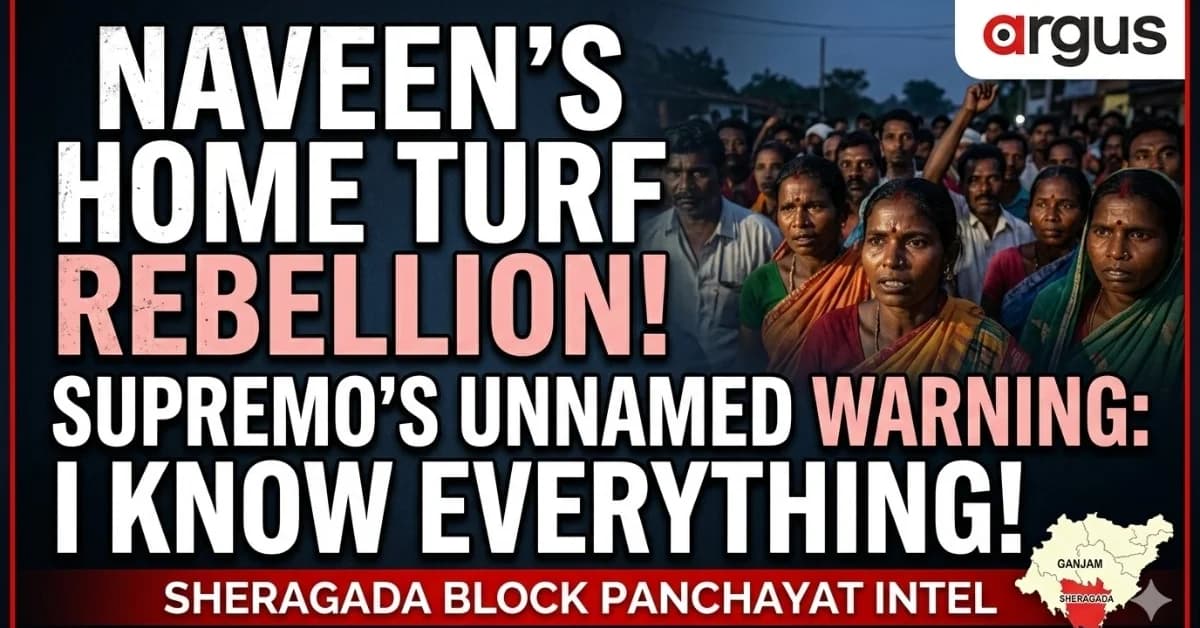
BJD supremo Naveen Patnaik has issued a stern warning against internal troublemakers in the crucial Sheragada rural block of his home constituency, Hinjili.
The transition of state power to the BJP has dried up traditional BJD patronage networks, fueling grassroots friction and parallel power camps.
With no state-level "carrots" to offer until the 2029 Assembly polls, Patnaik is relying heavily on the threat of ticket denial to enforce party discipline for the 2027 local elections.
Bhubaneswar: For nearly a quarter of a century, the Hinjili-Sheragada assembly constituency in south Odisha’s Ganjam district stood as an impregnable fortress of absolute political power. It was the bedrock upon which Naveen Patnaik built the longest-running chief ministerial legacy in modern Indian history.
In Hinjili, elections were historically treated as mere formalities; victory margins were massive, and the regional leadership functioned with absolute obedience to the high command at Naveen Niwas.
However, the political landscape of Odisha underwent a profound transformation in mid-2024. The loss of state power to the Bharatiya Janata Party (BJP) stripped the Biju Janata Dal (BJD) of its most potent asset: the vast administrative apparatus and state machinery that kept regional factions unified.
Now, as the countdown to the crucial 2027 three-tier panchayat elections begins, the internal cracks within Patnaik’s home turf have burst into the open.

📱 Get Argus News App
✨When BJD President Naveen Patnaik summoned hundreds of grassroots representatives and panchayat leaders from his constituency to his private residence, the gathering was far from a routine strategy session. The address delivered by the BJD supremo carried a sharp, uncharacteristic edge.
Acknowledging that certain elements within the Sheragada unit were causing trouble and behaving mischievously, Patnaik issued a stern, unequivocal warning: "I know everything. I will take action against them at the right time."
Stripped of its standard party public-relations spin, this unusually direct address, political observers feel, exposes a deep political vulnerability. The headline “Naveen Fears Panchayat Shock in Home Turf: BJD Supremo’s 'I Know All' Tells All” cuts straight to the core of the BJD’s current crisis. It reveals a high command that is acutely aware of its defensive position, battling an unprecedented undercurrent of grassroots rebellion, and resorting to the threat of disciplinary action to maintain control over its most symbolic constituency.
The Geometry of Grievance: The Dominance of Sheragada
To understand why Patnaik’s warning focused so heavily on Sheragada, one must look at the unique demographic and structural mathematics of the Hinjili assembly constituency. The seat is not a uniform political landscape; it is a tale of two distinct administrative blocks, each carrying entirely different political weights.
HINJILI ASSEMBLY CONSTITUENCY
Total Registered Voters: 2,32,439
SHERAGADA BLOCK
(Rural Electoral Engine)
Gram Panchayats: 24
Ward Members: 322
Zilla Parishad Seats: 3
HINJILICUT BLOCK & NAC
(Urban & Semi-Rural Core)
Gram Panchayats: 21
Ward Members: 295
Zilla Parishad Seats:3
During general assembly elections, the urban electorate of the Hinjilicut Municipality acts as a highly disciplined, loyal balancing weight that historical trends show favored Patnaik. However, the three-tier panchayat elections follow a completely different set of rules. In the rural polls, the urban municipality is excluded from the voting process, leaving the election to be decided entirely by the rural blocks.
In this rural arena, Sheragada is the undisputed electoral engine. With 24 Gram Panchayats and 322 wards compared to Hinjilicut’s 21 GPs and 295 wards, Sheragada commands the numerical majority of the rural electorate. Consequently, the BJD's performance in the upcoming local body polls depends heavily on Sheragada.
This numerical dominance explains the leadership's deep anxiety. The BJD high command recognizes that any internal friction, localized sabotage, or shifting party loyalty within Sheragada will immediately impact the party's performance. In a political environment where the BJD's state-level dominance has already been shaken, a setback or a loss of Zilla Parishad zones in Patnaik’s home turf would deliver a massive psychological blow to the party's image across the state.
The Anatomy of Disgruntlement
The rising tension within the Sheragada BJD unit is not an overnight phenomenon; it is the direct result of a major shift in the local balance of power.
For 24 years, being a grassroots BJD worker in Ganjam meant possessing significant local authority. It guaranteed access to lucrative public works contracts, control over local cooperative societies, and a reliable shield from the state administrative machinery.
The transition of power to a BJP-led state government completely disrupted this established patronage network. The current wave of internal disgruntlement within the block stems from three interconnected factors:
The Loss of Administrative Immunity: Grassroots workers and mid-level leaders suddenly feel exposed to aggressive political tactics from the opposition without the immediate protection of a sympathetic state government. The internal panic reached a flashpoint following a physical assault on a prominent local leader inside the block office chamber, which sent shockwaves through the local party cadre.
Economic Stagnation at the Grassroots: Without control over state departments, the distribution of rural developmental contracts – the financial lifeblood of local political networks – has slowed down significantly. Ambitious local leaders are now competing fiercely over a shrinking pool of regional resources, leading to intense factional rivalries.
The Rise of Parallel Camps: Anticipating a challenging election cycle, several regional coordinators and panchayat-level leaders have begun operating independent "interest camps" rather than following a unified strategy from the party central command. These factions are focused more on protecting their personal local influence than on defending the broader interests of the party.
The Daughter of Aska: The Cross-Party Shadow
What transforms this internal local friction into a major strategic threat for the BJD is the changing political landscape of the larger Aska Lok Sabha Constituency, under which the Hinjili assembly segment falls. The Aska parliamentary seat is currently represented by the BJP’s Anita Subhadarshini Pattnaik, the daughter of the late legendary veteran leader Ramkrushna Patnaik.
The Pattnaik family legacy casts a long shadow over the politics of Ganjam district. Ramkrushna Patnaik was one of the founding architects of the BJD and a powerful regional leader before parting ways with the party high command. Over decades of public service, he built a deeply entrenched, highly personalized network of loyalty across the Aska-Sheragada belt.
Ganjam District Power Dynamics
┌────────────────────────────────────────┐│BJD HIGH COMMAND ││Naveen Patnaik │└───────────────────┬────────────────────┘│▼┌────────────────────────────────────────┐│BJP PARLIAMENTARY CAMP ││Anita Subhadarshini Pattnaik │└───────────────────┬────────────────────┘│▼┌────────────────────────────────────────┐│LOCAL SHERAGADA BJD CADRE │├────────────────────────────────────────┤│ •Quiet Alignment ││ •(Fearing loss of patronage) ││ •(Local leverage)└────────────────────────────────────────┘
Today, many mid-level BJD workers and veteran panchayat figures in Sheragada trace their initial political entry and training back to Ramkrushna Patnaik’s camp. With his daughter now holding the parliamentary seat for the ruling BJP, these latent, multi-generational family networks have been quietly reactivated.
Information from regional political circles indicates that the "troublemakers" targeted in Patnaik’s address are suspected of engaging in quiet, strategic alignments. Facing pressure from a strong opposition, certain local BJD elements are reportedly keeping communication channels open with the BJP localized framework. More so, they cut deal with BJP loca network to win administrative support, and long-term viability under the new state government. This under-the-radar collaboration presents an existential threat to the BJD's absolute authority over its safest stronghold.
No Carrots Left: The Strategy of the Stick
In traditional party politics, a centralized leadership maintains internal discipline through a balanced mix of incentives and deterrence – popularly known as the carrot-and-stick approach. A ruling party can easily resolve local disputes by offering state board chairmanships, government positions, or assurances of future political advancement.
However, with the next Odisha Legislative Assembly election not due until 2029, the BJD high command faces a major structural constraint: it has no carrots left to dangle. It cannot promise government patronage to resolve local rivalries, nor can it offer state-level rewards to keep ambitious grassroots leaders in line.
Traditional BJD Patronage
State Patronage: Active government backing
Development Contracts: Direct economic leverage
Administrative Shield: Full institutional protection
Core Dynamic: Unified Cadre & The Party Carrot
Current 2026 Reality
No State Patronage: Opposition role (Next Assembly: 2029)
No Contract Leverage: Limited financial patronage tools
The Only Tool Left: Internal party discipline & monitoring
The
	Party Stick:
"Ticket Denial in 2027"(Local Panchayat focus)
With its options limited, the BJD leadership has been forced to rely almost entirely on the stick. The explicit threat of denying party tickets for the 2027 Panchayat Elections is the last major point of leverage the high command holds over its local representatives. By publicly warning that he "knows everything" and will act at the "right time," Patnaik is using his substantial personal authority to send a clear message: any local leader who engages in covert cross-party alignments will be completely cut off from the party’s future plans and denied a political platform in 2027.
Preempting the Narrative of Sabotage
Beyond serving as a direct warning to potential rebels, Patnaik’s address at Naveen Niwas serves a broader strategic purpose: it helps control the political narrative well ahead of the elections.
By identifying internal disruption as a key challenge months before the first ballot is cast in the 2027 rural polls, the BJD president is establishing an explanatory framework for the party’s future performance.
If the BJD performs well and retains its dominance across the Zilla Parishad zones, the high command can claim that its timely, firm intervention restored order and unity.
Conversely, if the party faces setbacks or drops critical seats to a rising BJP, the narrative is already set: the loss will be attributed not to a decline in the party’s core popularity or leadership, but to deliberate sabotage by self-serving local actors.
The Bottomline: The Test of Personal Charisma
The intense political chatter following the meeting at Naveen Niwas underscores a critical moment in Odisha's contemporary political history. The headline “Naveen Fears Panchayat Shock in Home Turf” points to an ongoing, fundamental shift in the state's political dynamics. It shows that in the absence of state power, even the most established political fortresses require active, hands-on management to keep local factions aligned.
Patnaik’s declaration that he "knows all" is a bold reassertion of his personal authority over the party's grassroots network.
However,
relying on warnings also highlights the limitations of managing a
major political organization purely from opposition benches. As the
2027 panchayat elections approach, the BJD's performance in the rural
strongholds of Sheragada will serve as a crucial test of whether a
leader's personal charisma alone can maintain absolute party
discipline when the traditional networks of state patronage are no
longer available.
Also Read: EXCLUSIVE | Odisha’s October Political Showdown: BJD Revives Centre-versus-State Battle, BJP Deploys Seva Setu to Defend Its 2024 Victory