



EXCLUSIVE | Odisha’s October Political Showdown: BJD Revives Centre-versus-State Battle, BJP Deploys Seva Setu to Defend Its 2024 Victory
Key Points
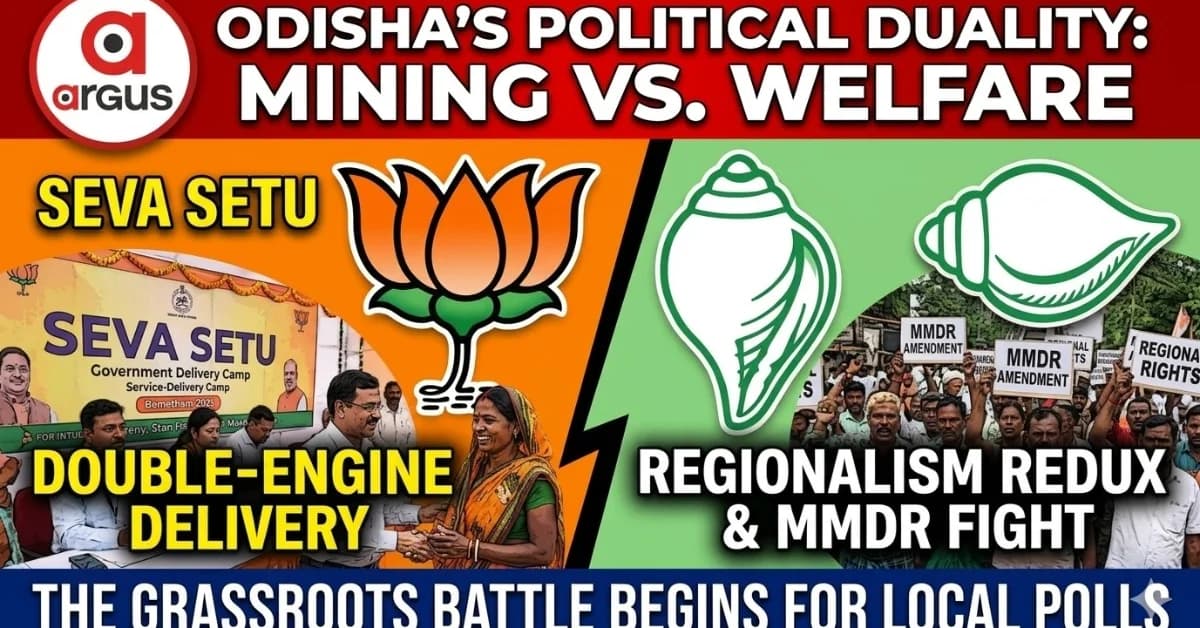
Resource Nationalism vs. Welfare Governance: The BJD is leveraging the MMDR Amendment Act to revive regional pride, while the BJP is centering its strategy on grassroots welfare delivery and administrative outreach.
Preparing for the 2027 Local Polls: Both parties are actively mobilizing their grassroots machinery and cadres to secure a strong foothold ahead of the upcoming panchayat and urban local body elections.
The Battle for Public Perception: The political contest has escalated into a high-stakes clash between the BJD's narrative of central neglect and the BJP's promise of double-engine development.
Bhubaneswar: October is set to bring more than a seasonal change to Odisha. As the monsoon clouds begin to retreat, the political atmosphere across the state is gathering momentum, with the ruling Bharatiya Janata Party (BJP) and the opposition Biju Janata Dal (BJD) preparing for an intense battle over public perception, regional identity and grassroots political influence.
With the 2027 panchayat and urban local body elections approaching, the two principal political forces are moving towards a crucial test of their organisational strength, competing narratives and ability to connect with voters beyond the electoral promises of 2024.
The BJD, which lost power after 24 years of uninterrupted rule, is attempting to revive its time-tested political weapon of regionalism and alleged central neglect, using the Mines and Minerals (Development and Regulation) Amendment Act, 2026, as the centrepiece of its renewed offensive.
For the BJP, which scripted a historic electoral victory in 2024 by combining the appeal of Odia Asmita with the promise of double-engine governance, the challenge is to translate its mandate into a durable grassroots presence.

📱 Get Argus News App
✨Its response is taking shape through an expansive service-oriented mobilisation, with the Seva Setu initiative emerging as a key component of the BJP's wider Seva Sankalp Abhiyan.
The political contest is therefore moving beyond the Assembly's legislative chambers and the competing claims over mineral rights.
It is increasingly becoming a battle between two different approaches to electoral mobilisation: the BJD's attempt to turn a question of MMDR amendment into a mass political movement, and the BJP's effort is to reinforce its governing credentials through visible welfare delivery, administrative outreach and direct engagement with beneficiaries.
BJD’s Regionalism Redux: MMDR Becomes the Political Chess Piece to Challenge BJP
For the BJD, the political challenge following its 2024 defeat is twofold. It must rebuild an organisation that spent more than two decades operating from the corridors of power while simultaneously establishing a credible opposition identity under Naveen Patnaik. The party's renewed campaign against the MMDR Amendment Act represents an attempt to address both objectives through a single political issue: the protection of Odisha's mineral resources and its financial interests.
The BJD has increasingly positioned the amended mining legislation as a question of Odisha's rights over taxation and mineral administration. Its argument is that the changes could restrict the state's fiscal authority over mineral-bearing land and mining-related revenues, potentially weakening its capacity to mobilise resources. The party has also alleged that the legislation undermines the federal structure by reducing the state's control over resources that are central to its economy.
These are the BJD's political and legal claims, which the BJP has contested.
However, the strategy is to log on to the political vocabulary that historically helped the BJD retain power as the sole voice of regionalism. During its long tenure in government, the regional party frequently sought to frame Odisha's interests as distinct from those of the political establishment in New Delhi. By reviving the Centre-versus-State narrative, the BJD is seeking to reposition itself as the political custodian of Odisha's economic interests, a role it thinks could help it reconnect with sections of its traditional support base.
The choice of the MMDR Amendment Act is significant in this context. Odisha is a mineral-rich state, and mining revenues have an important bearing on its public finances. The BJD is attempting to convert this economic significance into a wider political argument, linking mineral governance with state autonomy, public expenditure, and the future of mineral-bearing regions. Its campaign seeks to take the issue beyond legal interpretations and legislative proceedings to the villages, panchayats and urban constituencies where the consequences of resource allocation can be presented as a matter of public interest.
After the Assembly high voltage drama, the next stage of the BJD's strategy seems to be carring this campaign into the grassroots political landscape. The traditional Jan Sampark Padayatra, associated with the period around Gandhi Jayanti and other October anniversaries, offers an established organisational platform for direct public contact. The party has signalled that it will rake up the MMDR Act in a big way to make ist key theme of public outreach.
The timing is important because the party is not merely seeking to register opposition to a central law. It is also attempting to rebuild political networks, consolidate its cadre and prevent the erosion of its rural organisational base. Panchayat and urban local body elections will provide a different electoral environment from the 2024 Assembly polls, with local leadership, beneficiary relationships, civic issues and booth-level organisation playing significant roles.
KEY TAKE: The BJD top leadership has been going gung ho against BJP over the MMDR to stop desertions, and factionalism, ahead of the coming local rural and urban polls. The party strategists are now in a mission mode to galavanize its cadre, leaders and supporters to face the upcoming Panchayat and Urban civic polls cohesively to revive its fortunes.
For the BJD, therefore, the MMDR campaign has a dual purpose. It provides a platform to challenge the BJP government while offering a common political cause around which its organisational machinery can be mobilised.
Whether the issue resonates beyond politically engaged sections of the electorate will depend on how effectively the party explains the legislation's potential fiscal implications and connects them with everyday concerns.
The larger objective is to make the BJP's first full term in power a debate about the state's relationship with the Centre, rather than allowing the ruling party to define the political conversation exclusively through welfare schemes and development initiatives.
BJP’s Counter-Offensive: From Odia Asmita to Double-Engine Delivery, The Battle Shifts to Beneficiaries
For the BJP, the emerging political challenge is to protect the electoral gains of 2024 while establishing that its victory represented a structural change in Odisha's political landscape, rather than a temporary shift in voter preference.
The party came to power by successfully combining the appeal of Odia Asmita, or regional pride, with its promise of double-engine governance, under which the BJP governments at the Centre and in the state would work together to accelerate development and welfare delivery.
The BJD's attempt to revive regionalism through the MMDR Amendment Act presents the BJP with a direct political challenge.
The ruling party must defend a central legislation while convincing voters that its commitment to Odisha's interests remains intact. It also needs to demonstrate that its political and administrative alignment with the Union government can translate into tangible benefits for the state's population.
The BJP's response has two distinct dimensions.
The first is a political and policy-based counter to the BJD's allegations.
The second is an extensive grassroots outreach strategy intended to establish direct connections between the government, party organisation and citizens.
On the policy front, BJP leaders have rejected the BJD's contention that the amended MMDR framework takes away Odisha's mineral-related taxation rights. The party has sought to challenge the opposition's estimates of potential revenue losses and argue that the new legal framework does not eliminate the state's powers within the applicable taxation system. Puri MP Sambit Patra's Press Conference on the issue, including his clarification on the estimated retrospective liability, is part of this effort to contest the BJD's interpretation of the legislation.
The BJP is seeking to shift the debate from the opposition's claims of lost fiscal autonomy to the legal framework governing mineral taxation, the state's continuing revenue powers and the administration of mining-related liabilities.
It has also questioned the BJD's record in managing Odisha's mineral resources during its years in government. This counter-narrative is designed to make the MMDR controversy a debate about the interpretation of the law and the respective records of the two political parties, rather than allowing the BJD to establish an uncontested regional-rights narrative.
However, the BJP's broader political calculation extends beyond the technical aspects of the legislation.
Its 2024 victory was accompanied by expectations of improved welfare delivery, administrative responsiveness and development under a government that shares political alignment with the Centre.
The coming local elections will provide an opportunity for voters to assess the implementation of these promises at the village, block, municipality and ward levels.
The BJP's grassroots strategy is consequently centred on making governance more visible. Rather than limiting its political response to press conferences, legislative arguments and public rebuttals, the party is expanding its engagement through service programmes, beneficiary outreach, community activities and organisational mobilisation.
The Seva Sankalp Abhiyan, launched on September 17 and scheduled to continue until October 17, is an important part of this approach.
The month-long programme commemorates Prime Minister Narendra Modi's 25 years in public service and includes activities extending from organisational districts and mandals to individual booths. The BJP has planned a range of initiatives involving students, women, farmers, youth and disadvantaged communities, including blood donation drives, cleanliness campaigns, awareness programmes and educational competitions.
For the state BJP, the political significance of such initiatives lies in their ability to keep its organisational machinery active between major elections. They also offer an opportunity to present the party's governing agenda through activities that take place within communities, rather than exclusively through political rallies.
The BJP's emphasis on beneficiary outreach is particularly relevant to its electoral strategy. Welfare programmes are often experienced by citizens through their access to housing assistance, pensions, healthcare, food security and other public services. The party is seeking to make the process of accessing these benefits more direct and visible, while strengthening its political engagement with the people who use them.
This is where the BJP's administrative and organisational approaches intersect. By coordinating its campaign with government departments and local-level institutions, the party is seeking to extend the reach of its service initiatives across the state. The approach also provides an opportunity for local BJP leaders and elected representatives to establish relationships with communities, identify administrative difficulties and communicate the availability of welfare schemes.
The BJP's political challenge, however, will be to ensure that this outreach is experienced as effective public service and that citizens can access entitlements through transparent, accessible administrative processes. The political value of welfare delivery will ultimately depend on implementation, the quality of services and the extent to which eligible beneficiaries actually receive the assistance intended for them.
Seva Setu: BJP’s Strategic Answer to BJD’s MMDR Chess Piece
The timing of the BJP's Seva Setu initiative adds another dimension to the emerging political contest.
As the BJD prepares to take its MMDR campaign from the Assembly to the grassroots, the BJP is moving to expand its direct service-oriented engagement with citizens.
The Seva Setu programme is intended to connect eligible beneficiaries with government welfare schemes through local-level camps and administrative outreach.
The initiative is part of the wider Seva Sankalp Abhiyan, but its focus on identifying beneficiaries and facilitating access to government services gives it a distinct operational role.
Preparations for Seva Setu have involved the Panchayati Raj Department, with block-level programme calendars and beneficiary databases envisaged to facilitate the camps. The BJP's stated approach is to bring eligible citizens closer to the schemes available to them, including those administered by the state and the Centre.
The political timing places the programme alongside the BJD's renewed mobilisation over the MMDR Amendment Act.
While the BJD is seeking to turn a question of resource governance into a wider debate about Odisha's rights, the BJP is emphasising the immediate relationship between citizens and public services.
The contrast is between two different political methods: one seeks to build public mobilisation around a policy framework, while the other seeks to demonstrate the government's presence through practical assistance and welfare access.
The distinction is particularly important in rural Odisha, where panchayat-level political relationships are shaped not only by party affiliation but also by local leadership, access to public services and the responsiveness of government institutions.
A citizen seeking a pension, housing assistance or enrolment in a welfare scheme may encounter the government through a local administrative camp long before encountering a major political rally.
By facilitating access to these services, Seva Setu could give the BJP an opportunity to strengthen its organisational links at the grassroots. It also creates a platform for the party to communicate its governance priorities directly to communities, while potentially expanding its support network among people who benefit from public programmes.
The BJP's objective is not limited to countering the BJD's political campaign in the immediate term. Its broader organisational challenge is to establish a sustainable presence in local bodies, where the BJD has historically maintained extensive networks of elected representatives, local leaders and party workers.
Seva Setu, therefore, represents an effort to connect the BJP's governing mandate with the local political structures that will matter in the next round of elections. The programme's effectiveness will depend on how efficiently the camps function, whether administrative bottlenecks are addressed and whether beneficiaries receive timely assistance. Its political impact will also depend on whether these service relationships translate into lasting public confidence.
The BJP's approach also has an important distinction from the BJD's MMDR mobilisation. The opposition's campaign is primarily focused on challenging a policy decision made at the national level and questioning the state government's response. The BJP's Seva Setu initiative is focused on the delivery and accessibility of government services. Both approaches seek to establish political relevance among voters, but their outcomes will be measured through different forms of public engagement.
The Larger Battle: Who Will Define Odisha’s Political Narrative?
The emerging contest reflects a broader transition in Odisha politics. For much of the past two decades, the BJD's political identity was closely linked to its position as the state's dominant regional party. The BJP's rise to power in 2024 has altered that relationship, placing the regional party in opposition and giving the national party the responsibility of governing a state with a strong regional political identity.
The BJD's revival of the Centre-versus-State narrative is an attempt to re-establish a political distinction that once helped it sustain its electoral position. By linking the MMDR Amendment Act to resource rights and fiscal autonomy, it is seeking to make the protection of Odisha's interests a defining issue of its opposition politics.
The BJP, meanwhile, is attempting to demonstrate that regional identity and national political alignment are not necessarily competing ideas. Its emphasis on Odia Asmita and double-engine governance seeks to present the state and Union governments as partners in delivering development. Through Seva Sankalp and Seva Setu, it is also attempting to give that political proposition a visible grassroots expression.
October, therefore, marks an important phase in Odisha's evolving political contest. The BJD is seeking to turn the question of who controls the state's mineral wealth into a larger debate about regional autonomy, while the BJP is attempting to make accessible governance and welfare delivery central to its political identity. The competing campaigns are likely to shape the political conversation in the months leading up to the 2027 local elections.
Ultimately, the significance of the coming months will not lie merely in the scale of rallies, the number of welfare camps or the intensity of political exchanges. It will lie in how effectively each party addresses the concerns of citizens, maintains its organisational connections and establishes credibility at the grassroots.
The
2027 local polls will provide an electoral measure of these competing
approaches, offering an important indication of how Odisha's
political landscape has evolved since the historic change of
government in 2024.
Also Read: EXCLUSIVE| MMDR Theater in Odisha Assembly: BJD's Cash Race and Congress U-Turn Not Only Betrays Rajiv-Manmohan Legacy but Leave the Common Voter Biggest Loser
Related Topics
Explore more stories