



Political Analysis| MMDR Politics Inversion: Dharmendra Pradhan Turns BJD’s ‘Central Exploitation’ Cry into ‘Corporate Accommodation’
Key Points
Judicial Blow to BJD: The Orissa High Court dismissed Mega Corporation's150-million-tonne bauxite claim, dealing a major legal setback to corporate demands.
The 2020 Letter Reveal: Court documents exposed that the previous BJD government had actively lobbied the Centre to lower bauxite conversion factors for private firms.
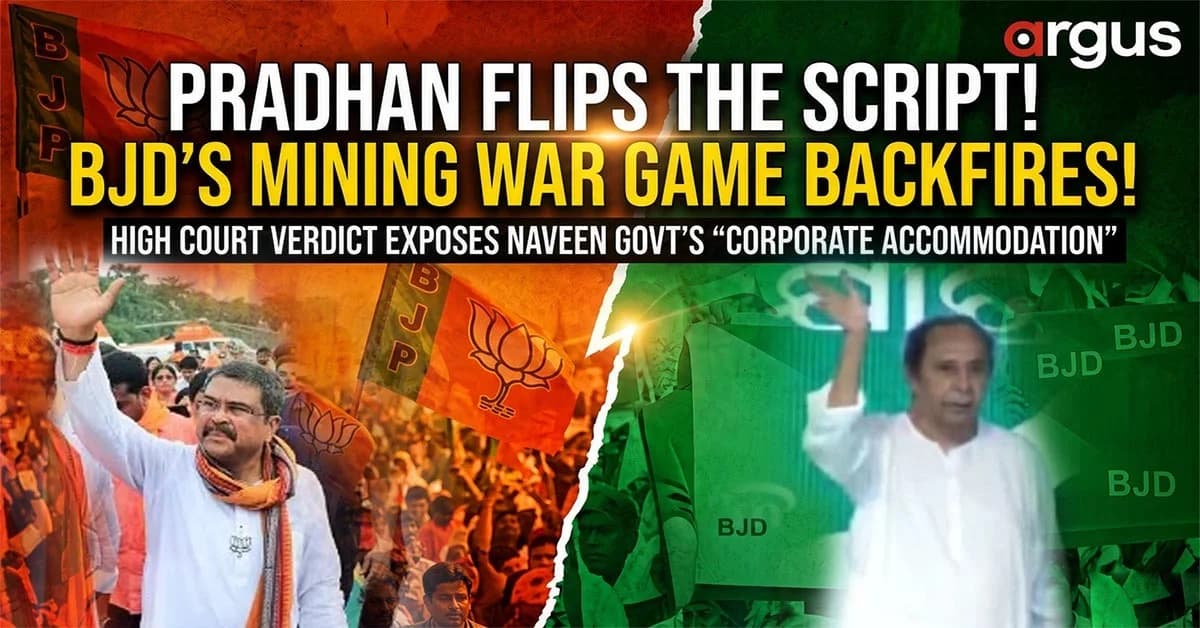
Flipping the Script: Sambalpur MP Dharmendra Pradhan leveraged the court verdict to neutralize the BJD's "Central exploitation" campaign during its Jan Sampark Padayatra.
Bhubaneswar: Timing has always been the ultimate clincher in politics, where strategic moves and countermoves dictate the timeline. An attack on a rival camp must be delivered at the exact psychological moment to pin them down under the weight of their own liabilities. On Friday, in the theater of Odisha’s politics, this mastery of timing was on cinemascope display.
Just as the BJD scripted an aggressive narrative of 'Central exploitation' to serve as the central theme of its month-long Jan Sampark Padayatra, the High Court delivered a dramatic legal climax. The BJP immediately seized this verdict, flipping the script to expose what it termed as years of 'corporate accommodation' by the Naveen Patnaik-led BJD.
The Orissa High Court's Dramatic Climax
A division bench comprising Chief Justice Harish Tandon and Justice Murahari Sri Raman rose after dismissing Writ Petition (Civil) No. 9617 of 2023, titled Vedanta Limited v. Odisha Mining Corporation Ltd. & Others. The Orissa High Court’s October 1 ruling in the bauxite pricing dispute handed Sambalpur MP Dharmendra Pradhan a significant legal shield to challenge the Biju Janata Dal’s campaign against the Centre’s mining framework, adding a volatile new dimension to Odisha’s political debate over mineral resources.

📱 Get Argus News App
✨The timing carried profound political significance. On October 2, the first day of the BJD’s month-long mass outreach campaign, the party sought to place the Mines and Minerals (Development and Regulation) Act (MMDR) and the Centre’s mineral pricing framework at the absolute heart of its political strategy. Former Chief Minister and BJD president Naveen Patnaik portrayed the Centre’s approach as an erosion of Odisha’s sovereign rights over its mineral wealth, accusing the BJP-led central government of prioritizing mining conglomerates over the state’s economic growth and public welfare.
Pradhan’s response, anchored in the High Court’s findings in the dispute involving the mega-refinery corporate body, systematically dismantled that political argument. Rather than allowing the BJD to frame the MMDR framework as an instrument of central exploitation, he used the judicial record to question the previous BJD government’s own interventions on bauxite pricing. Specifically, he targeted official state communications sent to the Centre seeking a downward reduction in the mining conversion factor.
This intervention instantly shifted the focus of the political contest from a broad ideological question of central control over mineral resources to a specific, damaging issue: whether the previous state government’s closed-door positions on mineral pricing were consistent with its current public claim of defending Odisha’s financial interests.
The Paper Trail of 2020: A Judicial Finding Becomes a Political Counter-Narrative
As documented in the Orissa High Court judgment, the corporation had long argued against the state’s Long-Term Linkage (LTL) Policy of 2018. Under that regime, 70% of the state’s saleable bauxite was allocated directly to local industries, while the remaining 30% was sold via national e-auctions to ensure price discovery.
The real friction—the legal spark that ignited this judicial climax—occurred on September 20, 2019. The Central Government amended Rule 45 of the Mineral Concession Rules. This amendment introduced a mathematical "conversion factor" designed to calculate the true Average Sale Price of metallurgical-grade bauxite by linking it directly to international London Metal Exchange (LME) aluminum prices.
The financial impact was immediate and severe for the balance sheets of private buyers as the statutory calculation caused the floor price of bauxite to soar. The corporation rushed to court, filing writ petitions claiming that Rule 45 was meant exclusively for valuing unmined blocks during lease auctions, not for the mercantile commercial sale of already extracted ore. They demanded a reversion to the old state formula: simple cost of production plus a 50% profit margin. Under temporary court protections, the corporate house had managed to lift bauxite at a heavily discounted interim rate of just Rs1,000 per metric tonne.
However, a devastating revelation lay waiting on Page 43, Paragraph 9.23 of the High Court's ruling.
When the corporate lawyers were arguing their case in the courtroom, they did not just rely on their own legal submissions – they brought official letters written by the BJD government itself to bolster their stance. The judgment explicitly records this fact:
"The State Government‘s communication recorded that the formula appeared unrealistic and that its application would adversely affect the economics of the alumina and aluminium industry. The average sale price calculated under the notified formula appeared substantially higher than the actual value of metallurgical-grade bauxite."
Armed with this exact paragraph, Pradhan tore into the opposition's campaign. He explicitly cited the letters hidden behind the court's summary: Letter No. 1044 dated February 1, 2020, and Letter No. 8569/SM dated October 7, 2020.
While the BJD was preparing to march through the streets accusing the BJP of being "anti-people" and favoring wealthy mine owners, its own official administration had been quietly lobbying the Central Government in writing. They were pleading for a downward revision of the bauxite conversion factor to accommodate a private enterprise. This revelation handed a thermonuclear political weapon to the BJP on the exact day the BJD launched its main campaign missile.
How Dharmendra Pradhan Flipped the Script on Naveen Patnaik’s Mining War Game
The core element of Pradhan’s counterargument relies on the distinction between the state’s constitutional interest in protecting its public resources and the commercial expectations of an individual mining company. By utilizing the Orissa High Court’s landmark judgment, the Sambalpur MP effectively flipped the script on Naveen Patnaik’s core campaign narrative.
1.
The BJD Strategy: Framing the Center as "Anti-Odisha"
When
Naveen Patnaik launched the padayatra, he positioned the MMDR Act
framework as an instrument of central exploitation. The BJD's
narrative was calculated to evoke fierce regional pride:
The Accusation: Patnaik accused the Modi government of "stripping Odisha of its rights" over its own natural resources through rigid federal guidelines.
The Target: He attacked local BJP MPs for their "silence," claiming it proved the state’s ruling BJP was "anti-people" and preferred to help wealthy mine owners rather than fund public welfare.
2.
The BJP Counter-Strike
Instead of staying on the defensive,
Dharmendra Pradhan used the High Court’s dismissal of the petition
to completely upend Patnaik’s arguments. Pradhan leveraged the
factual history documented in the court text to launch a
three-pronged counter-attack:
A. Reframing the 2015 MMDR Act as "Pro-People," Not "Anti-Odisha": Patnaik campaigned that the central rules hurt the state. Pradhan countered with cold numbers backed by the statutory transition. He pointed out that under the modified Rule 45, the introduction of a transparent conversion factor successfully pushed bauxite floor prices up from Rs750 to Rs1,707 per tonne. Pradhan argued this federal strictness was exactly what protected Odisha's treasury, ensuring thousands of crores of rupees in increased revenue through Royalty, DMF, and NMET for the public.
B. Exposing the State’s Official Lobbied Letters: The most damaging aspect of Pradhan’s rebuttal relied on the exact state communications referenced on Page 43 of the judgment copy. Armed with these facts, Pradhan asked the public: If the BJD is "pro-people," why did Naveen Patnaik write official letters to the Center in 2020 explicitly pleading to lower the bauxite conversion factor? By linking the text of the judgment to the BJD’s political demands, Pradhan framed the previous state government’s agitations not as a battle for Odisha’s rights, but as a corporate accommodation strategy.
C. The Twist: Who Really Protects the "Mine Owners"?: Patnaik claimed the BJP prioritizes mine owners over public welfare. Pradhan flipped this accusation entirely by pointing to the Rs5,400 crore in outstanding overdue revenue that the private company had avoided paying while operating under lenient historical terms and court-mandated price caps. Pradhan’s narrative proved that it was the Central MMDR Act that acted as a barrier against corporate favoritism, while the BJD's current campaign to rescind the Act stems from its own soft corner for private mining conglomerates.
The collision of the High Court verdict with the launch of the BJD padayatra completely reshaped the political landscape in Odisha.
By grounding his political attack in the factual record summarized by the High Court, The State's ace BJP leader Dharmendra Pradhan successfully transformed the MMDR debate.
What
the BJD intended to be a campaign about "Central
neglect of state resources"
was swiftly turned by the BJP into an aggressive public
cross-examination over "Why the state government
actively lobbied to lower mineral prices for private corporations."
Also Read: EXCLUSIVE| MMDR Theater in Odisha Assembly: BJD's Cash Race and Congress U-Turn Not Only Betrays Rajiv-Manmohan Legacy but Leave the Common Voter Biggest Loser
Related Topics
Explore more stories