



Political Analysis | How Lok Seva Bhavan Meet Puts Spotlight on BJP’s Policy Prescription for Naveen’s Puri Development Pain Points
Key Points
Grassroots Course Correction: CM Mohan Majhi reverses BJD-era local resentment through emergency vendor rehabilitation near Shree Setu and heritage preservation.
Beyond the Temple Perimeter: Development expands into "Greater Puri," encompassing Sakhigopal, Kakatpur, Satyabadi Bana Bidyalaya, and the Konark circuit.
Strict Accountability & Connectivity: Directives demand time-bound project execution while fast-tracking the Shri Jagannath International Airport.
Bhubaneswar: The high-level review meeting led by Chief Minister Mohan Charan Majhi on Monday, when the State has shifted its gear to festive mood, represents a calculated shift in Odisha's cultural politics.
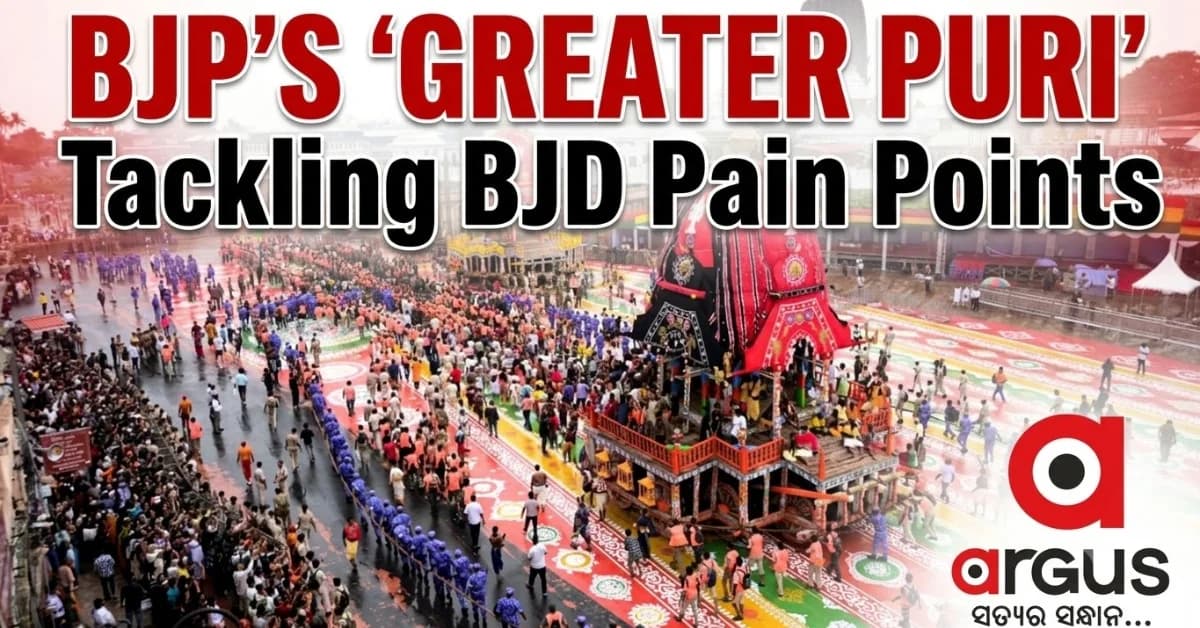
An analysis of the CM’s emphasis in the meeting carries an imprint of political tone. The layers of the decision implies how by framing Puri as the core of "Odia Asmita" (Odia Identity), the BJP government is systematically addressing the local grievances left behind by Naveen Patnaik’s massive BJD-led Shree Jagannath Heritage Corridor (Parikrama Prakalpa) project.
The political takeaways reveal a strategy of tactical reversal, local reconciliation, and expansion beyond the immediate temple perimeter.
Key Direct Comparisons

📱 Get Argus News App
✨|
Feature / Focus Area |
Patnaik’s Puri Overhaul (BJD) |
CM’s Puri Review (BJP) |
Political/Strategic Takeaway |
|
Governance Philosophy |
Top-Down Modernisation: Focused on architectural grandeur, security perimeters, and making Puri a global heritage hub using high-profile bureaucratic execution. |
Grassroots Correction: Focused on human-centric rehabilitation, correcting local administrative oversights, and invoking Odia Asmita (Pride).
Majhi is positioning himself as a leader who listens to the locals, directly countering the "bureaucrat-led, detached" image often attributed to the late Patnaik era.
Displaced Evictees & Vendors
Aggressive Evictions: Cleared structures within a 75-meter radius of the temple for safety zones, which led to the displacement of centuries-old mathas and local street vendors.
Emergency Rehabilitation: Mandated the immediate rehabilitation of displaced Grand Road (Badadanda) vendors near Shree Setu on an emergency basis.
Majhi is directly healing the economic wounds caused by Patnaik’s project, capturing the goodwill of the local trading class.
Servitors (Sebayats) & Rituals
Transactional Compensation: Offered financial packages to affected servitors but faced internal pushback over standardising traditional spaces.
Ritual & Heritage Priority: Prioritises the needs of sebayats, building a new kitchen (Roshaghara), and restoring heritage sites like Raghunandan Library.
By focusing on traditional spaces, the current government aligns itself with the orthodox religious custodian class of Puri.
Geographic Scope
Intra-City Core: Highly concentrated around the immediate perimeter of the Jagannath Temple and the beach corridor.
Greater Puri Blueprint: Extends development to Sakhigopal, Kakatpur (Maa Mangala), Satyabadi Bana Bidyalaya, and the Konark circuit.
The BJP is expanding its cultural footprint beyond the city limits into rural and semi-urban constituencies in Greater Puri.
The Major Political Takeaways
1. Reversing the Local Backlash of the Heritage Corridor
While Patnaik’s Parikrama Project was widely praised globally for its scale, it created significant local resentment due to the demolition of historic mathas and the sudden eviction of street vendors from the Badadanda. By explicitly ordering emergency rehabilitation near Shree Setu, Majhi is addressing these pain points. He is signaling that his administration values local livelihoods over mere cosmetic modernization.
2. Rebuilding Traditional Institutions
The destruction and alteration of historic mathas under the previous government alienated traditionalists. Majhi’s directives to reconstruct the Raghunandan Library, redevelop the Annapurna Theatre, and restore the Satalahari Matha serve as a direct cultural correction. It reframes development not as a replacement of the old, but as an act of heritage preservation.
3. Expanding the Footprint to "Greater Puri"
Patnaik’s focus was heavily centered on the immediate temple surroundings. Majhi is expanding this focus by looping in the broader religious and historical landscape of the district:
- Satyabadi Bana Bidyalaya & Bakulabana: Restoring this on the ancient Gurukul system honors the legacy of the Pancha Sakha (the five icons of Odia literature and nationalism), heavily appealing to regional sentiment.
- Maa Mangala (Kakatpur) & Gopaljee Temple (Sakhigopal): Upgrading infrastructure at these ancillary pilgrimage sites spreads developmental capital out of the main city and into peripheral areas.
4. Strict Bureaucratic Accountability
Majhi’s warning that "no negligence, delay, or irregularity will be tolerated" and his directive for top officials to monitor the ground directly is a subtle political critique of the previous regime. The BJD government was frequently accused by the opposition of operating via a centralized, opaque bureaucratic apparatus. Majhi is attempting to project an image of a transparent, time-bound, and people-first administration.
The Bottomline
The Monday meeting at Lok Seva Bhawan delivered a strong political
message by systematically resolving the key pain points left behind by Naveen
Patnaik’s Puri Parikrama Project. At the same time, CM Mohan Charan Majhi
prioritized major infrastructure gains, ordering officials to fast-track the
development of the Shri Jagannath International Airport.
Also Read: Odisha SIR Row: How CM Mohan Majhi Deployed Riker’s Doctrine against Former CM Naveen Patnaik
Related Topics
Explore more stories