



Political Analysis| Congress Calls for Odisha Bandh on Oct 8: Will the Violent Pattern Reboot as BJD Backs Out to Hive Off Political Liability?
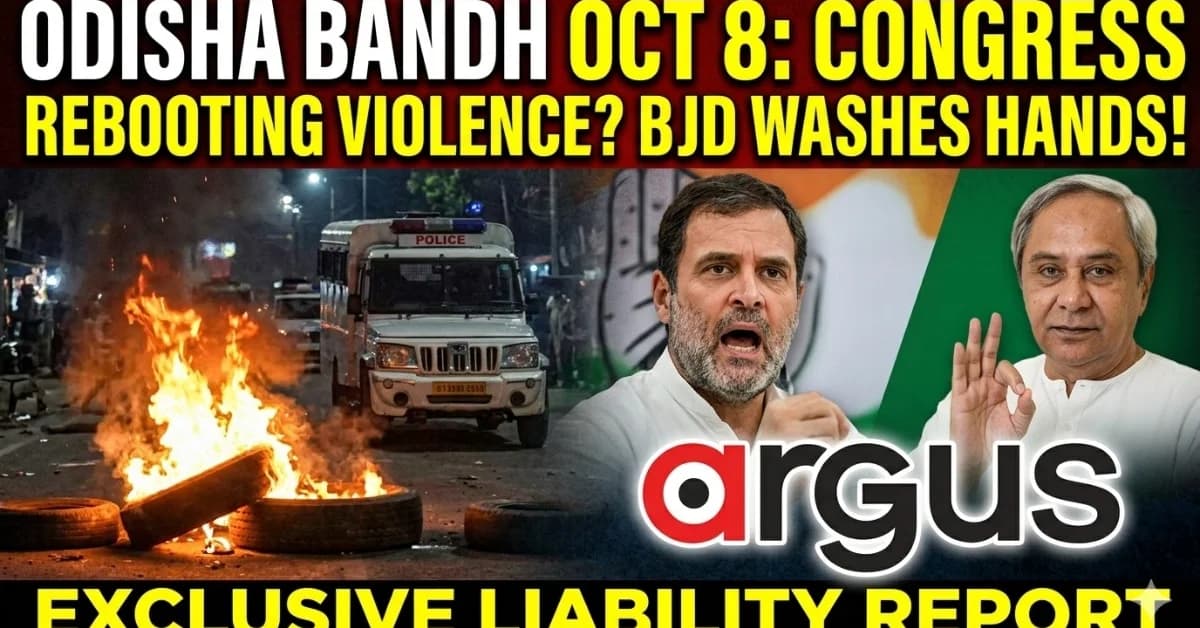
Key Points
Strategic Disconnect: The Congress-led shutdown relied on complex legislative and administrative grievances that failed to strike an emotional chord with the public.
Commercial Pushback: Citing historical precedents of property damage and coercion, the Odisha Private Bus Owners' Association firmly rejected the strike to protect transit services.
BJD's Tactical Retreat: Fearing association with street violence and the "INDI" brand, the BJD executed a sharp 30-minute U-turn to distance itself from the failed protest.
Historically, a successful shutdown functions as a high-stakes referendum on the popularity of an opposition group. When executed well, it disrupts normal life not through fear, but through shared grievance, transforming public streets into a stage for collective defiance. However, the relevance of this political tool is entirely dependent on timing, emotional resonance, and structural backing.
When a shutdown centers on deep, emotive issues - such as systemic cultural slights, devastating regional economic crises, or visceral threats to local identity - it naturally draws organic public support. In these instances, the common citizen willingly bears the financial burden of an idle day because the cause feels existential. Conversely, when a political party attempts to weaponize dry, legislative adjustments or localized administrative blunders that lack a deep emotional core, the exercise risks exposing their organizational weakness.
The Congress-led Odisha Bandh on October 8, 2026, represents this precise political friction. It exposed a major disconnect between the strategic ambitions of an aggressive opposition and a public weary of artificial disruptions. More importantly, it triggered a rapid, 30-minute political retreat by the Biju Janata Dal (BJD), altering the state's opposition landscape.
Blast From the Past: The Trademark Blueprint of Congress Bandhs
To understand the public anxiety surrounding tomorrow's shutdown, one must look at the pattern of agitations established by the Indian National Congress since losing power in the historic 2000 state elections. Over the past two and a half decades, major state-wide shutdowns called by the Congress have consistently shared a distinct blueprint: they frequently spiral into coercion, property damage, and violent friction with law enforcement.
Here is a flowchart of Congress Bandh pattern in Odisha.
| Phase / Stage | Description & Key Incident |
| 1. Trigger | Congress Call for State-Wide Bandh |
| 2. Disruption | Aggressive Street-Level Enforcement (Tyre Burning & Road Blockades) |
| 3. Impact | Targeting of Public & Private Transit (Vandalism of Buses/Vehicles) |

📱 Get Argus News App
✨Escalation into Law Enforcement Clashes
(Lathicharge / Retailer Intimidation)
A slip Into the archives post-2000 era show a clear pattern:* The June 2015 Bandh: Orchestrated around the emotional delays during the Brahma Parivartan of the Nabakalebara festival, this protest quickly escalated from peaceful non-cooperation into open street-level intimidation. Aggressive party workers wielding bamboo poles smashed the windows of private cars and auto-rickshaws, forcefully shuttered shopping centers in Bhubaneswar, and physically assaulted public officials in districts like Jagatsinghpur. The enforcement became so undisciplined that even emergency transit was targeted, including a violent assault on a "108 Ambulance" driver.
* The September 2012 Capital Agitation: A massive march outside the State Assembly transformed into a urban riot, injuring dozens of police officers and party activists. The subsequent state-wide shutdown saw Congress workers setting public buses on fire in the middle of major urban corridors, forcing law enforcement to resort to widespread lathicharges and mass arrests to clear choked highways.
* The Legislative Gheraos of Early 2024: Opposition marches frequently ended with the Capital Police Station registering criminal cases for rioting, attempting to torch government vehicles, and using physical force against public servants.
This history explains why groups like the Odisha Private Bus Owners' Association have taken a firm, defensive stance against tomorrow's shutdown. By refusing to suspend bus operations across the state and explicitly demanding robust police protection, the association sent a clear signal: the commercial sector will no longer quietly tolerate the financial losses and structural damage historically associated with Congress-led shutdowns.
Dissecting the 2026 Demands vs. Historical Precedents
The current 2026 bandh called by the Congress-led INDIA bloc relies on three central grievances: the repeal of the central Mines and Minerals (Development and Regulation) Amendment Act, 2026, the resignation of Odisha’s School and Mass Education Minister Nityananda Gond over textbook errors, and electoral list issues under Chief Election Commissioner Gyanesh Kumar. When contrasted with the deeply emotional or immediate economic crises that fueled successful historical protests, these issues fail to strike an organic chord with the public. Each demand disintegrates under scrutiny when evaluated against past political precedents and real-world context:
1. The MMDR Amendment Act, 2026: A Contradictory Stance The Congress party's fierce opposition to the MMDR Amendment Act, 2026—which consolidates central regulatory authority over major mineral-bearing lands and mineral taxation—is undercut by its own history. Congress frames the amendment as an aggressive assault on Odisha’s fiscal autonomy and mineral wealth, claiming it denies the state over Rs 1 lakh crore in potential historical dues. However, the structural centralisation of India's mineral and natural resource policies was aggressively championed and codified during the Rajiv Gandhi era and the subsequent UPA tenures.
For decades, the central Congress leadership consistently favored central oversight to ensure uniform national pricing and prevent regional monopolies. Attempting to generate a populist, anti-Centre regional movement over a policy framework that Congress historically built makes the protest feel politically inconsistent rather than an authentic defense of federalism.
2. The Textbook Errors: Administrative Failure vs. Political Crime: The demand for the resignation of School and Mass Education Minister Nityananda Gond over approximately 1,741 factual and typographical errors across state textbooks for Classes I to VIII lacks the explosive political weight needed to sustain a state-wide shutdown.
While the errors—which included mislabeling vital landmarks like the Konark Sun Temple and Niyamgiri Hills—provoked valid anger among educators and families, the state government quickly managed the situation.
Stage Actions & Details
1. TriggerDiscovery of 1,741 Textbook Errors2. Administrative Action
• Suspension of TE and SCERT Directors
• Disciplinary Proceedings against 6 Deputy Directors
• Launch of Crime Branch (CB-CID) Investigation
3. Mitigation Strategy• Corrigendum & Error-Free Booklets Dispatched to Schools4. Outcome / SentimentResolved Bureaucratic Lapse (No Emotive Trigger)
Instead of deflecting blame, the BJP-led state administration launched an immediate administrative crackdown: it suspended the Director and three Assistant Directors of the SCERT, initiated disciplinary proceedings against six other deputy directors, and handed the case to the for a thorough investigation. Simultaneously, the department printed and distributed corrected revision booklets to all schools to keep teaching unaffected. Because the government took clear accountability and moved swiftly to fix the issue, the public viewed it as a bureaucratic lapse that was resolved, stripping the Congress of an emotive rallying cry.
3. Resignation Of CEC Gyanesh Kumar: When there is no widespread, organic voter agitation on the streets of Odisha, Why suddenly CEC Gyanesh Kumar morphed into a pretext for a political bandh in Odisha?
The reason this has been the purported dissent by ECs Sukhbir Singh Sandhu and Vivek Joshi on adding mandatory, multi-generational ancestry-linking blocks to the online Form 6 without amending the Registration of Electors Rules, 1960, which they obesrved was legally inappropriate.
From a factual standpoint, the Special Intensive Revision (SIR) framework was legally validated by the Supreme Court in its May 27, 2026 judgment, which explicitly upheld the Election Commission’s constitutional right under Article 324 to purify electoral rolls.
Following that ruling, SIR was implemented across Bihar, West Bengal, Tamil Nadu, and Kerala. Elections in those states were successfully conducted without triggering massive, grass-roots public protests or public strikes over voter lists.
A Purely Opportunistic Opposition Narrative? In states like Kerala or Tamil Nadu, where Congress and TVK led by Vijay had already won or securely maintained their local mandates under standard electoral processes. They had no structural or local political incentive to disrupt their own governance with street agitations over a voter list cleanup.
The Odisha Context: In contrast, the Congress party in Odisha is currently struggling to regain its footprint as a dominant political force after being relegated to a distant third behind the BJP and BJD.
For the state Congress, the ongoing SIR exercise in Odisha provided a timely, multi-layered vocabulary ("voter exclusion," "bureaucratic overreach") that they could pack together with other grievances - like the textbook errors - to justify a show of street presence.
Does it trigger public chord?
For ordinary citizens, such technical mechanics of a portal interface - such as online dropdown fields, ancillary declarations, or internal ECI voting majorities - do not possess an intuitive, emotional pull.
For the average citizen, voter registration is viewed as a routine, ongoing administrative procedure. If a name is dropped, the public expects to resolve it through local Booth Level Officers (BLOs) or standard continuous enrollment, rather than participating in a political shutdown.
The 30-Minute Volte Face
BJD’s Insulation from the "INDI Paint" In political calculations, “timing is not everything; it is the only thing.” The dramatic sequence of events that occurred on the eve of the bandh perfectly illustrates this reality. Initially, senior BJD leader and Opposition Chief Whip Pramila Mallik announced that the party would back the shutdown, seeking to project a unified opposition front alongside the Congress against the ruling BJP. Yet, within a brief 30-minute window, the exact same spokesperson made a volte-face, completely withdrawing the party's support and stating that the BJD would maintain an independent stance.
Phase Assessment & Details
1. Subject BJD Internal Assessment of the Congress Bandh
2. Key Findings
• High Risk of Violence
• Lack of Public Emotive Appeal
3. Identified Risk Being linked to Congress Vandalism & "INDI" Brand4. Strategic OutcomeDecision: 30-Minute Sharp Public U-Turn
This sudden retreat was driven by practical political calculations. The BJD leadership quickly realized that the Private Bus Owners' Association’s firm stance, backed by the BJP government's readiness to deploy heavy police security at crucial terminals like Baramunda and Badambadi, set the stage for an intense security crackdown.
If Congress workers resorted to their typical aggressive tactics, any outbreak of street violence or property damage would instantly become a political liability for anyone associated with the protest.
Furthermore, the BJD recognized that the bandh's core issues failed to connect emotionally with voters. Getting deeply involved in a disruptive, potentially violent protest that lacked genuine public backing offered no real political reward.
By stepping back, the BJD insulated itself from voter frustration, protected its regional brand from being tied to national Congress politics, and avoided taking blame for a shutdown that seemed destined to lose public support.
Also Read: Analysis| Odisha Bandh: Education Crisis or Political Survival? NNKS’ September 30 Shutdown Raises Questions
Related Topics
Explore more stories