



Analysis| Odisha Bandh: Education Crisis or Political Survival? NNKS’ September 30 Shutdown Raises Questions
Key Points
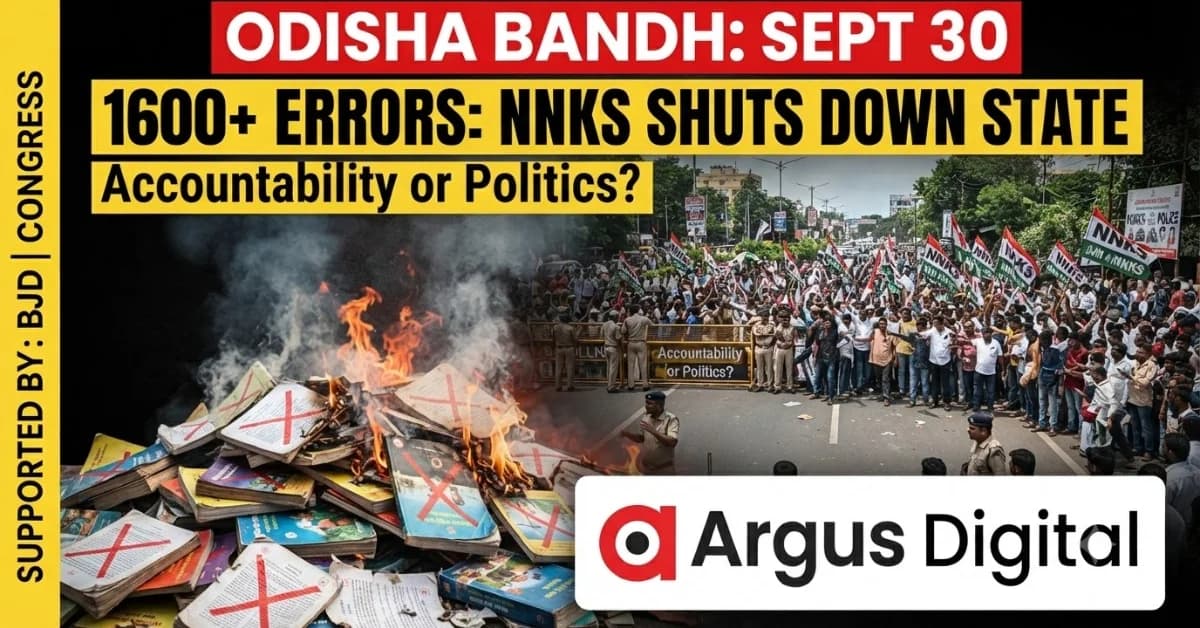
Statewide Disruption: NNKS has called for a 12-hour statewide bandh across all 30 districts of Odisha on September 30.
Core Grievance & Demands: The shutdown protests over 1,600+ errors in school textbooks and demands the resignation of Education Minister Nityananda Gond.
Shifting Political Dynamics: The protest has drawn strategic support from opposition parties BJD and Congress against the BJP government.
Bhubaneswar: As Odisha braces for a 12-hour statewide bandh on Wednesday, September 30, the political temperature is rising ahead of the crucial panchayat and urban local body elections.
The shutdown, called by the Naba Nirmana Krushaka Sangathan (NNKS) and its student wing over more than 1,600 errors in school textbooks, has brought the BJP government led by Chief Minister Mohan Charan Majhi under renewed pressure.
But beyond the demand for accountability in the education system, the bandh has opened up a larger political question: Is the agitation an uncompromising fight for educational reform, or is it also an attempt by a pressure group to reclaim lost political relevance in a changed political landscape?
The answer may lie not merely in the demands being raised, but in the timing of the shutdown, the government's response, the shifting political alliances and the disruption the bandh could cause to ordinary citizens.

📱 Get Argus News App
✨The Textbook Blunders: Has the Original Issue Lost Its Urgency?
The controversy over more than 1,600 factual and typographical errors in textbooks for Classes I to VIII has exposed serious questions about quality control, institutional accountability and the functioning of Odisha's school education system. The scale of the errors provides a substantive basis for public concern, particularly because the affected books are used by young students.
The state government, meanwhile, has initiated disciplinary proceedings against officials of the State Council of Educational Research and Training (SCERT) and the printing firms held responsible for the errors. The School and Mass Education Department has also distributed printed errata sheets to schools to correct the mistakes.
For the NNKS, however, these measures do not address what it considers the larger question of political accountability. The organization, led by national convener Akshaya Kumar, has rejected the correction sheets as an inadequate remedy and continues to demand the resignation of School and Mass Education Minister Nityananda Gond.
This is where the central disagreement emerges. While the government’s actions indicate that corrective measures are underway, the organizers argue that administrative action against officials cannot substitute for accountability at the political leadership level.
The textbook controversy, therefore, remains unresolved in political terms, even as the administration has initiated remedial steps. Whether those steps are sufficient is a matter of public and political scrutiny. But whether a statewide shutdown is proportionate to the outstanding demands is a separate question.
The Timing Question: Why a Statewide Bandh Now?
The timing of the September 30 bandh is central to understanding the political dynamics surrounding the agitation. The textbook errors were identified months ago, while the decision to escalate the movement into a statewide shutdown followed a series of smaller protests, hunger strikes and satyagrahas by the student wing in Bhubaneswar.
The organizers' position is that the government’s corrective measures have failed to address the systemic shortcomings exposed by the controversy.
The sequence also raises a political question: if the textbook controversy has been festering for months, does the move to a statewide bandh represent the culmination of a sustained campaign for accountability, or a calculated escalation to regain public attention?
The distinction matters. A delayed protest is not necessarily an opportunistic one, particularly when organizers believe that earlier forms of agitation have failed. At the same time, the decision to disrupt public life on a statewide scale inevitably raises questions about the political objectives accompanying the stated educational demands.
From Confronting BJD to Joining Hands With Its Political Rivals
The changing political alignments of NNKS
2010 – May 2024
BJD government
NNKS targeted the BJD government.
Congress frequently supported its agitations.
NNKS eventually entered electoral politics in 2024.
June 2024 – Present
BJP government
NNKS shifted its protests towards the BJP administration.
BJD and Congress have extended support to the current bandh.
The textbook controversy has become a common opposition issue.
The political history of the NNKS offers another perspective on the current agitation. For more than a decade, the organization was a vocal critic of the BJD government under Naveen Patnaik, organizing protests over farmers' issues and alleged restrictions on agitations. The Congress frequently extended support to these movements, while the NNKS maintained its independent pressure-group identity.
The relationship became particularly significant in the run-up to the 2024 Assembly elections, when the organization entered electoral politics and fielded candidates in several constituencies. Akshaya Kumar also contested against Naveen Patnaik from Hinjili, bringing the organization directly into the electoral arena.
The electoral outcome, however, did not translate into a legislative presence for the organization. Following the BJP's formation of the government in June 2024, the political landscape changed, and the BJD moved into the opposition.
The present bandh illustrates how dramatically the alignments have shifted. The BJD, which was once a principal target of NNKS agitations, is now supporting its statewide shutdown against the BJP government. The Congress, which had backed several earlier NNKS movements, has continued to align with the organization on the current issue.
This changing relationship does not, by itself, establish that the NNKS has abandoned its independent agenda. Issue-based cooperation between pressure groups and opposition parties is a familiar feature of democratic politics.
Yet, the convergence of interests between the NNKS and the opposition raises the question of whether the textbook controversy is also providing a shared political platform to challenge the ruling BJP.
The Political Survival Question: What Does the NNKS Stand to Gain?
For an organization that has moved between mass agitations and electoral politics, the period following the 2024 Assembly elections presents a different political environment.
Having failed to secure a legislative foothold, the NNKS must continue to demonstrate its capacity to mobilize public opinion if it is to remain an influential voice in Odisha's political discourse.
A statewide bandh offers that opportunity. It brings the organization into the centre of public debate, attracts extensive media attention and places the government under pressure to respond. It also allows the NNKS to demonstrate its capacity to mobilize support beyond its traditional constituency of farmers.
The organization's earlier agitations indicate that it has repeatedly used statewide shutdowns to amplify issues extending beyond agriculture.
Its February 2019 bandh, held amid a major government KALIA scheme convention, its July 2022 agitation following a student's death at BJB Autonomous College, and its January 2026 strike over paddy procurement mandis demonstrate the breadth of issues around which it has mobilized.
The September 30 bandh adds primary education and administrative accountability to that record.
The question, therefore, is not simply whether the NNKS is seeking political relevance. Its history of public mobilization and its participation in the 2024 elections make political visibility an evident dimension of its activities.
The more important question is whether the current shutdown is primarily driven by the unresolved education issue or whether the pursuit of organizational relevance has become an equally significant consideration.
The available sequence of events offers grounds for examining both possibilities, but does not independently establish the organizers' primary motive.
The Opposition's Opportunity: A Common Issue Against the BJP
The bandh also comes at a time when the BJD and Congress are seeking to consolidate their opposition to the BJP government. The textbook controversy provides them with an issue that cuts across conventional political divisions, involving students, parents, teachers and the wider public.
By supporting the NNKS, the opposition parties can amplify demands for the resignation of the School and Mass Education Minister while questioning the government's administrative oversight. For the BJD in particular, supporting an organization that once challenged its own administration reflects the changed political circumstances since the 2024 election.
However, the opposition's support and the NNKS's organizational objectives need to be examined separately. The BJD and Congress may view the bandh as an opportunity to intensify political pressure on the government, while the NNKS may regard their support as a means of expanding the reach of its campaign.
The convergence is politically significant, but it does not necessarily mean that the agitation is being directed by opposition parties. The extent to which the shutdown reflects an independent pressure-group campaign or a broader opposition mobilization will become clearer through the nature of participation, the demands pursued and the course of negotiations with the government.
The Public Cost: Who Pays for the Political Confrontation?
The most immediate impact of the bandh will be felt outside the political arena. A 12-hour disruption, scheduled from 6 am to 6 pm across all 30 districts, could affect public transport, local markets, commercial establishments and routine economic activity.
Expected Impact on Public Life
Hospitals & Emergency Services
Impact: Exempted; essential services are expected to operate.
Board Examinations
Impact: Scheduled examinations to continue.
Public Transport
Impact: Possible disruption from blockades and traffic diversions.
Daily Wage Earners
Impact: Loss of working hours and potential earnings.
Small Businesses & Vendors
Impact: Reduced trading hours and possible closure.
Government Offices
Impact: Administration directed to maintain normal functioning.
The burden of a shutdown is often disproportionately borne by those with the least capacity to absorb a day's loss of income. Daily wage workers, transport employees, street vendors and small traders may face immediate financial consequences even though they have little direct involvement in the political dispute.
The organizers may argue that disruption is necessary to compel political accountability. Critics, on the other hand, may question the proportionality of a statewide shutdown when the government has already initiated disciplinary action and distributed correction sheets.
This is the central public-interest dilemma of the bandh: the demand for better education and accountability concerns the wider public, but the means adopted to pursue that demand can also impose significant costs on the same citizens.
Government's Response: Preventing Disruption Without Escalating Tensions
The state administration has moved to prepare for the bandh through security and administrative measures. Joint Secretary Sarat Chandra Marandi of the Home (Special Section) Department has issued directives to District Collectors and Magistrates to ensure law and order and maintain essential services.
Police deployment has been planned for sensitive locations, highway intersections and major transit hubs, with instructions to prevent road blockades, damage to public property and other disturbances. Special security and attendance protocols have also been directed for government offices to ensure that administrative functioning is not obstructed.
The government faces the dual challenge of maintaining public order while allowing peaceful democratic protest. The effectiveness of its response will depend not only on the prevention of unlawful activities but also on ensuring that essential services, examinations and the movement of citizens remain protected.
Is the September 30 Bandh About Political Survival?
The sequence surrounding the bandh presents a layered political picture. A genuine administrative controversy has triggered demands for accountability; the government has initiated corrective action, but the organizers consider those steps inadequate.
For the NNKS, the bandh offers an opportunity to reassert its presence in Odisha's political landscape after its unsuccessful electoral entry in 2024. For the BJD and Congress, it provides a platform to question the BJP government's handling of a sensitive public issue. For the government, it is a test of administrative responsiveness and its ability to manage political confrontation without compromising public services.
Is it, then, a bandh for educational accountability or an exercise in political survival? The two objectives are not necessarily mutually exclusive. An agitation can originate in a legitimate public concern and simultaneously serve the organizational and political interests of those leading it.
The decisive indicators will be whether the movement remains focused on measurable improvements in textbook quality or whether the political confrontation increasingly overshadows the objectives.
Also Read: EXCLUSIVE | Odisha’s October Political Showdown: BJD Revives Centre-versus-State Battle, BJP Deploys Seva Setu to Defend Its 2024 VictoryRelated Topics
Explore more stories