



EXCLUSIVE| The Battle for Gen Z: How Odisha College Elections Redrew Odisha’s Rural Power Lines and Set the Stage for 2027 Rural Polls
Key Points
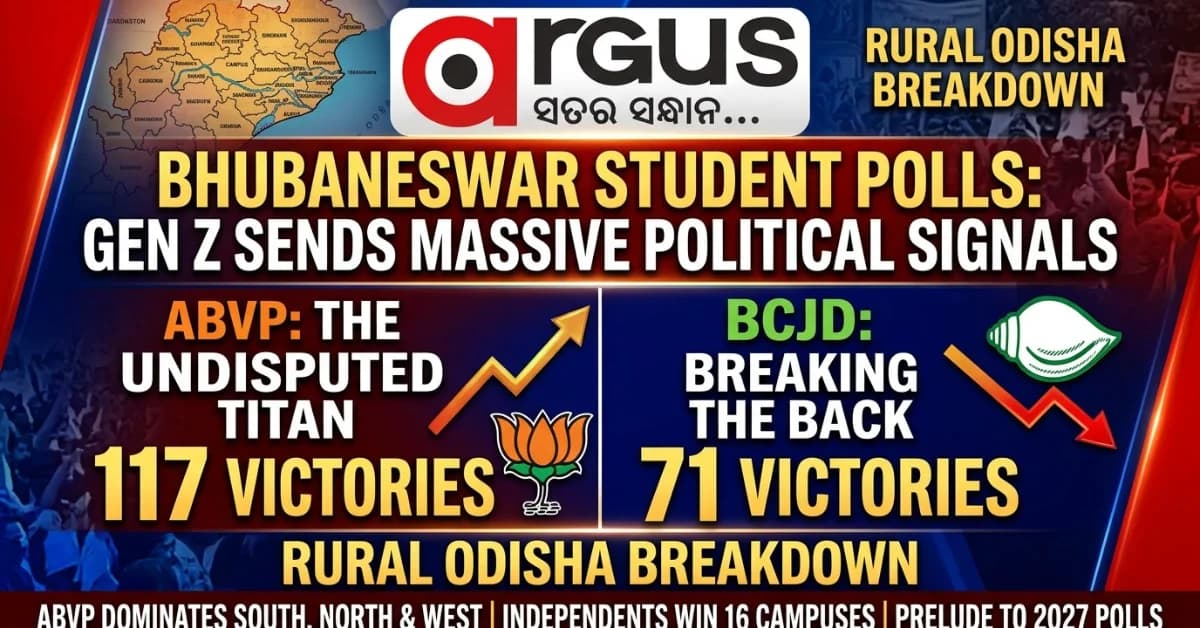
ABVP Emerges Dominant: ABVP secured a decisive victory in 117 out of 337 participating higher education institutions, outperforming BCJD's 71 wins and leaving Congress’s NSUI with just two colleges.
Grassroots Anti-Incumbency: The election results revealed sustained anti-incumbency against the BJD’s 24-year legacy, driven by rural Gen Z voters raising concerns over poor campus infrastructure and faculty shortages.
Blueprint for 2027 Polls: The campus election results and mobilized youth cadres serve as an early political bellwether and foundational strategy for all major parties ahead of the 2027 local panchayat and civic elections.
Bhubaneswar: The dust has settled. The decibels have given way to a deafening silence. Euphoric Gen Z students immersed themselves in campus election fervour as the poll bugle sounded after a hiatus of eight long years.
With the 2026 student union polls officially done and dusted on October 15 across the state's higher education landscape, the post-poll numbers are now flashing massive political signals for the principal political parties whose student wings wrestled to dominate the Gen Z voters and their mindscape.
As the certified institutional tallies filtered out of campus gates, a profound macroeconomic and political shift became clear:
· the Akhil Bharatiya Vidyarthi Parishad (ABVP) emerged as the undisputed titan of the state's student elections. By securing a resounding 117 institutional victories out of 337 participating campuses, the BJP student wing didn't just win a campus election – it systematically broke the back of the Biju Chhatra Janata Dal (BCJD), which managed only 71 institutions.

📱 Get Argus News App
✨· Meanwhile, the National Students’ Union of India (NSUI), the student wing of the Congress, suffered a near-total wipeout, scraping together victories in just two colleges
· The Big Signal: Independent panels aggressively carved out spaces in 16 institutions.
Beyond the numbers, this historic poll also offers an unvarnished diagnostic look at rural Odisha.
The Gen Z Poll Blip: Setting aside the elite metropolitan echo chambers of Bhubaneswar and Cuttack, the localized district results exposed the live presence of deep-seated grassroots anti-incumbency against the 24-year rule by BJD.
The Other Signal: The October student elections have also provided a foundational blueprint and mobilized youth cadres for the respective parties ahead of the highly anticipated 2027 local panchayat and civic polls.
The District-Wise Breakdown: Mapping the Shift in Rural Fortresses
To truly comprehend the depth of this narrative shift, the analytical lens must be pulled away from the state capital and focused onto the sub-divisional degree colleges and district universities. The geographic distribution of the wins showcases a distinct churning among Gen Z across the state's traditional political zones.
Thirteen universities went to poll on Thursday. The Friday morning count stood at ABVP: 8, BCJD: 5 NSUI: 0
Southern Odisha: ABVP Dominates Eclipsing BCJD
In the southern belt, historically characterized by mixed tribal and rural voting segments, ABVP achieved a staggering success ratio close to 70%. The defining center of gravity was the Ganjam District – the literal home turf of former CM Naveen Patnaik and traditional political citadel of BJD. Here, ABVP registered a near-total clean sweep, seizing controlling panels and administrative influence.
In further south like Rayagada and Koraput, ABVP seamlessly swept regional degree institutions by capturing tribal hostel alliances.
The Signal here: in Ganjam 2024 momentum continues. But Rayagada and Koraput shows Gen Z switched on to ABVP, as Congress won most seats in Rayagada and Koraput districts.
· But The Southern Blip: A major pushback came from the highly sought-after Khallikote Autonomous University, where highly organized Independent student collectives defied both the ruling state apparatus and the opposition, winning on localized campus-improvement mandates.
Northern and Western Odisha: A Long Echo of the 2024 Political Deluge
Across Western Odisha's industrial and mineral-rich blocks, ABVP converted its existing general election momentum into student power.
· Sambalpur & The Tribal Belt: ABVP locked down high-value victories, most notably at the iconic Gangadhar Meher (GM) University in Sambalpur. Moving into the northern tribal-dominated districts of Mayurbhanj and Kendujhar, ABVP effectively monopolized block-level degree colleges. Their candidates aggressively out-campaigned rivals by focusing on the absolute decay of local higher education infrastructure.
· The BCJD Resistance: The BJD's student wing found a temporary shield in the Jharsuguda district, showing the shoots of 2024 still rooted here, as a result retains the vital sub-divisional colleges through heavy deployment of local parental-party resources.
The Coastal Belt: BCJD’s Fragmented Citadel
The coastal districts, long considered the impenetrable defensive wall of the BJD, saw a highly fragmented and aggressive turf war, just like the 2024 poll results.
· Kendrapara & Jajpur: The BCJD proved its resilience here. In Kendrapara, the student wing secured flagship institutions such as Patta mundai College.
· In 2024, BJD won 4 seats, leaving 1 (Mahakalpada)for BJP. And the ABVP maintained the momentum winning both colleges falling under Mahakalpada.
· In Jajpur, where 2024 saw 3:3 between BJP and BJD, the BJD claimed the high-profile presidential seat at the Narasingha Choudhary Autonomous College, demonstrating that the BJD’s 2024 win still running deep in Gen Z.
· Puri & The Cancelled Zones: In Puri district, the results were mixed; while BCJD held small rural colleges, the central SCS Autonomous College in Puri town fell entirely to independent student panels tells a tale.
· Furthermore, in highly volatile sub-divisions across Bhadrak and Jajpur, intense pre-poll clashes, the brandishing of weapons, and arson forced college principals to implement sine die administrative shutdowns, effectively canceling the voting process before ballots could be cast.
Digital and Grassroots Playbooks: How ABVP Won the Rural Ground
The primary reason behind ABVP's unprecedented rural success ratio lies in its tactical adaptation to the rural student’s daily struggles. While urban student elections focused heavily on tech-driven, aesthetic Instagram campaigns, the rural district campaigns required raw, physical service and smart, data-light messaging.
1. The Weaponization of the "Save Education, Save Odisha" Manifesto
ABVP’s campaign strategy in rural areas bypassed abstract nationalistic rhetoric in favor of hyper-local, physical grievances. They crafted a brutal, highly effective state-wide campaign under the slogan "Save Education, Save Odisha."
In district degree colleges, the primary crisis is not the lack of international corporate placements, but the absolute absence of basic human infrastructure.
ABVP cadres systematically filmed raw, cell-phone footage of leaking college roofs, crumbling science laboratories, empty libraries, and broken hostel sanitation facilities.
Crucially, they focused on the chronic shortage of permanent college lecturers and the state's extreme over-reliance on poorly paid guest teachers.
By blasting these unedited videos into rural village networks, they successfully shifted the blame onto the decades-long management of the previous BJD administration.
2. The Dominance of "Data-Light" Media and WhatsApp Broadcasts
While rival student groups wasted massive financial resources trying to build highly aesthetic, heavy video campaigns for platforms like Instagram, ABVP recognized the reality of erratic data connectivity in sub-divisional blocks. They shifted their entire digital war room to compressed, low-resolution, forward-friendly WhatsApp videos and loop graphics.
Instead of trending Hindi or English electronic music, their campaign clips were set to high-energy local Sambalpuri folk music and traditional dhol beats. This immediately localized their identity, making their candidates appear as authentic sons and daughters of the soil rather than corporate-backed political implants.
3. Year-Round Institutional Support Systems
Unlike the BCJD, which many neutral students felt re-emerged on campuses just weeks before the poll notification, ABVP spent years laying deep structural foundations. Through their SAMS (Student Academic Management System) Helpdesks, ABVP volunteers physically stood outside rural colleges during admissions cycles. They assisted first-generation, low-income college applicants with form-filling, subject selections, and hostel applications. Additionally, they ran constant campus blood-donation drives and localized student safety groups, building a deep bank of personal goodwill among incoming batches of Gen Z voters long before an election was even announced.
Campus Echoes on Bigger Canvas: A Direct Vote of Anti-Incumbency
For political analysts, the most significant takeaway from the October 15 polls is how seamlessly the campus results mirror the changing undercurrents of Odisha's broader electorate. The overwhelming shift toward the ABVP in rural degree colleges serves as a clear persistence of anti-incumbency against the 24-year-long structural legacy of the BJD government.
By keeping student elections suspended for nearly a decade, the previous administration had effectively frozen the organic political evolution of Odisha’s youth. The sudden reopening of the democratic valve under Chief Minister Mohan Charan Majhi’s administration allowed eight years of repressed student anxieties, lack of employment opportunities, and educational decay to explode into a massive protest vote.
Rural Gen Z voters explicitly used their ballots to reject the old establishment, signaling the aspirations of the state's youngest voters.
Road to 2027: How the Political Signals Shape the Local Body Polls
The Odisha Student Union polls that have been seen by political observers as Gen Z’s political mood, served as the classroom for mainstream political parties, displaying on Blackboard in capital Letters the lingering 2024 shift.
The 2026 Odisha student union elections also proved that Gen Z voters are neither politically passive nor easily manipulated by superficial digital branding.
The ABVP’s massive, district-wide victory signals that the state's youngest demographic has hitched on to a new political spectrum.
As the parties transition from
college hostels to rural panchayat booths, the strategic signals,
organizational networks, and psychological spins born out of this campus battle
will directly decide who controls the grassroots heart of Odisha in 2027.
Also Read:EXCLUSIVE | Odisha College Elections 2026: BJD MLAs Punch Below Their Weight, BJP Machine Scores, Congress Disastrous
Related Topics
Explore more stories